Several traffic signals at busy intersections across Lucknow are either non-functional or stuck in blinking mode, raising questions about the maintenance of the city’s ₹109-crore Integrated Traffic Management System (ITMS), designed to improve road safety, regulate traffic and ease congestion.
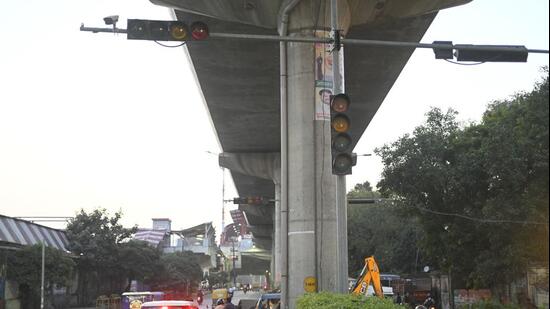
A Hindustan Times ground check on Friday and Monday across multiple stretches found traffic signals either non-functional or operating in blinking mode at locations including Baniya Bazaar, Subhani Khera Road near Telibagh, Keshav Nagar, parts of the Cantonment area, Kursi Road and Durgapuri crossing.
The findings raise questions about the effectiveness of the system being operated under the Lucknow Smart City project and the authorities’ oversight of the agency responsible for its maintenance.
The project, which integrates smart traffic signals, surveillance cameras and e-challan facilities, was also designed to use adaptive signalling technology to automatically adjust signal timings according to vehicle movement. However, an official familiar with the system said traffic signals were largely being operated manually rather than through the proposed automated mechanism.
The ITMS was intended to improve traffic management by using technology to monitor traffic conditions and regulate signal timings at intersections. Yet the ground situation presents a different picture, with several signals found to be non-functional during HT’s visits.
{{/usCountry}}The ITMS was intended to improve traffic management by using technology to monitor traffic conditions and regulate signal timings at intersections. Yet the ground situation presents a different picture, with several signals found to be non-functional during HT’s visits.
{{/usCountry}}An official, speaking on condition of anonymity, said maintenance problems had affected the system’s performance, with around 50 of the 155 traffic signals reportedly experiencing day-to-day operational issues.
The official’s estimate points to a significant maintenance challenge for a project intended to bring technology-driven traffic management to the state capital.
During its visit to the Lucknow Smart City office, HT observed that the ITMS monitoring screen displayed intersections including Hazratganj, Samta Mulak, Burlington, Qaiserbagh, Lalbatti and Sikandarbagh. This prompted questions about the extent of live monitoring across the network and how effectively the authorities track malfunctioning signals.
Changes in traffic arrangements have also affected the use of certain signals. An official said the Lucknow traffic police had introduced barricading and U-turn arrangements at some locations, prompting authorities to switch signals to blinking mode or stop using them where traffic now moves straight through.
However, revised traffic arrangements do not necessarily explain the signals found non-functional at other locations. The authorities need to distinguish between signals that have become redundant because of traffic changes and those that require repairs or maintenance, the official added.
For commuters, dysfunctional signals at busy junctions can create confusion over right of way and increase the risk of traffic conflicts, particularly where motorists approach intersections without clear signals.
The maintenance agency responsible for the ITMS has also come under scrutiny. An official said the authorities had proposed a penalty against the agency, but the final amount remained under review. The review has reportedly continued for two to three months.
When HT contacted Lucknow Municipal Corporation additional municipal commissioner Pankaj Srivastava, who also oversees Lucknow Smart City projects, he asked for the locations where dysfunctional signals were found. He said he would seek a report from the agency responsible for the ITMS and take necessary action.
Lucknow Smart City general manager SC Singh remained unavailable for comment despite multiple attempts to contact him.