
The roar of aircraft engines may be unavoidable, but the noise passengers hear inside the cabin could become less intrusive. The Indian Institute of Technology Kanpur (IIT-K) and Rolls-Royce, one of the world’s largest manufacturers of aircraft engines, have joined hands to study how engine vibrations contribute to cabin noise and explore ways to make air travel quieter and more comfortable.
The six-month research project, announced by the two institutions on Wednesday, will focus on understanding structure-borne noise arising from engine vibrations, a key factor affecting aircraft cabin comfort. The initiative is being undertaken as Phase 1, with the possibility of subsequent research phases.
The project will combine numerical methodologies with experimental validation. IIT-K will establish an experimental test rig to study how engine vibrations travel through aircraft structures and contribute to cabin noise.
“The engine vibration-related noise project offers an opportunity to investigate an important aspect of aircraft cabin comfort through a combination of numerical methodology and experimental validation,” said IIT-K director Prof Manindra Agrawal.
He said the research would generate insights into vibration transmission and noise-reduction strategies, adding that the collaboration would strengthen the institute’s deep-tech ecosystem by connecting research capabilities with industry needs.
The initiative follows a broader industry-academia collaboration between Rolls-Royce India and IIT Kanpur, formalised through a memorandum of understanding (MoU) earlier this year. The agreement provides a framework for joint research projects, internships, knowledge exchange and skill development.
{{/usCountry}}The initiative follows a broader industry-academia collaboration between Rolls-Royce India and IIT Kanpur, formalised through a memorandum of understanding (MoU) earlier this year. The agreement provides a framework for joint research projects, internships, knowledge exchange and skill development.
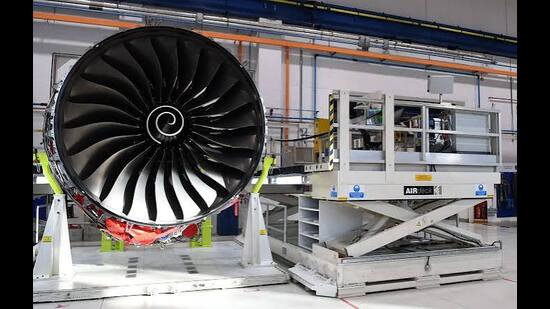
{{/usCountry}}Rolls-Royce said its engines, including the Trent XWB, incorporate advanced technologies and low-noise features. The latest project will help researchers better understand the impact of engine vibrations and explore further ways to reduce cabin noise.
Sashi Mukundan, executive vice-president, Rolls-Royce India, said the partnership would strengthen local research capabilities and promote collaborative innovation. He added that the company was also advancing internships and knowledge-sharing initiatives to provide students with hands-on experience in addressing real-world engineering challenges.
ABOUT THE AUTHOR
Rajeev Mullick, Assistant Editor, is a Lucknow-based journalist with over 26 years of experience covering governance, public policy and administration in Uttar Pradesh. His reporting focuses on the district administration, the Divisional Commissioner's Office, the Regional Meteorological Centre, and government policies relating to technical, higher, secondary and primary education. Known for impactful public-interest journalism, his investigations have led to significant policy attention, including a report on deficiencies in a state-run school footwear distribution scheme that prompted widespread national coverage and High Court intervention. He broke the story on the Uttar Pradesh government's One District One Cuisine initiative, highlighting the inclusion of sweets and the exclusion of non-vegetarian dishes, triggering widespread public debate. He covered Mahakumbh 2025 at Prayagraj, reports on the event's administrative, logistical and civic dimensions. From 2012 to 2024, he headed the Lucknow City Bureau, leading coverage of the state's administrative and civic developments while mentoring young reporters. He loves to travel, listen to music. He is fond of eating good food both veg and non veg. He has travelled to several states like West Bengal, Uttarakhand, Maharashtra, Madhya Pradesh, Gujarat, Family Nadu, Kerela, Bihar, Jharkhand and home state UP.