UP BJP draws red line on caste assertion within party
State BJP chief Pankaj Chaudhary’s stern message is being seen in the light of the party’s long-standing effort in UP to project a broad-based, inclusive political identity that rises above caste loyalties
In the wake of growing caste-based assertions within its ranks, the Bharatiya Janata Party (BJP) leadership in Uttar Pradesh has stepped in to reinforce internal discipline as the party gears up for the crucial 2027 battle.
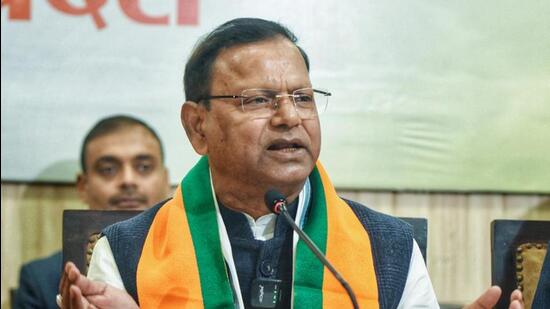
UP BJP president Pankaj Chaudhary has expressed strong disapproval of caste-based gatherings held by party legislators. (FILE PHOTO)
{{^htLoading}} {{/htLoading}}
The immediate trigger is Tuesday’s closed-door meeting of the party’s over 50 Brahmin legislators in the name of a feast at an MLA’s Gomti Nagar residence here during the winter session of the state assembly. This evoked a sharp response from newly- appointed UP BJP chief Pankaj Chaudhary.
Earlier, during the monsoon session in August, about 50 Thakur legislators of the BJP had a similar meeting.
“The leadership feels if such caste mobilisation within the party are left unchecked (they) could turn into organised pressure groups and distort the party’s political messaging that targets caste consolidation,” a senior BJP leader said.
In a press release circulated here by the party’s media cell on Thursday evening, Pankaj Chaudhary expressed strong displeasure over the meeting (he did not specify the meeting), warning that holding caste-based gatherings would not be tolerated in future.
{{^htLoading}} {{/htLoading}}
{{^usCountry}}
Chaudhary emphasised that the BJP did not believe in “family or class-based politics” and warned that any activity that undermines the party’s inclusive ideology would amount to indiscipline under its constitution.
{{/usCountry}}
{{#usCountry}}
Chaudhary emphasised that the BJP did not believe in “family or class-based politics” and warned that any activity that undermines the party’s inclusive ideology would amount to indiscipline under its constitution.
{{/usCountry}}
“If any BJP public representative repeats such activities in future, it will be treated as indiscipline in accordance with the party’s constitution,” he warned.
“The BJP representatives should avoid negative narratives and work within party discipline. The party has wide political consensus under strong leadership,” said Chaudhary.
He asserted that the caste-based politics of the Opposition in the state is coming to an end in the face of the developmental politics and nationalism widely exemplified by Prime Minister Narendra Modi.
“The BJP representatives should avoid such negative narratives. The BJP, with its strong leadership, has broadened the scope of political consensus,” said Chaudhary.
{{^htLoading}} {{/htLoading}}
“The unusually firm and detailed nature of the BJP president’s public statement underlines the leadership’s discomfort with caste-based political activity, particularly when it risks sending a wrong message to society at the cost of the party’s electoral interests,” another BJP leader pointed out.
Chaudhary’s stern message is broadly being seen in the light of the party’s long-standing effort in UP to project a broad-based, inclusive political identity that breaks caste loyalties. The party’s electoral success since 2014 has relied heavily on maintaining this carefully balanced social coalition to the extent that non-Yadav OBCs and non-Jatav SC, apart from upper castes, threw their weight around it.
The cracks in the party’s carefully crafted social coalition were first visible in 2024 Lok Sabha polls where the Samajwadi Party (SP), riding its PDA formula, won 37 seats against the BJP’s 33 in Uttar Pradesh.
{{^htLoading}} {{/htLoading}}
According to BJP sources, these MLAs were planning to hold another meeting on January 5.
Whether they go ahead with their decision or step back, or other caste groups within the party convene similar meetings will indicate how seriously the warning has been taken.
Brajendra K Parashar is a Senior Journalist with the Hindustan Times, based in Lucknow, with nearly three decades of experience covering governance, public policy, politics and development in Uttar Pradesh. Over the years, he has reported extensively on key sectors, including energy and renewable power, mobility and transport, road safety, agriculture and allied sectors and issues related to farmers, rural development, taxation under the Goods and Services Tax (GST) and public administration. A seasoned political correspondent, Parashar closely tracks the Bharatiya Janata Party (BJP) and has covered every major election in Uttar Pradesh right from three-tier panchayat elections and urban local body polls to Assembly and Lok Sabha elections. He also reports regularly on the proceedings of the Uttar Pradesh Legislature, bureaucracy, governance, policy decisions and administrative developments with focus on their impact on public life. His reporting is known for its strong analytical approach, extensive use of official data. His areas of interests include investigative journalism, long-form political and policy analysis, data-driven reporting, elections and institutional reforms. Parashar holds a postgraduate degree in Political Science with First Division from Aligarh Muslim University (AMU), followed by a Diploma in Journalism and Mass Communication from the same university. His inclination towards journalism began during his student days, when he regularly contributed letters to editors and articles to newspapers and magazines. In the mid-1990S, his essay, “Should India Switch Over to the Presidential Form Of Government?”, published in Politics India magazine edited by noted constitutional expert Subhash C Kashyap, was adjudged the best entry in a national competition. His work has received professional recognition, including the Hindustan Times Journalist of the Month Award for an impactful series on drinking water issues during the 2010 Lok Sabha election campaign. Originally from Kasganj in western Uttar Pradesh, Parashar is currently based in Lucknow where continues to report on politics, governance and public policy.
Pawan Dixit, Assistant Editor, brings over 20 years of frontline reporting experience to the newsroom. A specialist on Uttar Pradesh politics and governance, he has reported from the ground across the state’s most consequential stories. He cut his teeth in eastern UP, spending 15 years covering the region. Based in Varanasi, he reported the 2012 UP Assembly polls and the 2014 Lok Sabha elections that reshaped the state’s political map. Moving to Lucknow in 2016, he has since led coverage of the 2017 and 2022 UP Assembly elections and the 2024 Lok Sabha polls. His reporting tracks the BJP’s strategy, opposition moves, and voter sentiment across all 75 districts. Pawan has been a constant presence in Ayodhya since 2016. He reported the entire arc of the Ram Mandir movement — from the legal fight to the Supreme Court verdict, through temple construction, to the inauguration. He continues to track every development at the Shri Ram Janmabhoomi Teerth Kshetra Trust. On the state beat, he covers the BJP, the Industrial Development Department, and handles key outstation political assignments. He also reports major cases from the district court, Lucknow bench of the High Court, and the State Information Commission. Along with this, he also reports on NGT's important decisions related to UP. Known for sharp sourcing and clear analysis, Pawan connects politics, policy, infrastructure and faith — the forces driving UP today. He has reported developments in Ayodhya and Ram Mandir movement since 2016. The Supreme Court's Ram Mandir verdict, temple construction and the its opening have been reported by him.
He reports all developments in Ayodhya and Ram Mandir Trust.
He covers state BJP, Industrial development department, outstation political assignments, reports special cases from district court, high court and state information commission