LUCKNOW A toxic canopy of smog and metallic fumes engulfed Lucknow on Diwali night, sending particulate pollution surging beyond national safety limits and reversing years of environmental gains, according to a report released by the CSIR-Indian Institute of Toxicology Research (CSIR-IITR) on Wednesday.
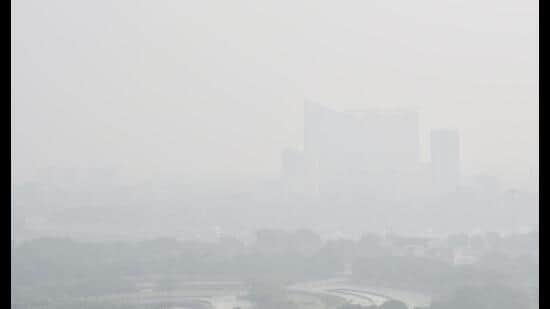
A 10-year comparative analysis from 2017 to 2026 showed that this year’s air pollution was at concerning levels. Diwali night pollution peaked in 2018 when PM10 touched 990 micrograms per cubic meter, followed by a decline that bottomed out at 396 micrograms per cubic meter in 2022. However, the years after 2022 have reversed those gains. Compared with Diwali 2025, mean PM10 and PM2.5 concentrations in 2026 increased by 28.5% and 13.5%, respectively.
Widespread firecracker bursting, coupled with near-zero wind speeds and dipping temperatures, trapped lethal pollutants directly in the human breathing zone across residential and commercial hubs alike, the premier research body revealed in its report — ‘Assessment of ambient air quality of Lucknow city during Pre-Diwali, Diwali and Post-Diwali festival’.
The survey monitored representative residential and commercial zones, which revealed that particulate matter concentrations, PM 10 and PM 2.5, exceeded national safety standards set by National Ambient Air Quality Standards (NAAQS) at 100 micrograms per cubic meter and 60 micrograms per cubic meter, respectively, on Diwali night.
{{/usCountry}}The survey monitored representative residential and commercial zones, which revealed that particulate matter concentrations, PM 10 and PM 2.5, exceeded national safety standards set by National Ambient Air Quality Standards (NAAQS) at 100 micrograms per cubic meter and 60 micrograms per cubic meter, respectively, on Diwali night.
{{/usCountry}}The survey monitored ambient air quality and noise levels at four locations - Aliganj and Vikas Nagar representing residential areas, and Aminabad and Chowk, representing commercial and traffic zones.
CSIR-IITR researchers said while administrative measures, including promotion of certified green crackers, designated bursting zones, restricted time windows and public awareness campaigns were formally put in place, the on-ground implementation remains concerning.
On Diwali night, the average PM10 concentration surged to 726.2 micrograms per cubic meter, marking a 108.4% increase from the pre-Diwali night average of 348.4 micrograms per cubic meter, and heavily exceeding the NAAQS limit. Similarly, PM2.5 concentration reached a peak average of 400.1 micrograms per cubic meter, a 150.6% jump compared to the pre-Diwali baseline of 159.6 micrograms per cubic meter, breaching the permissible NAAQS limit, the report noted.
It also mentioned that among individual sites, residential Aliganj recorded the highest PM10 concentration at 912 micrograms per cubic meter, followed by Chowk at 751 micrograms per cubic meter, Aminabad at 642 micrograms per cubic meter and Vikas Nagar at 599 micrograms per cubic meter. For PM2.5, Aliganj also registered the highest level at 558 micrograms per cubic meter.
Gaseous pollutants displayed mixed trends with sulphur dioxide remaining within the NAAQS limit of 80 micrograms per cubic meter with an average of 54.0 micrograms per cubic meter on Diwali night, whereas nitrogen dioxide breached the prescribed 80 micrograms per cubic meter standard with an average nighttime spike of 113.8 micrograms per cubic meter.
While both the pollutants can be harmful for health, CSIR-IITR director Bhaskar Narayan said that PM 2.5 can be severe as it can get mixed with the bloodstream.
“Meteorological factors heavily compounded the crisis. The onset of winter brought low temperatures between 18 and 20 degrees Celsius and calm wind speeds below 0.5 m/s, creating a stagnant atmospheric inversion layer that prevented pollutants from dispersing. The large quantity of pollutants formed due to the burning of firecrackers during Diwali are the cause of the increase of air pollution in the city, which may also be the cause of increased mortality and morbidity in urban areas. Individual bursting of firecrackers should be discouraged and community burning be promoted. Such community burning festivals or fetes can be organised by urban local bodies where people from across the city can gather around the river body to watch the fireworks,” said Narayan.
Deafening Diwali: Vikas Nagar hits 90.3 dB
Ambient noise levels also crossed Central Pollution Control Board (CPCB) limits at all monitored locations during Diwali night. The highest average nighttime noise level was recorded at Vikas Nagar at 90.3 decibels, while Chowk recorded 85.2 decibels.
Researchers said sustained exposure to such noise and toxic metallic oxides present in fireworks poses immediate hazards, triggering hypertension, severe headaches and acute respiratory distress in vulnerable groups like children, the elderly and patients with pre-existing asthma or bronchitis.