Mumbai: Raver has been a Bhartiya Janata Party (BJP) bastion ever since it was demarcated as a Lok Sabha constituency in 2009, with sitting MP Raksha Khadse securing comfortable victories in the 2014 and 2019 general elections. Renominated by the party this time too, she is up against the NCP (SP)’s Shriram Patil, a manufacturer of drip irrigation accessories who is contesting elections for the first time.
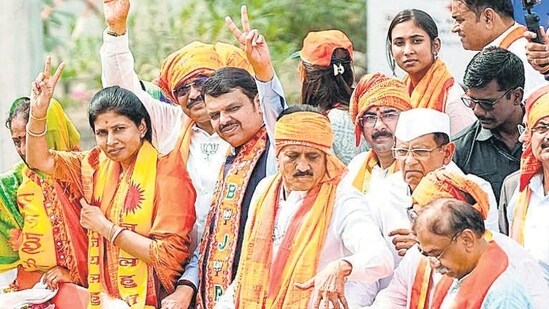
Khadse appears confident of securing a hat-trick, owing especially to the BJP’s strong network and favourable caste dynamics. But she also faces strong anti-incumbency and discontent among farmers over the central government’s ‘anti-farmer’ agricultural policies.
Advantage BJP
The constituency is divided into six assembly segments, with one of them, Malkapur, being located in Buldhana district. Politically, BJP is in a strong position, with its MLAs representing two of the six assembly segments – Girish Mahajan from Jamner and Sanjay Sawkare from Bhusawal. Its ally Shiv Sena has one MLA, Latabai Sonawane, while one independent MLA, Chandrakant Patil, is supporting the ruling Mahayuti alliance. Congress, on the other hand, has two seats – Raver, represented by Shirish Chaudhari and Malkapur, represented by Rajesh Ekade.
Other Backward Classes (OBC) comprise the largest segment of the constituency’s population, with the Leva Patil community, to which Khadse belongs, numbering around 2.30 lakh; other prominent OBC communities include Gujar Patils and Malis, who number around 1.10 lakh and 70,000, respectively. Nearly 4.23 lakh Marathas comprise the second largest population group in the constituency, followed by Muslims and Scheduled Castes (SC), whose population is 3 lakh and 2.5 lakh, respectively.
{{/usCountry}}Other Backward Classes (OBC) comprise the largest segment of the constituency’s population, with the Leva Patil community, to which Khadse belongs, numbering around 2.30 lakh; other prominent OBC communities include Gujar Patils and Malis, who number around 1.10 lakh and 70,000, respectively. Nearly 4.23 lakh Marathas comprise the second largest population group in the constituency, followed by Muslims and Scheduled Castes (SC), whose population is 3 lakh and 2.5 lakh, respectively.
{{/usCountry}}OBCs, especially Leva Patils, have played a big role in elections to the Raver Lok Sabha seat thus far. This time though, the Marathas are trying to consolidate their votes as Patil represents their community. Maratha reservation is non-issue in Raver as most community members have Kunbi certificates, which entitle them to reservations under the OBC category.
“Raksha Khadse is set to create a hat-trick in this election. The party is doing well, and we hope to win the Raver seat by a margin of over 3 lakh votes,” said Maharashtra’s rural development minister and Jamner MLA Girish Mahajan, who controls the BJP in Jalgaon district.
Khadse’s father-in-law Eknath Khadse was a BJP heavyweight before he fell out with deputy chief minister Devendra Fadnavis around two years ago and switched over to NCP (SP). Having returned to the BJP prior to the elections, he is using all his goodwill to get his daughter-in-law elected.
“I have covered most of the villages and I am sure she will be elected once again,” Khadse, who still has a large number of followers in the constituency, told HT.
Deepak Nagare, a senior journalist from Raver, too said Khadse had an edge over her main rival. “She has done a good amount of work in the last ten years. It was she who got Raver developed as a model station, although things changed after the Covid-19 pandemic as trains stopped halting at Raver,” he said, adding that the Tapti mega recharge irrigation project worth over ₹4,500 crore had also been pending for years despite water scarcity being a major issue in the constituency.
Unrest among farmers
Like the neighbouring Jalgaon Lok Sabha seat, Raver is plagued by water crisis and lack of infrastructure, with its residents largely dependent on cultivation of cotton, soyabean and banana.
Uttam Kundundhe, who owns a five-acre farm on which he cultivates cotton, rued that prices of farm produce had been falling steadily for over two years, thus rendering farming unviable. “Cotton should fetch at least ₹8,000 per quintal. Only then will we be able to recover input costs and earn a small profit. But in the last two years, the price has hovered around ₹5,000 to ₹6,000 per quintal, leading to massive losses,” said the 65-year-old who lives in Dhormal village.
Kundundhe said that although he had been voting for the BJP for the past 20 years, he was looking for a change this time. “The construction of the Ram temple will not help us run our families. Modi gave us nothing. He is taking ₹100 from us as GST and returning only ₹1 back under different schemes,” said the elderly farmer.
Sunanda Shirsode, a resident of Ramkheda village, said that farmers had been completely ignored by the Modi government. “We did not get compensation after our crop was damaged by unseasonal rain last year. We want to vote for those who will make our lives better,” said the 52-year-old farmer who cultivates cotton on a three-acre plot; she also grows vegetables on a small plot adjacent to it, which she sells in the market in Muktainagar to generate money for daily needs.
Given the drought-like situation in Jalgaon, with 89 tankers supplying water to 199 villages of the district, and the unrest among farmers, Khadse encountered opposition in villages such as Bhor, Purnad and Pachora when she visited these areas for campaigning. Patil, her opponent, who has good connections among farmers despite being a newcomer in politics, is trying to take advantage of this discontent.
“He is getting very good response from the people considering the issues they have been facing for years,” said Rohini Khadse, state president of the NCP (SP)’s women’s wing, and Eknath Khadse’s daughter who did not follow her father’s footsteps to return to the BJP. Water shortage was a major problem in the constituency, she said, especially in areas like Bodhwad, Muktainagar, Jamner and Chopda tehsils.
A BJP leader admitted that farmers were very much upset with them and even the Modi factor was not working this time. “Our last three internal surveys showed that only 2% people were willing to vote for PM Modi, another 2% for the Ram temple and 0% for the abrogation of Article 370. The anger within the agrarian community is huge,” said the leader. The latest survey indicated that Khadse had an upper hand over Patil, he said – it showed that Khadse was preferred by 53% voters against Patil’s 38%.
Stay updated with all the Breaking News and Latest News from Mumbai. Click here for comprehensive coverage of top Cities including Bengaluru, Delhi, Hyderabad, and more across India along with Stay informed on the latest happenings in World News.
Stay updated with all the Breaking News and Latest News from Mumbai. Click here for comprehensive coverage of top Cities including Bengaluru, Delhi, Hyderabad, and more across India along with Stay informed on the latest happenings in World News.