Mumbai: As the painstakingly restored ‘Manthan’ (1976) – India’s first crowd-funded film -- premiered at Cannes making headlines across the globe, nearly 6,400 km away in Gujarat’s Anand district, there are many hearts swollen with pride. Among them is Pushpaben V Patel, 78, a resident of Ajarpura, who remembers when it was first announced everyone would contribute ₹2 to make the film.
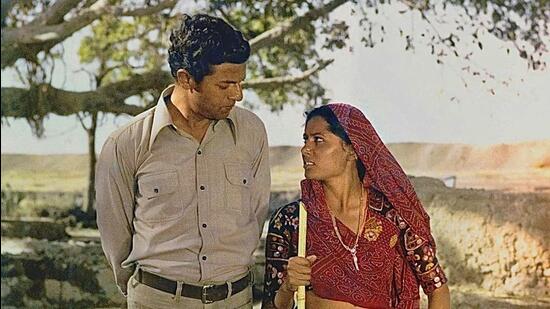
“ ₹2 was a day’s earnings made from depositing milk at the collection centre in the morning and evening. The money for both times was given in the evening. We forewent our share for the day,” she recalls and adds, “I remember everyone giggling shyly when told the film was about our lives. We wondered why anyone was interested in our mundane cooking, washing, taking care of children and elders at home, patting cow dung cakes, bathing and milking animals, and depositing milk.”
However, when an official from the National Dairy Development Board (NDDB) called their work “a part of nation building” he had everyone’s attention. Later, the villagers converged to speak among themselves about what lay ahead, “and it all made sense”.
“If people are still watching it 50 years later in foreign it must mean something. I would like to watch the film again; hope they organize a screening,” she says, hoping her granddaughter-in-law Gayatri who heads the Ajarpura dairy, the oldest in the Anand Milk Union Limited (see box: ‘The Amul Story’), might initiate it.
{{/usCountry}}“If people are still watching it 50 years later in foreign it must mean something. I would like to watch the film again; hope they organize a screening,” she says, hoping her granddaughter-in-law Gayatri who heads the Ajarpura dairy, the oldest in the Anand Milk Union Limited (see box: ‘The Amul Story’), might initiate it.
{{/usCountry}}Gayatri says that though it has taken 75 years for a woman to head the local dairy, the milk cooperative movement has always been run by women. “Apart from creating an alternative independent source of income, the cooperative is a space where women interact and share stories about family, air issues within the community and find ways of negotiating solutions. When a woman speaks up here, the sorority closes ranks with her. The knowledge that everyone backs you makes women confident,” she says.
She is not the only one who brings up financial independence. Septuagenarian Jaya Patel, one of the five lakh donors for the film says, “Long before milk production came into prominence, this region was part of Gujarat’s tobacco belt. Since men controlled trade and commerce women depended on them for everything. Caring for milch animals became a woman’s preserve, and the earnings from that took care of small domestic expenses,” she says. “And in doing so, women got used to the freedom of buying power.”
Jaya, also an embroiderer of repute in the community, remembers the special premiere held at Anand’s Gopi Talkies which she attended with her family. “It was a packed affair attended by luminaries from Delhi and Ahmedabad – you could feel the excitement in the air. I had only watched one religious film before. This was different.”
Financial independence has been handed down in legacy to her granddaughter Jigya who heads one of the country’s fastest growing label. “Just like my mother Uma and grandmother before, once I apply myself to something there’s no looking back,” says Jigya (see box: ‘She learnt to weave dreams from her grandmother’). She calls it a proud moment that a film based in her native region has made it to Cannes.
One of the oldest hands at the Ajarpura dairy, Kaushik Patel, 63, was 15 when the film was screened on popular demand at an open ground near the present NDDB premises two days after the screening at Gopi Talkies in December 1976, although at the time he found the film “boring, slow and exactly like our lives, as I was expecting to watch cars, songs and fights”. What had surprised him and his mother was the turnaround in his father, “who thought movies were amoral in those pre-TV days” but contributed to the film.
“He got ready in a new kurta-pyjama and insisted on the film. He kept telling everyone proudly that he had also contributed to its making,” says Kaushik.
Subhaschandra Padihar, 68, a resident of Asodar, 15 km off Anand, has had the longest association with the film – longer than the crew. When his dairy farmer father Buddhabhai made the contribution, he was barely 21 and had just joined NDDB as an extension worker. “I was actively involved in logistics for the Gopi Talkies and the open-air screenings,” he recounts.
He was transferred to Patna in January 1977 where ‘Manthan’ screenings were organised by NDDB in order to mobilise milk farmers. But that was not all. Later while on a transfer to Calcutta (1979-80) he was trained at the Photophone Company to operate a 16-mm projector.
“With a petrol-run generator and an assistant who doubled as the driver I took ‘Manthan’ to villages all around Hooghly district,” he remembers. When transferred back to Bihar (1981-85) he went around villages screening the film by himself. “If petrol ran out, we would use kerosene and keep the show going. Between reel changes I played Bhojpuri songs and ran interviews of dairy farmers who had benefited from NDDB,” he reminisces.
Recalling how Dr Kurien had encouraged him to make documentaries on rural marketing programmes and Operation Flood, auteur Shyam Benegal who calls ‘Manthan’ “the gift that keeps giving” says he told Kurien at the time that documentaries have a limited reach. “Initially he was against a feature film but later he not only warmed up to the idea but also thought of the crowd-funding idea. Later, the film did very well across Gujarat, especially in the Anand belt so the farmers not only became producers but also consumers of the film.”
Benegal admits feeling excited about Anand’s reaction to the restored film when it releases in theatres. “I have heard of the complete transformation, prosperity and mass migration to the US and UK. Wonder how the young descendants will see ‘Manthan’.”
Actor Naseeruddin Shah who attended the screening at Cannes called it “one of Shyam’s greatest.” He recalled learning to make cow dung cakes and milk a buffalo while filming. “The passion of the film was quite infectious and it felt like we were part of something great even then. So one went through the motions because one felt for the cause.” Like Benegal, he too laments the early passage of Smita Patil who played a lead in the film. “This would have all been so special for her.”
In the past his co-actor the late Girish Karnad had also expressed this lament to this writer on the sidelines of his joint session with Shah at the Jaipur LitFest in 2015. Recalling the 45-day shoot he had said: “Though it was a lot of hard work we were all like a large family while working on ‘Manthan’. For 45 days we all lived together and made friends with several locals who became part of the film. Everyone actually wore the same clothes every day to give them the worn-out look. Since I was playing the city slicker I had the best clothes,” he had laughed adding, “It was transformative cinema at its best. It both drew from the masses and also gave back.”
The Amul story
· It all started at Ajarpura, Anand, in Gujarat’s Kaira district. After the arrival of Polson, a group headed by Pestonjee Edulji in 1920 which provided butter to the British Army, a huge dairy was built in Anand 10 years later which began supplying pasteurised milk in cans covered with gunny sacks soaked in chilled water to the Bombay Milk Scheme.
· Polson soon got a monopoly over Kaira’s milk. By 1945, as Polson dairy flourished, the exploited farmers grew angrier. That sowed seeds for a milk cooperative under Vallabhbhai Patel’s vision. Under the leadership of freedom fighter Tribhuvandas Patel the cooperative struck for 15 days, pouring milk on the street instead of selling it to Polson, bringing it to its knees.
· Kaira Dist Coop Milk Producers Union Ltd was started in 1946 and three years later, Dr Verghese Kurien arrived in Anand to serve his bond in lieu of a scholarship.
· Tribhuvandas recognised Kurien’s potential and asked him to set up a new dairy with new machinery (bought on Kurien’s advice) for which the cooperative raised money. By 1951 this saw procurement jump from 200 litres (1948) to 20,000 litres (1952) daily.
· When Dr Kurien succeeded in making buffalo milk powder, President Dr Rajendra Prasad, laid the foundation for the world’s first dairy to manufacture buffalo milk powder (November 15, 1954). 11 months later on Sardar Patel’s birth anniversary (October 31, 1955), PM Pt Jawaharlal Nehru inaugurated it.
· As production and the cooperative grew, a brainstorming session saw a chemist at the laboratory suggest the name Amul, which stuck.
· During the 1962 Sino-Indian war the PMO asked Amul to supply milk powder to the army. While Amul got busy, Polson tried to decrease its butter prices to take advantage. A complaint to the PMO saw the government freeze Polson’s manufacturing.
· On October 31, 1964, then PM Lal Bahadur Shastri called Gujarat CM Balwantrai Mehta with a request to visit Anand and spend a night at a small farmer’s house without security to find out why the model was successful. The PM was taken to Ajarpura where he spent a night at farmer Ramanbhai Patel’s house.
· Next day at Dr Kurien’s home when he heard how the cooperative was wholly owned by farmers, Shastri asked Kurien to replicate Anand across India. The price ( ₹650 cr) for Operation Flood (OF) irked most state authorities because it would upset politically connected monopolies.
· Dr Kurien then convinced European nations to donate surplus milk to India and used proceeds thereof to fund OF (1970). And ‘Manthan’ happened five years later!
‘Making financial independence fashionable’
There’s nothing about Jigya Patel, 40, that suggests she owns what is arguably India’s fastest growing fashion label Jigya M. This Anand-based designer’s handmade ensembles have clients which include the A-list from the world of business, politics and entertainment, from India and abroad.
Born to a family of tobacco farmers, she says the women of the house were always inclined to sewing their own outfits. “Preparations for elaborate outfits for the nine nights of Navratri would begin months before. My grandfather and father would buy expensive handloom fabric from south India, Odisha and Calcutta which would be cut and hand sewn into outfits which were then adorned with the finest embroidery and embellishments to make them stand out,” she remembers. “My grandmother Jaya is a pro at this and so is my mother. I joined them from a very early age. My family members were indulgent as I lost my father when I was only 18.”
Did she ever consider formal training in fashion after schooling at the Amul-run Anandalaya? “In Anand we were not aware of such options. I pursued B Pharm but I would sit on the back bench sketching my own designs which became outfits for myself, my friends and extended family,” she says.
Marriage into a family (2009) that owns Gujarat’s biggest music company Surmandir (its recording studio was inaugurated by Lata Mangeshkar) gave further fillip to her passion for fashion as her outfits became a rage with her marital family too. “My sister-in-law Hiral suggested I start my own line of clothes which made me take a plunge. In the beginning I was only making lehngas in a basement. Soon the orders increased and I converted the guest house on our property into a studio and began my label Jigya M.”
Did she seek financial help from anyone to set herself up? “I come from a lineage of independent women from Anand who never ask for a penny. How could I? I did it all on my own steam.”
Word had spread of her work and she was invited to be part of a fashion show in Mumbai in December 2022. Her equity grew and in August 2023 she set up Jigya M at Kala Ghoda, now a tony fashion district. Does that intimidate her? “My work has roots in the soil of Anand. We have really rare embroidery work on our clothes – from Kutchi taka to Mochi taka, cutting and sewing,” she says. “I don’t leave it only to the karigars. I work with them on each piece – some of which take months to make. When you put that much love into your clothes, it gives you the confidence that they will hold their own.”
After being invited to the London Fashion Show in February this year Jigya is now being wooed by several international fashion shows on both sides of the Atlantic. Doesn’t that feel heady for someone with no professional training in fashion at all? “Why should it? My grandmom funded a film which is still making waves at Cannes 50 years later!”
Stay updated with all the Breaking News and Latest News from Mumbai. Click here for comprehensive coverage of top Cities including Bengaluru, Delhi, Hyderabad, and more across India along with Stay informed on the latest happenings in World News.
Stay updated with all the Breaking News and Latest News from Mumbai. Click here for comprehensive coverage of top Cities including Bengaluru, Delhi, Hyderabad, and more across India along with Stay informed on the latest happenings in World News.