MUMBAI: Global artist Jitish Kallat, who runs a full schedule with major showings across the world – his multiple projects recently featured in the Asian Art Museum, San Fransisco; Pushkin House, London; Art Institute of Chicago; Galerie Templon, Paris; and Menil Drawing Institute, Houston – is back in his home city to show at its oldest museum, the Dr Bhau Daji Lad (BDL) Museum.
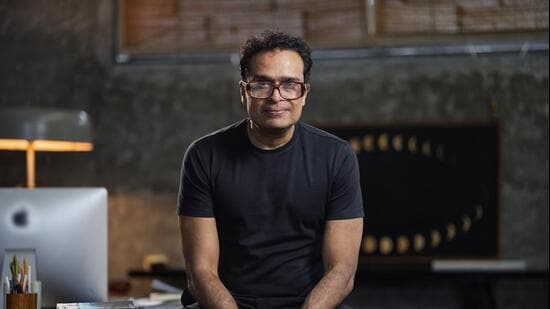
Conjectures on a Paper Sky, curated by Alexandra Munroe, senior curator at Solomon R Guggenheim Museum and Foundation, New York, was first shown at the Centre for Contemporary Art, Delhi, and opens at BDL on November 14.
The exhibition is spread across the museum with new and expanded works. It’s an expansive, survey show that explores Kallat’s practice and artistic inquiry over the last decade. “Inventive and speculative, Jitish Kallat’s art agitates the zone between fact and conjecture. Working at the intersection of science, historical memory and existential inquiry, he renders the planetary as a shared yet uneven condition, provoking both awe before cosmic vastness and an acute awareness of our precarity,” says Munroe.
It’s presented by BDL, The Kiran Nadar Museum of Art, Saat Saath Arts Foundation and Nature Morte.
Art is a myriad forms
{{/usCountry}}Art is a myriad forms
{{/usCountry}}Bringing together paintings, drawings, sculptures, installations and lenticular works (specialized lenses to display shifting images, motion, or 3D depth as the viewer changes their viewing angle), the show draws from historical archives, scientific thought and observations of the natural world.
A plan to bomb the moon during the Cold War; monkeys sent in space; The Family of Man, a landmark 1955 propagandist photography exhibition that went to 63 countries, including India; and drawings created in studio while in quarantine during the Covid-19 pandemic, Kallat’s art brings together myriad worlds and forms seamlessly. But how do they come together?
“That’s part of the mystery of art. You never quite know how, when or why something will take shape. Sometimes clarity comes only much later, when you look back,” says Kallat. There are treaties and books and researches which have become monumental works.
The exhibition takes its title from the work of the same name, a ten-part suite of paintings developed through research into Project A119, a once-classified 1950s American proposal to detonate a nuclear device on the moon, at the height of the Cold War. While it never happened, Kallat overlays the grids with ballistic trajectories and blast-like formations, alongside botanical, geological, suboceanic, and celestial forms, letting fact and conjecture share the same pictorial field. The paintings carry traces of forms and geometries from that historic document.
“But Project A119 was also a study in optics of perception. If a nuclear device were detonated on the Moon, would that be visible from earth, and if yes, how would it be perceived,” says Kallat, exploring these in the imagery.
Moon Treaty comprise 54 sculptures derived from the 1979 United Nations agreement governing the activities on moon and other celestial bodies, which only 11 countries signed. These resemble sheets of the treaty crumpled into planetary forms. The works evoke an unrealised international covenant that sought to place the moon beyond national appropriation and military use.
Untitled (Two Minutes to Midnight) is enlarged forms derived from palaeolithic hand axes and stone tools, among humanity’s earliest technologies, with a wedge-shaped plinth based on the distance between the hands of the Doomsday Clock, which stood at two minutes to midnight when the work was made. Cast in dental plaster, the work brings the beginnings of human tool-making into proximity with a contemporary measure of humanity’s capacity for self-destruction.
Another relevant work, in context to the museum’s location next to the zoo, is three bronze sculptures. One of them is Able, a female rhesus macaque sent into suborbital space in 1959 as part of early US experiments testing whether living beings could survive space travel. For her sixteen-minute flight, she was restrained in a harness, fitted with monitoring equipment, and launched in a pressurized nose cone atop a Jupiter missile. Although Able survived the mission, she died four days later during surgery to extract the embedded devices.
Kallat’s life-scale sculpture stands as a memorial to Able’s disturbing story. “The space race was also a moment when Cold War rivalries pushed the boundaries of human ambition, extending to animal and celestial bodies. These were extraordinary leaps in science and technology, but they also raise ethical questions that remain unresolved today,” says Kallat.
Of births and deaths
A major new element at Mumbai is the 365 original drawings from Integer Study (drawing from life), presented for the first time. Made daily over the course of 2021, each drawing begins with three algorithmically estimated numbers: the global human population at a particular instant, and the number of births and deaths recorded up to that moment in the day.
What is the message he would like to convey through the exhibition? “There’s not a single end purpose. If there was, it wouldn’t be art,” says Kallat. He thinks that the exhibition points to multiple locations in space and time. “It’s not addressing the problem at the same level of thinking that created it, to borrow an idea often attributed to Einstein. It’s trying to look somewhere else. Like when you look away and then look back, that now looks different.”
Tasneem Mehta, director of BDL sums it up well. “In these turbulent times, the project invites viewers to step back and consider events of varying magnitudes from a different perspective, provoking questions and at the same time filling us with an extraordinary sense of wonder.”
(Jitish Kallat’s exhibition -- Conjectures on a Paper Sky -- will run at the Dr Bhau Daji Lad Museum from November 14, 2026 to February 14, 2027.)
Stay updated with all the Breaking News and Latest News from Mumbai. Click here for comprehensive coverage of top Cities including Bengaluru, Delhi, Hyderabad, and more across India along with Stay informed on the latest happenings in World News.
Stay updated with all the Breaking News and Latest News from Mumbai. Click here for comprehensive coverage of top Cities including Bengaluru, Delhi, Hyderabad, and more across India along with Stay informed on the latest happenings in World News.