Gujarat may bring a female tiger to the Ratanmahal forest to ensure the existing tiger population can breed and establish a resident population. The decision comes after a committee of wildlife experts found that the contiguous forest tract in Gujarat and Madhya Pradesh is suitable for supporting a tiger population of 10 to 12 animals.
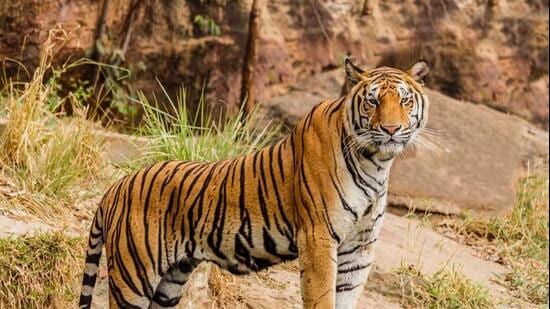
“The possibility of this area being declared a sanctuary in future cannot be ruled out. But for now, the focus is on introducing the female tiger, which should happen in the next three to four months,” said an official familiar with the development.
The three-member committee was constituted by the National Tiger Conservation Authority (NTCA) under the Union Ministry of Environment, Forest and Climate Change. The panel is headed by Dr HS Singh, former principal chief conservator of forests (PCCF), Gujarat, and includes Dr Bilal Habib, Scientist-F at the Wildlife Institute of India, and Nandkishor V. Kale, assistant inspector general of forests, NTCA, as members.
Gujarat sought permission from the NTCA. The NTCA will decide the source of the female tiger. It could come from Madhya Pradesh or another suitable location, depending on the availability of an appropriate animal and the authority’s decision, said an official.
The committee visited the area in the last week of September to assess its suitability and is likely to finalise its report by mid-October. The report will guide the next steps on developing the forest tract as a tiger habitat.
{{/usCountry}}The committee visited the area in the last week of September to assess its suitability and is likely to finalise its report by mid-October. The report will guide the next steps on developing the forest tract as a tiger habitat.
{{/usCountry}}The report will assess the habitat, prey base, carrying capacity and protection measures, providing the basis for a decision on the proposed translocation and the development of the connected Gujarat-Madhya Pradesh forest tract as a tiger habitat.
The committee in its preliminary findings assessed about 214sq km of forest in Gujarat and 225sq km in Madhya Pradesh. Together, the two areas form a continuous forest tract of around 450sq km without villages breaking the connectivity, allowing wildlife to move across the Gujarat-Madhya Pradesh border, said an official.
The committee estimated the prey base at about 2,500 animals, including wild boars and nilgais. The Gujarat Forest Department also established five to six breeding centres for chital and sambar in the area to strengthen the prey base.
The notified Ratanmahal Wildlife Sanctuary covers 55.65sq km, while its notified Eco-Sensitive Zone covers around 240sq km. The sanctuary is contiguous with forests in Madhya Pradesh’s Alirajpur district.
The larger forest tract could be developed as part of a wider protected area or sanctuary framework. Its uninterrupted connectivity across the state border would allow tigers and other wildlife to move and disperse between Gujarat and Madhya Pradesh, said a senior state forest department official.
A tiger has been consistently present in Ratanmahal since February 2025, after moving into Gujarat from Madhya Pradesh. The Centre said in a Rajya Sabha reply on February 5, 2026, that the tiger was consistently observed in the sanctuary and that Gujarat intensively monitored habitat and prey-base management and movement-based protection measures. The NTCA also conducted a scientific reconnaissance survey in Gujarat and submitted its report to the state.
An earlier NTCA team visited Gujarat, assessed the area and trained around 150 forest department officials in tiger monitoring and conservation, according to the Sandesh report. The arrangements at Ratanmahal, Chhota Udepur and Devgadh Baria were also reviewed.