Jharkhand is one of the few states in the country with potential for rubber cultivation and the Rubber Board was presently conducting cloning tests at Birsa Agricultural University in Ranchi for varieties which could be recommended for commercial plantation in the state, officials said on Tuesday.
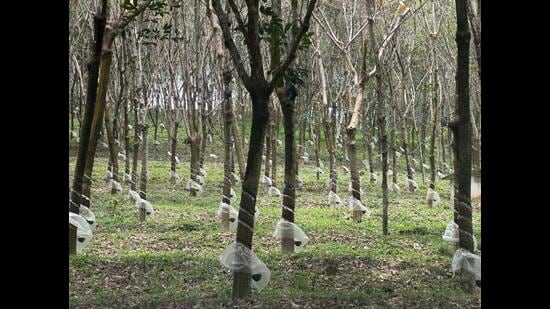
Currently, Kerala is the rubber capital of the country, followed by Tripura and other north eastern states in terms of total area covered under rubber plantation.
Rubber Board is a statutory body under the Union ministry of commerce & industry, which acts as the torchbearer for growers in terms of scientific research, developing clones and nurseries of plants, promotion of plantation in association with the stakeholders, including farmers and respective state governments.
“There is a lot of potential in states like Jharkhand, Bihar, Odisha and Chhattisgarh for rubber plantation. We enter into MoUs with local universities for testing of the varieties that we could recommend for a particular state. We have already signed an MoU with Birsa Agricuture University where plantation of few varieties has been done in one acre land. The gestation period for rubber plantation is seven years. So we still have to wait for 3-4 years to finalise which variety needs to be recommended for Jharkhand. Once that is done, it can be escalated for commercial plantation,” M Vasanthagesan, executive director, Rubber Board, said during an interaction with reporters at Rubber Research Institute of India (RRII), Kottayam on Tuesday.
The officials said the sector had lots of potential for growth as there was a huge gap between the demand and supply of natural rubber in the country.
{{/usCountry}}The officials said the sector had lots of potential for growth as there was a huge gap between the demand and supply of natural rubber in the country.
{{/usCountry}}“There is a deficit of around 35 per cent in demand and supply of natural rubber in the country. The rubber-based industry imports natural rubber to meet the gap. The two ways to bridge that gap indigenously is to either expand plantation or increase per hectare yield. The research institute has come up with high yielding varieties, but we also need to expand the crop growing area. It also helps the growers as this is an awarding cash crop. While Kerala has traditionally been growing rubber, Tripura and parts of other north east states have caught up and has now expanded to around 1.73 lakh hectares. Since most of the growers are marginal farmers, it is helping around 1.83 lakh growers in augmenting their income,” said Vasanthagesan.
Officials said on an average a farmer with one hectare land could earn up to ₹4-5 lakh annually by planting 370-450 rubber plants.
The officials said the plantation had no bearing on the exotic vegetation of the respective state as generally the Board pushed for cultivation on barren lands.
“All such lands where farmers are able to grow single crop can go for it. Once the variety is recommended, we can help develop nurseries for providing saplings. In north east, we gradually got hundreds of societies registered where marginal farmers are doing plantation in a cooperative model,” said Debabrata Ray, director, research, RRII.