Chandigarh Last week’s unseasonal record rain (highest in 10 years) in October, coupled with intermittent showers till this time of the year, has led to late paddy harvest, raising alarm bells in the Punjab agriculture department over a probable delay in wheat sowing. Information that the field staff of the department has gathered shows that 50-55% of paddy harvest is yet to completed. This rabi season, wheat is expected to be sown over 86 lakh acre.
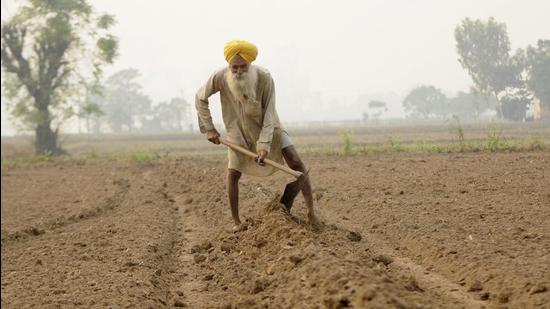
“We are already in the middle of rabi (wheat) sowing season, and the optimal time for this would be over by November 15. Our department is watching the scenario, because if the wheat sowing extends beyond mid-November, it could affect the cropping pattern,” said SS Sidhu, director, agriculture department. Intermittent rain when the kharif crop was ready to be cut has added to the delay, with farmers worried over the moisture content.
“In Mohali, Tarn Taran and Amritsar districts harvest is at an advanced stage and has been completed on about 70% area. In the rest of state, however, we are way behind harvest targets as compared to the corresponding period of the previous seasons,” said Harpreet Kaur, joint director, statistics, Punjab agriculture department.
She added that wheat sowing had not picked up pace, despite the current spell of weather being ideal for it. A shorter window for wheat sowing after khairf harvest usually means that farmers are forced to resort to burning of crop residue to clear their fields quickly.
{{/usCountry}}She added that wheat sowing had not picked up pace, despite the current spell of weather being ideal for it. A shorter window for wheat sowing after khairf harvest usually means that farmers are forced to resort to burning of crop residue to clear their fields quickly.
{{/usCountry}}Figures available with the state’s food and civil supplies department show that to date 89 lakh tonne paddy has arrived for procurement against the total expected arrival of 190 lakh tonne.
“To date, 46% of total arrivals have reached mandis, we are expecting crop arrival to pick up next week. With so much rain around, paddy has not dried below the permissible limits of 17% moisture content,” said a state food and civil supplies department functionary.
According to the research department of Punjab Agricultural University (PAU), the best sowing time for wheat is up to November 7, stretching up to November 15. “Our research benchmarks show that for the best possible yield, sowing should be completed by the first week of November. There is no chance for the sowing to be over within the given period,” said an officer with the agriculture department.
A professor with the PAU research department added that after November 15, germination take longer and other crop dynamics also change impacting the yield. He added, however, that varieties such as PBW 752 and PBW 771 have shown good results. He added that the Indian Agriculture Research Institute’s (IARI’s) JHD 308 variety is sown over 40% of the total area cultivated under wheat.
“Terminal heat stress is a major determinant of yield. Crop which is able to complete its growing time ahead of the days when rise in temperature begins in March-April, gives best yield,” said Navtej Singh of PAU research department.