Mumbai: More than 20 days after thousands of fish were found belly up in the city’s historic Banganga Tank, a natural reservoir that dates back to the twelfth century, investigations by the civic body have revealed that a severe oxygen deficiency in the water could have likely been the cause of death for the aquatic creatures.
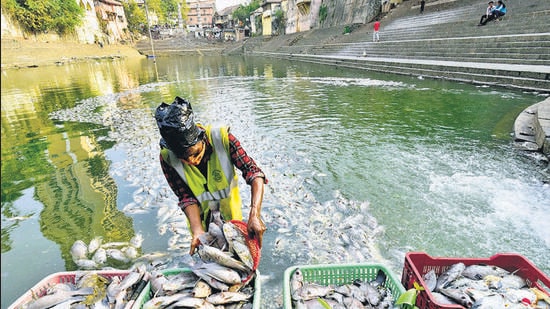
The Brihanmumbai Municipal Corporation (BMC) report on the chemical analysis of the water stated that its colour had turned light green due to presence of toxin components. The civic body’s D-ward office undertook an analysis after thousands of fish were found dead in the tank on April 20 and 21.
Located in Bhuleshwar, near the posh Malabar Hill neighbourhood, Banganga is a fresh water stepped tank and is one of the last remaining natural water bodies of Mumbai. It is a heritage structure and is owned and maintained by the GSB Temple Trust.
The BMC report, which was prepared on April 29, stated that there was an ingression of oil, grease and solid components in the water. The rate of turbidity of the main tank water was also found to be high along with the biological oxygen demand (BOD) level, which indicates a deficiency in the level of oxygen in the water, necessary for the sustenance of marine life.
“We have also carried out a water test from a private laboratory and that states that the overpopulation of the fishes as the primary reason behind the incident. We set up water pumps to maintain the oxygen level and poured fresh water into the tank after the incident,” said Rutvik Aurangabadkar, the chief operation officer, Projects, GSB Temple Trust.
{{/usCountry}}“We have also carried out a water test from a private laboratory and that states that the overpopulation of the fishes as the primary reason behind the incident. We set up water pumps to maintain the oxygen level and poured fresh water into the tank after the incident,” said Rutvik Aurangabadkar, the chief operation officer, Projects, GSB Temple Trust.
{{/usCountry}}“The trustees of the tank had stated that the water in the main tank gets polluted due to water coming from other sources that enter the tank through inlets. Therefore, we collected water samples from both the inlet and the main tank. However, the report states that the level of suspended solid components, oil and grease and ammonia is higher in the tank water than the water coming in from inlets,” said Prashant Gaikwad, assistant municipal commissioner and in-charge of D-ward where this tank is located.
“The report also suggests that the colour of the tank water has turned light green while that of the inlet water doesn’t show any change,” Gaikwad said.
Pramod Salaskar, a limnologist (scientist who studies inland aquatic ecosystems), said that there does not seem to be any evidence of pollution due to chemical toxins in the Banganga tank.
“The death of fish can be explained by the high BOD and COD levels, which essentially point to a severe oxygen deficiency. This makes the environment inhospitable to fish and other life forms that require oxygen to live. In lakes, high Biological Oxygen Demand (BOD) and Chemical Oxygen Demand (COD) levels almost always indicate that there is entry of raw sewage into the water body. But Banganga being an isolated tank would not have this problem. It could well be that materials used by devotees, like coconuts or flowers, are causing this problem as they are being dumped in the tank, but this would require more investigation before we can be sure,” Salaskar said.
Meanwhile, senior officials of the fisheries department who also carried out tests following the incident said that the primary cause was the high numbers of fish in the water. There are more than 12 species of fishes in the tank out of which Tilapia lays eggs at least six times a year.
“The toxicity of water increases automatically as the feces of the fishes remains suspended in the water. Also, people often provide religious offerings in the water in the form of flower and plastic which also add to the suspended solid components in the water and later degenerates into bacterial remains,” an official said, asking that he remain anonymous.
“The only way to solve this problem is to remove the fish stock from the water and control their population. However, as the tank is a religious site people are apprehensive to catch those fishes because of their religious sentiments,” the official said.
Aurangabadkar said that the Trust was chalking out methods to remove the fish stock from the water and they have already sought help from the state fisheries department.
“We have already appointed a private consultant who is preparing a report on the maximum capacity of the fishes the tank can hold. After that we will be removing the fish stock from the water and we are also working out process of setting aerators in the water,” he said.
(With inputs from Prayag Arora-Desai)