Uttar Pradesh government is planning to achieve an ambitious target of producing 16,000mw renewable power by 2026-27 and developing 20 cities comprising 10lakh households as ‘solar cities’ over the next five years.
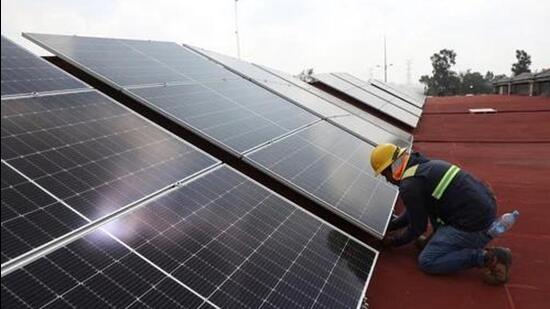
The state has rolled out a draft Solar Energy Policy-2022 which could get the cabinet’s nod soon as the current solar policy (notified in 2017) has completed its five-year term.
The 2017 policy had fixed a target of producing 10,000mw solar power by 2022, but only less than 3,000mw of the target was generated.
Of the total target, 10,000mw is expected to be produced by utilities and solar parks, around 4,000mw through rooftop and remaining 2,000mw through agriculture solar pumps.
Also Read: Generate power at home using solar panels: Union minister’s appeal to Telangana
“The targets are ambitious, but all efforts will be made to achieve it because the proposed policy seeks to remove all the bottlenecks that hindered setting up of solar plants and parks in the state,” said Narendra Singh, project director, Uttar Pradesh New and Renewable Energy Development Agency (UPNEDA).
The targets, he added, will be achieved by introducing a new mechanism that supports consumers, businesses and developers in the sector.
{{/usCountry}}The targets, he added, will be achieved by introducing a new mechanism that supports consumers, businesses and developers in the sector.
{{/usCountry}}Under the policy, 20 cities will be developed as ‘solar cities’ covering 10lakh residential households with solar rooftop installations across the state in five years.
The cities selected are Lucknow, Kanpur, Prayagraj, Agra, Varanasi, Ghaziabad, Meerut, Bareilly, Aligarh, Moradabad, Saharanpur, Gorakhpur, Noida, Firozabad, Jhansi, Muzaffarnagar, Mathura, Ayodhya, Azamgarh and Mirzapur.
Net metering facility will be given to residential consumers according to regulations by UP Electricity Regulatory Commission from time to time.
Under this facility, they can sell the excess power generated on their house to the area’s distribution company.
The proposed policy says that at least 21,000 un-electrified primary schools across the state, totaling a capacity of 40mw, will be covered with solar rooftop installations while secondary schools, government colleges, technical institutions and universities will also be equipped with solar rooftops in a phased manner.
Similarly, nagar nigam assets will be solarised using rooftops and all the public institutions such as hostels and training institutions and libraries will be asked to meet a part of their power requirement through solar power. MSMEs and start-ups will be encouraged for installation of solar rooftops.
Land banks not suitable for agriculture and waste lands will be created by UPNEDA across the state, specifically in Bundelkhand region. The state will promote setting up of off-grid solar systems like solar power plants, solar street lights and solar PV pumps in anganwadi centres and schools.
The proposed policy points out that the state has vast and largely untapped potential, availability of vast barren/un-cultivable unutilised government/private land in Bundelkhand and has potential to make Uttar Pradesh a highly preferred destination for solar energy at the global level.
The state will also promote setting up of solar cold storages to increase the shelf life of agriculture produce and enhance farmers’ income.
The UPPCL, through its discoms, will purchase solar energy as per the renewable purchase obligation (RPO) for the price as determined by the regulator.
The proposed policy offers 100% exemption on stamp duty on the land used for setting up solar power plant/solar park anywhere in the state.
“The state will provide government land for development of solar power projects through lease for a period of 30 years. The government land will be given on lease at a rate of ₹15000/acre per year for a period of 30 years,” the policy says.
The state government will also provide capital interest subsidy to the extent of 5% per annum for five years in the form of reimbursement on loan taken for procurement of plant and machinery subject to annual ceiling of ₹50 lakh. This subsidy will be applicable to utility scale solar power projects with a capacity of more than 5mw.
The draft policy points out the growing concern of global warming and climate change requires emphasis on clean and green energy.
“The setting up of new thermal plants and even renovation of old coal-fired plants is being discouraged for environmental issues all over the country. In such a situation, UP has to promote solar power to meet its growing electricity demand,” a senior energy department official said.