Accepting demands of the aspirants on the fourth day of their protest, the Uttar Pradesh Public Service Commission (UPPSC) on Thursday announced that it will hold the Provincial Civil Services (PCS) preliminary exam-2024 on a single day as per the old pattern instead of on two different dates.
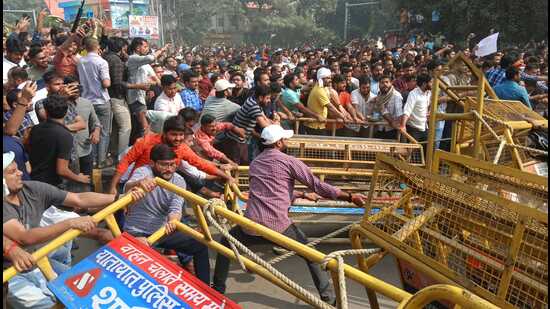
Besides, the commission postponed the review officer and assistant review officer (RO/ARO) preliminary exams-2023. It announced the formation of a committee before conducting this test.
Despite the decision on the PCS prelim exam-2024, students were still outside the UPPSC headqurters with their demand of a similar decision for a single-day RO/ARO examination-2023.
Earlier, the UPPSC had issued a notification on November 5 scheduling the PCS (prelims) examination-2024 in two shifts for December 7 and 8 and the RO/ARO (Preliminary) Examination-2023 in three shifts for December 22 and 23.
Since Monday, a number of aspirants had protesting outside the UPPSC headquarters in Prayagraj to press their demand for holding the exams in one shift.
Amid the ongoing agitation, at the instance of chief minister Yogi Adityanath, UPPSC officials on Thursday called a high-level meeting under commission’s chairman Sanjay Shrinet.
After the meeting concluded in the evening, UPPSC issued a brief release, stating that to maintain transparency and sanctity, the UPPSC had earlier decided to conduct the Combined State/Upper Subordinate Services Examination (preliminary)-2024, or PCS preliminary exam, in two days.
{{/usCountry}}After the meeting concluded in the evening, UPPSC issued a brief release, stating that to maintain transparency and sanctity, the UPPSC had earlier decided to conduct the Combined State/Upper Subordinate Services Examination (preliminary)-2024, or PCS preliminary exam, in two days.
{{/usCountry}}However, keeping in mind that the PCS is the most prestigious examination of the state, an in-principle decision has been taken to conduct the examination in one day as per the old pattern, the communique added.
State government officials said chief minister Yogi Adityanath directed the UPPSC to engage in a dialogue with the students and take appropriate action in view of their concerns. Following this, the commission, under the chief minister’s guidance, decided to hold the PCS preliminary examination 2024 on a single day, as was being done previously, they claimed.
Alongside, UPPSC has postponed the RO/ARO Examination-2023 and decided to constitute a committee to ensure transparency and fairness. This committee will study all aspects in depth and submit its detailed report soon so that the sanctity and credibility of these examinations can be ensured.
UPPSC secretary Ashok Kumar, Prayagraj district magistrate Ravindra Kumar Mandar, divisional commissioner Vijay Vishwas Pant and police commissioner Tarun Gaba came out of the UPPSC headquarters and made the announcement about the decision for one-day examination for PCS preliminary examination after the meeting was over in the evening.
Late in the evening, UPPSC issued a communique stating that a panel has been constituted for analyzing the facts and aspects for conducting a fair and transparent RO/ARO examination 2023 for which 10,76,004 aspirants have registered. The committee will soon present its report before the UPPSC.
The aspirants had launched a massive social media campaign against conducting the examinations on different days and in different shifts. The aspirants were asked to assemble in large numbers at UPPSC gate on November 11 to raise their voice against the normalisation and new pattern of examination.
Normalisation in an examination means adjusting values measured on different scales to a notionally common scale. The need for normalisation in an exam pertaining for a particular post/course could be spread across multiple shifts, which will have different question papers for each shift. The normalisation is to be done by considering the difficulty level of each set, since the questions may be different in different sets and the difficulty level of a particular set may be different from other sets. Hence, the normalisation of scores needs to be carried out for all the candidates who had written the exam, across shifts for the same post/course. UPPSC had derived a formula for it and was to implement it in a computerised process, claiming it to be transparent and foolproof.