
 E-Paper



Baramati mourns the leader who shaped the town
For many Baramati residents, Ajit Pawar’s death felt like the loss of a family member rather than that of a politician

 Prefer HTon Google


Baramati: Baramati, long regarded as a model of development in Maharashtra and a political stronghold of deputy chief minister Ajit Pawar, was engulfed in shock and grief on Wednesday following his death in a plane crash.
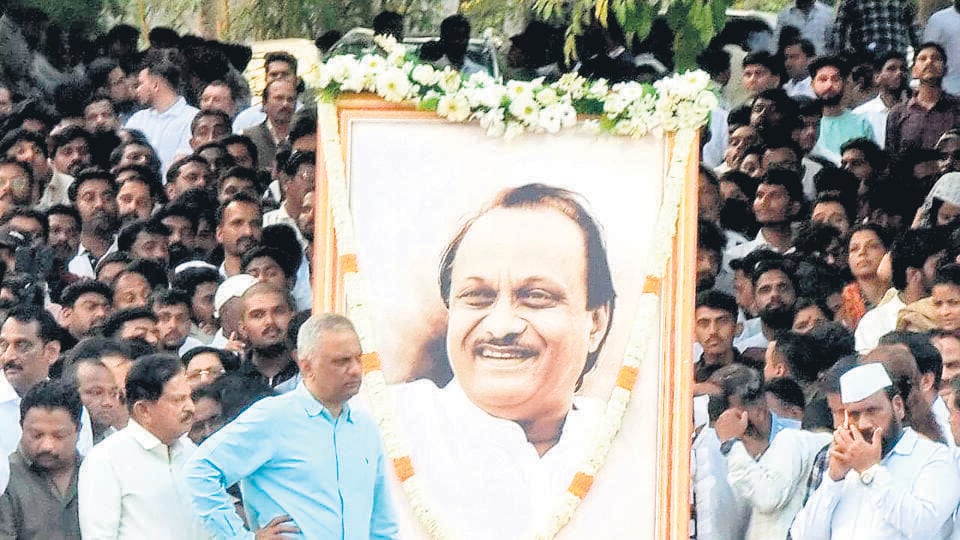
As news of the demise of the town’s most influential leader spread early in the morning, shops and markets remained shut in a voluntary bandh. Residents gathered near hospitals, cooperative institutions and public spaces, reflecting the deep personal bond many shared with a leader who had dominated Baramati’s public life for more than three decades.
From early morning, the usually bustling town, known for its constant movement of buses, traders, farmers and political workers, appeared subdued. Shop shutters stayed half-closed, tea stalls were deserted, and people stood in small groups speaking in hushed tones. For many residents, Pawar’s death felt like the loss of a family member rather than that of a politician.
Posters and banners recently put up for the Zilla Parishad and Panchayat Samiti elections stood awkwardly against the sombre mood. Locals said they should be replaced with condolence messages. At village chowks and outside cooperative offices, people stood silently, staring at Pawar’s images and struggling to accept the news.
“I have seen him here since my childhood,” said Tukaram Shinde, an elderly farmer near Bhigwan Road.
“For us, Ajit Pawar was Baramati.”
The sense of shock cut across age and occupation. Women paused their morning chores to exchange updates, college students sat silently on benches, and sugar factory workers lingered outside gates, uncertain about beginning their shifts. Grief was visible everywhere.
As the news spread, emotions spilt onto the streets. Some residents wept openly, while others remained numb. Many recalled how Pawar would arrive in villages without prior notice, question officials on the spot and speak directly to farmers. “He scolded officers, but work happened,” said a local shopkeeper.
Political flags were lowered, and staff at cooperative institutions observed silence. Even workers from rival parties were seen paying their respects, acknowledging Pawar’s central role in Baramati’s political and civic life.
By noon, crowds gathered outside the Punyashlok Ahilyadevi Holkar Government Medical College and General Hospital, where Pawar’s body was brought. Roads leading to the hospital quickly filled with party workers, farmers, students and women with children, all waiting quietly for updates. His wife, MP Sunetra Pawar, and MP and NCP leader Supriya Sule travelled from Delhi to Baramati along with other family members.
There were no slogans or raised voices, only anxious faces and subdued conversations. Police personnel tried to regulate the swelling crowd as grief continued to draw people in. When members of the Pawar family and NCP leaders, including Rohit and Rajendra Pawar, arrived, the crowd silently made way, united in mourning.
Later in the evening, Pawar’s body was shifted to the Vidya Pratishthan ground, a space closely intertwined with Baramati’s public and political life, where thousands gathered to pay their last respects.
Ajit Pawar’s association with Baramati ran deep. First elected to the Lok Sabha from the constituency in 1991 at the age of 32, he went on to represent the region repeatedly in the state assembly, building an unmatched political base. Over the years, Baramati became both his power centre and his political laboratory.
He was elected eight times to the Maharashtra Legislative Assembly from Baramati—first in a 1991 by-election and later in 1995, 1999, 2004, 2009, 2014, 2019 and 2024—and held several key positions, including minister of state for important departments and deputy chief minister.
Under his stewardship, the once semi-rural town emerged as one of the most developed regions in Pune district. Large-scale irrigation projects transformed agriculture, road connectivity improved, and investments in education led to the establishment of schools, colleges and professional institutes. Hospitals, cooperative sugar factories, dairy units and small industries strengthened the local economy and generated employment.
Baramati also became synonymous with the cooperative movement in western Maharashtra, with the Pawar family playing a key role in strengthening farmer-run institutions and ensuring steady political support across villages.
In 2024, Chief Minister Devendra Fadnavis lauded Ajit Pawar’s contribution to Baramati’s development while referring to the construction of new police department buildings in the town. On a lighter note, Fadnavis remarked, “They do not look like government buildings; they look like corporate offices. Thanks to Ajit Pawar’s initiative, these new buildings will add to Baramati’s development. I will take Ajit Dada’s help for constructing other buildings for the police, though I will continue to hold the home portfolio.”
Even in recent months, Pawar was actively involved in shaping Baramati’s next phase of growth. Projects he was overseeing included the Sharadchandra Pawar Centre of Excellence in Artificial Intelligence, a ₹325-crore Ayurvedic college and hospital, and the ₹650-crore Shivsrushti cultural landmark aimed at celebrating regional heritage and boosting tourism.
For the people of Baramati, Ajit Pawar was not merely a leader who represented them—he was a constant presence who shaped the town’s politics, economy and identity over generations. His absence has left a void that many here say will be difficult to fill.


