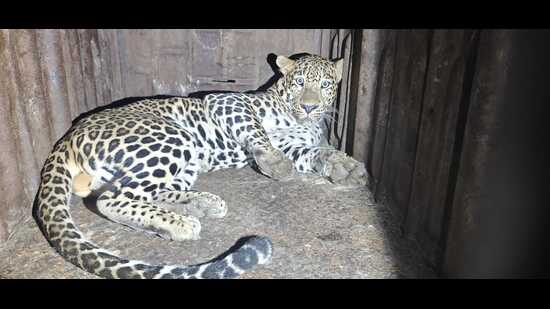
An eight-year-old leopard identified as ‘Binda’, suspected in a series of attacks on people in eastern Shirur tehsil, was captured by the Forest Department early Saturday, ending a month-long operation across Pimpalsuti, Inamgaon, Mandavgan Farata, Shirasgaon Kata and neighbouring villages.
The operation intensified after Pimpalsuti resident Bhagyashree Ware was killed in a leopard attack on July 22. The incident followed several other attacks, prompting villagers to block roads and demand immediate action.
Nearly 15 trap cages, 50 camera traps and drones were deployed to track the leopard. Forest officials and rescue teams studied its movements and placed livestock and bait at locations where it was frequently spotted. For six days, veterinarians also kept an overnight watch from a cage installed in a cattle shed.
Binda was spotted early Saturday near the farm of Shrinivas Ghadge at Nalge Mala in Inamgaon while feeding on bait. The rescue team tranquilised and captured the animal.
The leopard was shifted to the Manikdoh Leopard Rescue Centre in Junnar for treatment and further assessment. Forest officials said six leopards had been captured from Pimpalsuti and surrounding areas in recent days as part of the operation.
The operation was carried out by the Shirur Forest Department, rescue teams and members of the Rescue Charitable Trust under the supervision of Junnar deputy conservator of forests Prashant Khade, assistant conservator of forests Smita Rajhans and Shirur range forest officer Nilkanth Gavhane.
{{/usCountry}}The operation was carried out by the Shirur Forest Department, rescue teams and members of the Rescue Charitable Trust under the supervision of Junnar deputy conservator of forests Prashant Khade, assistant conservator of forests Smita Rajhans and Shirur range forest officer Nilkanth Gavhane.
{{/usCountry}}Wildlife researchers had tracked Binda for several years in coordination with the Forest Department. They identified him through distinctive facial patterns, body markings and other physical characteristics.
Gayatri Rajgurav-Avdhani, honorary wildlife warden for Junnar and a founder-member of Eco Rescue Daund, said she, her husband Nachiket Avdhani and sister Sharada Rajgurav had monitored the leopard with the Forest Department’s support.
“Individual identification gives us a much clearer understanding of how a leopard moves, which areas it frequents and how its behaviour changes over time. It also helps the Forest Department respond more scientifically when conflict incidents occur,” she said.
Binda was first observed as a cub in Kathapur. On March 26, 2023, wildlife observer Nachiket Avdhani photographed two leopards there. The female was identified as ‘Audi’ because of a distinctive head marking resembling the Audi logo. She later gave birth to two cubs, identified by researchers as ‘Chanda’ and ‘Binda’.
Binda’s movements were monitored through camera traps and field observations. He was later captured in a cage at Kathapur following demands from local residents and released away from his home range, separating him from his mother at an early age.
Researchers believe the separation may have affected his natural learning, including hunting skills and his ability to avoid human habitation.
The Forest Department and rescue teams linked Binda to several attacks based on photographic evidence, movement patterns, physical characteristics and observations from incident sites. According to the rescue team, victims in the attacks attributed to him were consistently targeted around the neck. Camera-trap records also placed Binda in or near several incident locations.
An injury to one foot, resulting in missing claws and a distinctive pugmark, provided another identifying feature. Investigators found similarities between pugmarks recorded after recent incidents and those associated with Binda.
Range forest officer Nilkanth Gavhane said evidence from camera traps, pugmarks and movement monitoring supported the assessment that Binda was involved in multiple attacks across Shirur.
The first major incident subsequently linked to Binda was the death of four-year-old Vansh Singh in a leopard attack on October 19, 2024. Further attacks were reported in Mandavgan Farata, where four-year-old Shivtej Tembhekar was attacked on November 15, 2024, and Pimpalsuti, where four-year-old Raksha Nikam was attacked on December 24, 2024. An attack on 82-year-old Laxmi Bhoite was reported on April 25, 2025, followed by the fatal attack on Bhagyashree Ware in July 2026.
The capture has highlighted the importance of maintaining long-term photographic records of individual leopards in areas witnessing recurring human-wildlife conflict.
“The key is to understand the individual animal and its behaviour. Knowing where a leopard moves, how frequently it appears near human settlements and how its movement changes over time can provide valuable inputs for preventing future conflict,” Rajgurav-Avdhani said.