A visit to the US in early 2017 changed the course of electronics engineer Vinay Kunvar’s career. “I saw children there who knew more about technology than many graduates and professionals in India. They were learning robotics and engineering through practical applications rather than rote learning. I wondered why Indian children couldn’t do the same,” recalls the 55-year-old entrepreneur.
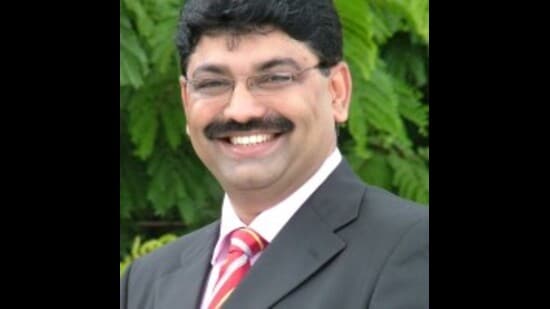
After starting his career as a technology trainer with DataPro in 1992, Kunvar joined MITCON in 2001 and rose to Vice-President. But the gap between classroom education and practical skills continued to bother him. Eventually, he quit his job to establish India First Robotics Innovation and Research LLP with his wife as a partner on December 28, 2017.
The beginning
With robotics education still relatively unfamiliar in Indian schools, Kunvar began by organising competitions. He brought an international robotics competition to India and secured support from organisations including PTC and NRB Bearings.
“We organised a major competition at Balewadi Stadium in Pune, where thousands of students participated. Watching children enthusiastically build and operate robots convinced me that this was the future of education,” he says.
Initially, Kunvar used imported robotics kits. However, their high prices and plug-and-play designs posed problems. “Students could connect components without understanding the electronics inside. As an electronics engineer, I wanted them to understand how sensors, controllers, mechanical components and software worked together.”
{{/usCountry}}Initially, Kunvar used imported robotics kits. However, their high prices and plug-and-play designs posed problems. “Students could connect components without understanding the electronics inside. As an electronics engineer, I wanted them to understand how sensors, controllers, mechanical components and software worked together.”
{{/usCountry}}He decided to manufacture his own kits. Designing the electronics, mechanical and plastic components involved numerous experiments and revisions. It took nearly 18 months to develop kits that allowed students to experiment, build prototypes and innovate independently.
Beyond education
Kunvar’s interest in robotics soon extended to industrial applications. For HPCL, his team developed a robotic arm capable of opening a vehicle’s fuel tank, unscrewing its cap and dispensing petrol.
“The technology worked, but regulations requiring human handling of hazardous fuels prevented its commercial deployment,” he explains. The robotic arm subsequently found applications in engineering college laboratories.
Another experimental project, undertaken with Tata Communications, involved autonomous vehicles equipped with LiDAR sensors for warehouse movement.
Yet education remains central to Kunvar’s philosophy. “When children build robots, they learn mechanics, electronics, programming, mathematics and physics. More importantly, they learn problem-solving and how to turn ideas into reality.”
Robotics, he believes, also helps children discover their aptitudes. “My daughter learnt robotics, realised it wasn’t her calling and eventually became a clinical psychologist,” he laughs.
Investment and growth
Kunvar started with ₹20 lakh, operating from two rooms in Kothrud, Pune, while outsourcing manufacturing to vendors.
Expansion was funded largely through bank borrowings. “I took loans ranging from ₹20 lakh to ₹50 lakh, repaid them and borrowed again as required.” His cumulative investment has reached approximately ₹1.5 crore.
Operating under the Sparkle Bots brand, the venture has trained around three lakh students over eight years. Its revenue last year touched ₹5 crore.
Before the pandemic, its franchise network had expanded to 33 cities across 11 Indian states and seven countries.
A landmark project
In 2017, Sparkle Bots, as part of a consortium, secured a contract to develop India’s first Robot Museum at Ahmedabad Science City for the Gujarat government.
The museum, inaugurated in July 2022, featured a robotic orchestra developed by Kunvar’s team.
“It was an entirely different experience. We were no longer simply teaching robotics but contributing to a major public technology education project,” he recalls.
The COVID turning point
The pandemic disrupted education and the franchise business. Rather than retreating, Kunvar diversified into artificial intelligence, IoT, 3D printing, drones, automation and humanoid robotics.
He also began offering technology solutions to MSMEs.
“AI shouldn’t remain confined to large technology companies and research laboratories. Smaller businesses must also learn to use it to improve products, processes and services,” he says.
In August 2026, Sparkle Bots received the Best Use of AI (MSME) award at Buzzing for Bharat, an Easebuzz initiative.
The road ahead
Today, Sparkle Bots develops humanoid robots, automated guided vehicles and collaborative robots for education, research and selected corporate applications. Defence robotics is another emerging focus.
In 2019, the company organised Milbotics, a military robotics competition, with Pune’s College of Military Engineering. Kunvar now plans to revive it in association with the Army Institute of Technology, inviting engineering students nationwide to tackle defence-related technological challenges.
What began as an effort to bridge the gap between theoretical knowledge and practical skills has evolved into a venture spanning education, manufacturing and advanced robotics.
“The technologies have changed, and our work has expanded considerably,” says Kunvar. “But the fundamental philosophy remains the same: learning must go beyond textbooks and enable people to create something useful.”