Heavy rainfall in the Khadakwasla catchment pushed the reservoir to 92.61% of live storage capacity on Wednesday, prompting the irrigation department to release water into the Mutha River for the first time this season. The discharge flooded several low-lying areas along the riverbanks, leading authorities to issue alerts and move residents to safety.
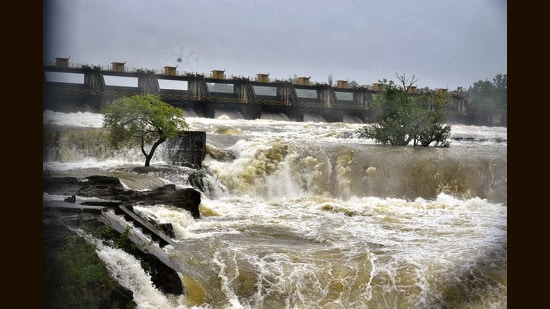
Water was released from Khadakwasla shortly after midnight at 842 cusecs. The discharge peaked at 27,203 cusecs at 5.30 am before being reduced to 18,271 cusecs by 12.30 pm, a level maintained until 5 pm, according to the Khadakwasla Irrigation Division.
At 5 pm, the reservoir held 1.83 TMC of water. It received 12 mm rainfall in 24 hours, with inflows at 300 mcft. A total of 0.26 TMC was released through the spillway. The dam’s water discharge, which had been reduced to 6,296 cusecs at 10 pm, was completely stopped by 10:30 pm.
Kiran Deshmukh, executive engineer of the Khadakwasla Dam Cluster, said the release was being regulated to ensure reservoir safety.
“The Khadakwasla reservoir has crossed 92% of its live storage capacity due to sustained inflows from the upper catchment. Water is being released in a calibrated manner to maintain reservoir safety while downstream conditions are being monitored continuously,” he said.
The rising discharge swollen the Mutha River, affecting low-lying areas including Ektanagari on Sinhagad Road and Bhimnagar in Shivane. The irrigation department and Pune Municipal Corporation advised residents near the river to avoid flooded areas and shift vehicles, livestock and belongings to safer locations.
{{/usCountry}}The rising discharge swollen the Mutha River, affecting low-lying areas including Ektanagari on Sinhagad Road and Bhimnagar in Shivane. The irrigation department and Pune Municipal Corporation advised residents near the river to avoid flooded areas and shift vehicles, livestock and belongings to safer locations.
{{/usCountry}}Pune Mayor Manjusha Nagpure visited Rajput Slum, Pulachiwadi, Ektanagari and Nimbajnagar to review relief measures.
The release came as the four-dam Khadakwasla system continued to receive strong inflows after heavy rainfall in the Western Ghats. Combined live storage in Khadakwasla, Panshet, Varasgaon and Temghar stood at 14.95 TMC (51.30%) at 5 pm, compared with 19.55 TMC (67.08%) on the same day last year. Combined inflows were 1,431 mcft.
Panshet was 53.04% full with 5.65 TMC storage, Varasgaon 48.82% with 6.26 TMC, and Temghar 32.82% with 1.22 TMC.
Rainfall in Pune’s ghat region also boosted storage at major reservoirs across western Maharashtra. Ujani dam storage rose from minus 28% on July 6 to 15.08% within 48 hours.
Prashant Mane, junior engineer with the Ujani Reservoir Project, attributed the rise to increased inflows from rivers originating in the Western Ghats.
“On July 6, the live storage in the Ujani reservoir was at minus 28%. Heavy rainfall in the Pune ghat sections has significantly increased inflows, particularly from the Indrayani River. Within 48 hours, storage has improved to 15.08%. The water level is continuing to rise by nearly 2% every hour. We are monitoring the situation closely, and it remains under control,” he said.
The Jayakwadi reservoir in the Chhatrapati Sambhajinagar division reached 28.69% of its live capacity by Wednesday evening, reflecting the impact of the active monsoon across Maharashtra.
Officials said reservoir levels are expected to rise further with more rainfall forecast over the Western Ghats, while dam releases will be regulated based on inflows and downstream conditions.