Marathwada accounts for nearly 45% of the tankers deployed for drinking water supply across Maharashtra, with the region continuing to depend heavily on tanker-based water supply despite the monsoon.
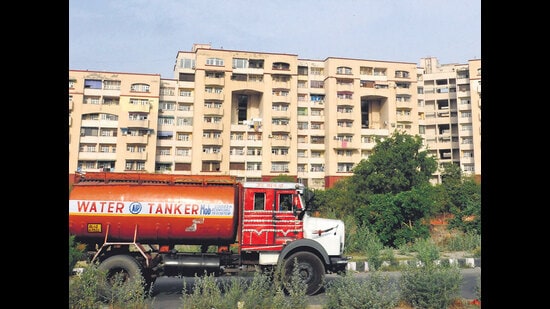
According to the latest tanker supply report issued by the state government for the period from September 14 to 20, a total of 479 tankers were supplying drinking water to 418 villages and 1,568 hamlets across Maharashtra. Of these, 214 tankers were operating in Marathwada alone, accounting for 44.7% of the state’s total deployment.
Marathwada - comprising Chhatrapati Sambhajinagar, Jalna, Beed, Parbhani, Hingoli, Nanded, Dharashiv and Latur districts - currently has 211 private tankers and three government tankers supplying water to 140 villages and 91 hamlets. Within the region, Chhatrapati Sambhajinagar has the highest deployment of tankers at 96; followed by Beed at 88. The concentration of tankers in Beed is particularly significant. The district had 65 villages and 68 hamlets dependent on tanker water during the week, with the fleet comprising government and private vehicles. Beed district collector Vivek Johnson said that the administration is assessing tanker requests on the basis of field conditions before granting permission. “There is a committee under an SDPO-rank officer, who basically analyses tanker request proposals by visiting the field and assessing the ground reality, and accordingly permission for the tanker is given,” Johnson said. According to Johnson, Patoda and Ashti have recorded the highest demand for tanker water in Beed, and the administration is meeting the requirement by allocating tankers to these areas. He said that the district currently has fodder stock for more than 50 to 60 days and that fodder camps will be made available thereafter in accordance with state government directions.
The statewide dependence on tankers has also increased in the past one week. The number of tankers rose from 411 during September 7-13 to 479 during September 14-20. The number of villages receiving tanker water increased from 362 to 418; while the number of hamlets rose from 1,354 to 1,568. The latest figures show that tanker dependence is concentrated in specific regions and districts where local water sources remain inadequate to meet drinking water requirements. North Maharashtra is the second-largest region in terms of tanker deployment, with 133 tankers; followed by western Maharashtra with 132. Konkan and Vidarbha have reported relatively limited dependence on tanker-based drinking water supply.
{{/usCountry}}The statewide dependence on tankers has also increased in the past one week. The number of tankers rose from 411 during September 7-13 to 479 during September 14-20. The number of villages receiving tanker water increased from 362 to 418; while the number of hamlets rose from 1,354 to 1,568. The latest figures show that tanker dependence is concentrated in specific regions and districts where local water sources remain inadequate to meet drinking water requirements. North Maharashtra is the second-largest region in terms of tanker deployment, with 133 tankers; followed by western Maharashtra with 132. Konkan and Vidarbha have reported relatively limited dependence on tanker-based drinking water supply.
{{/usCountry}}Within northern Maharashtra, Ahilyanagar accounts for a particularly large share of the total deployment, with 118 tankers currently supplying drinking water. The figure means that nearly nine out of every 10 tankers operating in north Maharashtra are deployed in Ahilyanagar alone. Officials said that the concentration of tankers in parts of Marathwada and other regions reflects persistent water stress and continued reliance on emergency drinking water arrangements despite the recent rainfall. In the Pune division, 132 tankers are currently in operation. Solapur has the highest deployment at 63, followed by Satara at 38, Sangli at 24, and Pune district at seven. Solapur has recorded a sharp increase in tanker-based drinking water supply in just one week. The number of villages receiving tanker water rose from 57 during September 7-13 to 77 during September 14-20; while the number of affected wadis increased from 233 to 338. The number of tankers deployed in Solapur also increased from 47 to 63 during the same period. Thus, in a week, tanker coverage expanded by 20 villages and 105 wadis, requiring 16 additional tankers. The sharp increase in tanker dependence in Solapur raises concerns over the availability of drinking water sources and the sustainability of water supplies in the coming months.