PUNE: Residents and environmentalists are concerned about the depleting biodiversity of the once migratory birds’ haunt, Pashan Lake. A recent visit by MP Vandana Chavan on the behest of citizens and environmentalists put the spotlight back on the deteriorating condition of Pashan Lake.
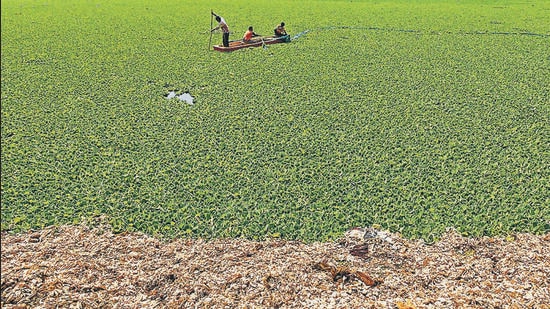
Chavan discussed with the local corporators issues including the overflowing hyacinth, sewage water and industrial effluents trickling into the lake, and reduced sightings of migratory birds. “There is a need to maintain this lake and the water hyacinths are a major problem that the Pune Municipal Corporation (PMC) is dealing with but will take a long time to clear. There is also growing concern over the increasing pollutants in the lake and the dumping of garbage in the lake for which I have already spoken to the officials to tackle it at the earliest if we have to restore the lake to its old glory,” Chavan said.
According to Dr Sameer Padhye from Biologia Life Science LLP and Dr Mihir Kulkarni from the Centre for Cellular & Molecular Biology (CCMB), Hyderabad, however, Pashan Lake is indeed in danger of losing its biodiversity. According to them, this once unspoiled lake has suffered due to urbanisation with restoration worsening its state. Dr Padhye said, “It is a 130 acre freshwater lake with a catchment area of 40 square kilometre and was created by constructing a barrage on the Ram nadi, a river that originates in the Bavdhan area of Pune and flows through the city into the Mula river.”
As part of the restoration activities, the lake was de-silted, an artificial island was created, the lake was re-contoured, walls were constructed, and non-native fish were introduced. This led to large-scale habitat modification of the lake, altering its natural shape and reducing the number of micro-habitats (mud flats, shallow littoral regions, natural littoral vegetation etc.). This in turn greatly impacted the entire community of the wetland, including zooplankton, macrophytes and birds.
{{/usCountry}}As part of the restoration activities, the lake was de-silted, an artificial island was created, the lake was re-contoured, walls were constructed, and non-native fish were introduced. This led to large-scale habitat modification of the lake, altering its natural shape and reducing the number of micro-habitats (mud flats, shallow littoral regions, natural littoral vegetation etc.). This in turn greatly impacted the entire community of the wetland, including zooplankton, macrophytes and birds.
{{/usCountry}}Dr Padhye said, “Restoration work carried out in Pashan Lake has affected its aquatic life to a large extent. Many groups of animals seen earlier such as freshwater sponges and freshwater prawns are not seen in the lake anymore, while the diversity of aquatic animals has decreased drastically.”
In their study titled ‘Does habitat restoration disturb? A case study of a shallow urban water reservoir in western India using Cladoceran zooplankton’, Dr Padhye and Dr Kulkarni have showed that the diversity of one group of small crustaceans commonly called ‘water fleas’ decreased from 28 species seen in 2009-10 to nine species in 2015-16.
“Many such groups of organisms not visible to the naked eye do play an important role in proper functioning of habitats like Pashan and human disturbances in the form of garbage dumping, physical alteration of the place can affect this functioning,” Dr Padhye said.
The biologists said that there needs to be a detailed assessment of biodiversity covering as many animal/plant groups as possible, before planning any restoration activities or beautification drives if one wants to save Pashan Lake from slowly depleting its biodiversity.