
 E-Paper



Revolutionising solar power with smart energy management
PUNE: Ayush Misra co-founded AmpereHour to manage solar battery energy discharge, aiming to innovate in India's renewable energy sector.

 Prefer HTon Google


PUNE: Renewable energy is about more than just generating megawatts of power. While installing solar panels or wind turbines is a crucial first step, effectively utilising the energy they produce presents a distinct challenge. As the cost of solar panels dropped over the years, solar energy became accessible to a growing number of households.
However, while the cost of generating solar power became affordable, storing it in batteries remained an expensive obstacle. This led to the introduction of net metering policies in 2013. With net metering, homeowners and businesses no longer needed to invest in costly batteries. Instead, they could feed excess solar energy back into the grid, which, until then, had primarily relied on coal and thermal power. Suddenly, the grid had to accommodate renewable energy as well.
Ayush Misra, a business development manager at CleanMax Solar, recognised a key issue as renewable energy adoption grew. Through his interactions with customers, he saw the challenges that would only intensify as the share of renewable energy increased.
“Coal and thermal energy can be ramped up or down at will because the source is available whenever it’s needed,” he explains. “So, if energy demand spikes at night, coal plants can quickly increase output. But with solar energy, that’s not the case.”
“Solar power is generated during daylight, and the power thus generated has to be stored. When it is plugged into the grid. Typically, energy consumption increases at night when solar energy cannot be produced. So we need batteries.” But that is Several large companies are in the business of manufacturing solar batteries. So what was Ayush’s great discovery?
“Batteries are made using various technologies—lithium, sodium, and so on. But storing energy is just half the job. The real challenge is how that stored energy is used: how it needs to be ramped up or down depending on the demand,” Ayush explains.
This insight led him to realise that what was missing in the market was a system that could intelligently manage and regulate the discharge of energy based on the needs of specific appliances—be it an air conditioner, a fan, or any other device. This was a problem he was determined to solve.
In 2018, confident in his discovery, Ayush left his position at CleanMax Solar to pursue this vision.
One is a lonely number
Ayush recognised a significant problem but knew he needed the right expertise to develop a solution. With 15 years of experience at CleanMax Solar, he had built a strong network of professionals who could help bring his vision to life.
“Rahul Shelke was the CTO at CleanMax,” says Ayush. “He brought 15 years of experience in electronics and the power systems domain. Recognising the potential of this new business, he joined me.” Ayush goes on to explain, “Neehar Jathar, an IIT graduate, was well-versed in the intricacies of software development. He also had experience in private equity, allowing him to wear two hats at AmpereHour, handling both finance and software development. I focused on marketing and client acquisition.”
The three co-founders invested ₹1 crore of their own savings to get the company off the ground. Their goal: to create a solution to regulate the stored power consumption from solar batteries. “The crux of our technology is the Energy Management Software (EMS) we developed in-house,” says Ayush.
“Solar batteries contain various systems—cells, inverters, meters, firefighting systems, and more. All these components need a central ‘brain’ that can communicate with them, determining what needs to be done, when, and how.”
This led to the development of their proprietary EMS, called Elina, which is designed to work with a wide range of battery chemistries.
“I asked them if we could do an audit to figure out the problem areas, and they let us do that. Luckily for us, these days, there aren’t too many players in this business. We did the audit and submitted the report. Meanwhile, the Trust was interested in creating another microgrid project in rural UP. In a small village called Parsa. They were looking at solar power generation of 25KWh. Given our experience of doing their audit, we already had built some credibility with them. They let us do that project. They paid us ₹50 lakhs for it.”
AmpereHour was lucky as this Parsa project served as a POC for them. They assembled the different parts of the solar battery, used lead cells from China, installed circuits, etc and had it ready for the villagers of Parsa. “It was our first use-case scenario. But it did not succeed as we planned. The reason was the lead batteries.”
The Trust gave them another opportunity. This time, it was a slightly bigger solar grid of 50KWh that they had to build for a village in Shivapur district in UP. This time, they were better prepared. They knew what lead batteries could fail. So this time they used lithium-ion batteries. And used their own software to guide its discharge. “It worked perfectly,” says Ayush. Two microgrid projects were the learning ground for them. Now they needed to expand their horizons.
Growing:
Further growth became imperative after having worked on microgrids. Says Ayush, “Larger developers like Softbak wanted to do a pilot. They wanted one company that could provide the EMS that would work on different batteries. This was our USP. We did the pilot, and it worked.”
The opportunity knocked at their door once again. This time it was a seriously big player – the BSES Rajdhani Power. They were doing a reverse auction for six energy storage systems of 250KWh each at six different locations in Delhi. AmpereHour was too small a player to participate in this auction. But not willing to be undone by size, they found a battery manufacturer, CosLight and partnered with them.
Says Ayush, “We didn’t have the net worth, but CosLight did. While they made the batteries, we had Elina, our energy management system. That auction had some seriously big players who participated, companies like L&T, Mahindra & Mahindra.” But CosLight won the bid, and AmpereHour got its first large customer. “Elina did an amazing job. It was our first commercially deployed system that worked in India.” This opened the gates for bigger and better deals. Since the six transformers worked so well, BSESRP went to the Electricity Regulator and got approval for a system that was 40 times bigger than the first one. “Just last month, this project got commissioned,” says Ayush. AmpereHour set up their factory in Chakan. “Here we build our solar batteries, that is largely procured from China.”
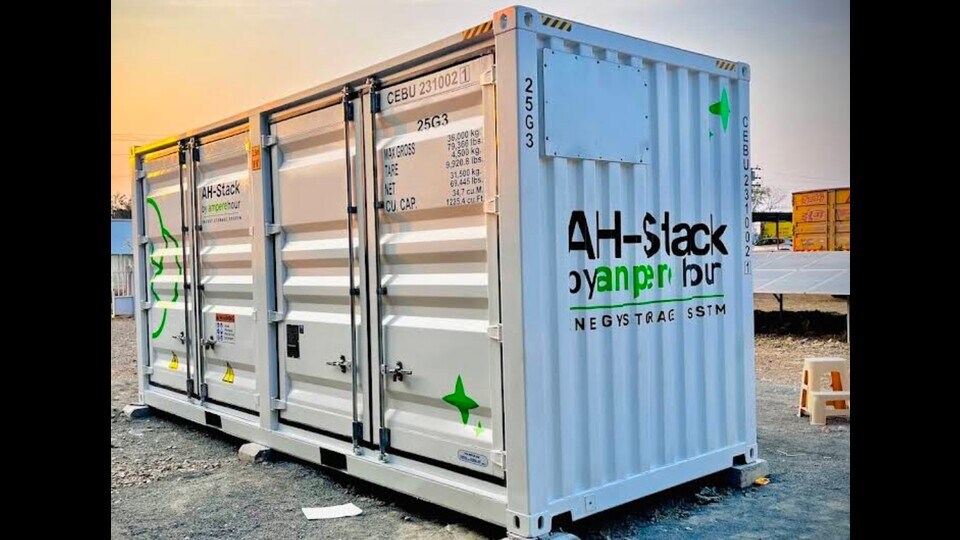
They use shipping containers and first have them treated. Says Ayush, “It is a modular system where we take a 20 ft container and use that as the base. We then process it for thermal management, put a fire safety coat, put in batteries that are largely procured from China, add battery protection circuits, and thus build a solar battery that can provide 25MWh. Our USP is that our EMS can run on any battery, be it lithium, lead, etc.”
Competition
As of now, Ayush states that competition is from big players, Fluence from the USA and Envison from China. “But they fundamentally focus on developed markets and their skill lies in the batteries, the hardware, though they do use some software. They sell the whole stack, and while our skill lies in our software, we too will join the bandwagon and sell the whole system using batteries from China. Indian companies like Reliance and Tata are also getting into battery cell manufacture, but as of now, China leads the game.
What their competitors lack, Ayush feels, is a holistic solution. “We partner with the client for the entire duration of the project, while the others simply want to sell their hardware along with a basic version of the software. For example, if a client wants to trade in the Indian market, these companies will not have that software while we do.”
So far, AmpereHour has raised USD 5 Mill and is profitable as a company. “We are growing 4X annually, as the space is also growing very fast. We will see how fast we will have to scale up before deciding to raise further funds or not.”
The Future
“Our goal is to be the 10 best energy storage players globally. As of now, we are the best in India and have 1.2GWh in our order book. These are for projects in Gujarat and Rajasthan.” From the best in India to the top 10 in the world looks quite possible.


