
 E-Paper



Taste of Life: Sharing food, spreading faith and fellowship
Christian missionaries played a vital role in the diffusion of crops, animals, agricultural practices, and eating manners throughout the early modern world

 Prefer HTon Google


Pune: The Collector is coming to distribute prizes to the boys in the government school tomorrow; all the principal people of the town will be present, and the “mamlatdar” will be very glad if you will come and show your magic-lantern pictures after the prize-giving is over,” said a message received by the master of the mission-school at Khed, a week before Christmas in 1895.
Khed was a town of about four thousand inhabitants and twenty-six miles from Poona. It was one of the most important outstations of the Church Mission Society (CMS) with a school where boys received Bible as well as secular teaching. The CMS had only just taken up work there, and there were not more than a dozen boys in the small English class.
Reverend RS Heywood, the incharge of the Poona Divinity School, was in Khed then. He told the “mamlatdar”, the magistrate, that all their lantern slides were Bible pictures, but the “mamlatdar” made no objection, so the reverend gladly seized the opportunity.
On the evening of the function, a sheet was put up against the wall of the courthouse and the lantern was kept ready. The Collector came with his wife and so did the “mamlatdar”. Prizes were distributed and the lantern show began. The Christian master incharge of the English class was interpreting. An opportunity to emphasise the Christmas message was not missed. The Christmas message was twofold – glory to god, and goodwill among men.
After the show, all the children were given laddoos made of wheat flour and jaggery. The Collector had brought with him some fresh fruits that were distributed among the children.
This was the first magic lantern address in India organised by the CMS. These shows almost always drew large audiences, including important people in the villages. The organising missionaries took care to distribute sweets and fruits their audience liked after the show was over. Several pastors and reverends were known to address the crowds in the local languages at these gatherings.
European and American missionaries set sail for parts unknown to preach their religion. They navigated linguistic diversity on foreign shores and gained such a firm grip on languages that they were able to convincingly convey religious concepts to the natives.
The Jesuit missionaries also played a vital role in the diffusion of crops, animals, agricultural practices, and eating manners throughout the early modern world. While they tried to preserve and reproduce their food culture in unknown lands, many also embraced local cuisine for the most part. Importing food from the West was difficult and expensive, and they had to rely on local food to feed themselves in several areas. They did not outright reject local food on cultural and ideological grounds as inferior, unhygienic, and even poisonous. The missionaries were on a mission to preach their religion, and for that, they needed to be close to the local population as much as possible. Not eating the same food as the natives in public would have been detrimental to their pursuit.
Several missions were at work at Poona, most of them having large schools and orphanages. The St Matthew’s (CMS) Church was situated in the Wellesley Road, Civil Lines, almost opposite to the Jewish Synagogue. In the same compound as the church was St Matthew’s Divinity School which was started by Reverand RA Squires in 1888. The building consisted of a school with two classrooms and a lecture hall.
In the Divinity School every year a few Indian Christians, who brought their wives and families with them, studied to become more efficient evangelists to their fellow countrymen. Heywood and his assistants stayed in a tiny mission-bungalow chiefly to have better opportunities for studying Marathi, the local language.
Every Sunday at eight am, the Marathi congregation assembled for worship, and gave place to the Christians of the Tamil colony, each having their distinct language and clergyman in charge. The Tamil congregation was looked after by G Yesudian, a Tamil catechist from Tinnevelly.
In 1895, the annual Christmas subscription dinner of the Tamil congregation was a happy scene. To this, several visitors, including the English missionaries, always received a cordial invitation. The latter personally managed “sitting down” all right but getting up again after dinner was a more difficult operation for knees and legs not accustomed to such positions, according to Heywood.
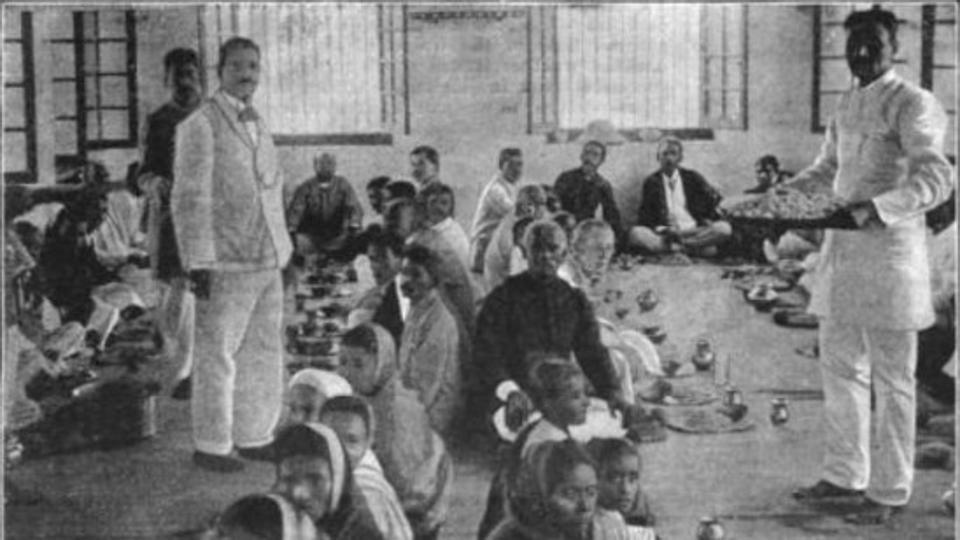
The dinner took place in the large upper hall of the Divinity School building where monthly meetings, Sunday school, and other gatherings were regularly held. On the menu were pumpkin curry and rice eaten with fingers from plates made of leaves.
The photo in today’s column was taken during the Christmas dinner of the Tamil congregation and was published in “The Christian Advocate” in January 1896. In it, Yesudian, who acted as a host, sat in the centre with his hands on his knees. The gentleman wearing a white waistcoat and sitting at the further end on the right-hand side was the Christian master of the English class. Standing up, to the left of the photo, in a light suit, was one of Yesudian’s chief helpers in the congregational affairs. In his hands was a large plate with “boondi” in it. These were tiny sweet round balls made of gram flour and dipped in sugar syrup. They were often offered to the gods in Hindu temples and served to guests during weddings.
Members, both male and female, of the congregation could be seen sitting in neat rows with plates in front of them. Unlike the custom prevalent in those days, where women did not sit to eat with men, in the photo, men and women sat together to have dinner. They were dressed in Indian attires. They might have been of different castes.
Retaining several cultural norms related to food during the preaching protected the natives from “food shock”. They did not have to alter their food habits after accepting a new religion and that made them more amenable. “Food shock” was common among missionaries, officers, and soldiers when moving to India and efforts were taken by the government, missions, and individuals to blur the gap between the food of “here” and “there”.
At St Mary’s Church, an “entertainment” would be held for the soldiers who belonged to the Diocese of Bombay. After tea, several carols and hymns would be sung, and then all drew around a bonfire in the compound, telling and hearing stories, until the neighbouring gongs gave a warning that Christmas Day was nearly over.
At the barracks and messes, the menu typically comprised tomato soup, roast turkey, roast pork, cauliflower white roast and creamed potatoes, new peas, and mince pies. The dessert was Christmas pudding with brandy. Beer, lemonade, mixed nuts, and cheese biscuits were also served. Each soldier was gifted a pack of cigarettes. This menu distinguished the “Westerner” from the native.
The food system of a country is a repository of traditions and collective identity and as such a crucial vehicle for representation and cultural exchange. Food rituals in Poona during Christmas demonstrate how food is also a powerful pathway for acculturation, the assimilation to a different culture, in personal and social domains.
Chinmay Damle is a research scientist and food enthusiast. He writes here on Pune’s food culture. He can be contacted at chinmay.damle@gmail.com


