Pune: The anarsa, a crisp sweet made by mixing jaggery or sugar with flour ground from soaked and dried rice, is usually topped with poppy seeds. It is known for its intricate, mesh-like texture, called the “jaali”. It is a popular Diwali sweet and is also traditionally given to a son-in-law during Adhik Maas, the additional month in the Hindu lunar calendar.
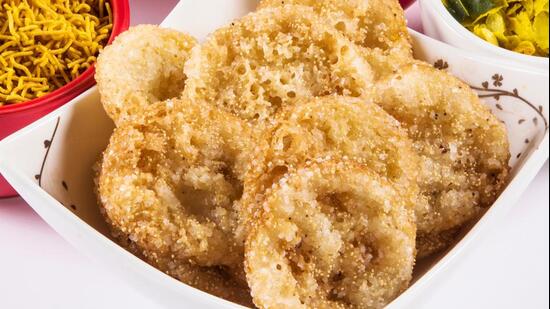
Every Diwali, as households prepare the customary festive sweets, food columns, blogs, and social media feeds are flooded with an odd seasonal claim that anarsas must be fried during high tide. Some social media pages go a step further and publish the schedule of high tides for the upcoming weeks.
Modern proponents of this belief insist that the moon’s gravitational pull draws moisture upward through the dough at high tide, guaranteeing this porous texture once the pastry enters hot ghee. Some claim that the anarsa absorbs less oil if fried during high tide.
There is no established scientific basis for the claim that the tides influence the making of anarsa. The formation of the jaali depends on the composition and consistency of the dough, the conditions under which it is rested, and the temperature of the ghee during frying. Yet the lunar myth resurfaces without fail every year because anarsa is a notoriously fussy sweet to get right.
When dough fails to hold together or refuses to form a crisp mesh, blaming the tide offers cooks an explanation for why the dough does not behave as expected. The belief also reflects the association of anarsa with one particular method of preparation. A recipe published in 1935, however, bypassed these difficulties altogether and used the name anarsa for a very different preparation.
{{/usCountry}}When dough fails to hold together or refuses to form a crisp mesh, blaming the tide offers cooks an explanation for why the dough does not behave as expected. The belief also reflects the association of anarsa with one particular method of preparation. A recipe published in 1935, however, bypassed these difficulties altogether and used the name anarsa for a very different preparation.
{{/usCountry}}Published in a section titled “Striyanche Prashna” (Women’s Issues) in the Marathi newspaper “Dnyanaprakash” on October 10, 1935, the recipe was written by Mrs Lakshmibai Baldota of Pune. Titled “Khobryache Anarse” (coconut anarsa), it describes a preparation made with coconut and semolina, cooked over embers, and cut into squares.
The section titled “Striyanche Prashna” published articles on a range of social issues, often approached from a liberal and reformist perspective. These included women’s education, divorce laws, inter-caste marriages, adoption rights, and women’s right to property. But the section also carried recipes, many of them for dishes that may not have been familiar in the kitchens of its readers, including households then described as “upper caste” and “upper class”. Tomato soup and cabbage samosas, for instance, appeared alongside coconut anarsa.
According to Baldota, these anarsas made a good sweet to serve after tea in place of biscuits and took little time to prepare. The ingredients were 250 grams each of whole coconut, fine semolina, and powdered “swadeshi Belapuri” sugar, 60 grams of khoa, and about 375 grams of good-quality, thick ghee. The quantities in the original recipe, given in older units of weight such as the sher and chhatak, have been converted to grams. These quantities were sufficient to make coconut anarsas for four people.
First, the coconut was grated and the khoa roasted until it turned red. The powdered sugar, semolina, khoa, and grated coconut were mixed. The powdered seeds of five cardamom pods, half a teaspoon of saffron, and the ghee were added. The mixture was kneaded into a dough.
Some poppy seeds were sprinkled over a flat plate. The dough was spread evenly on the plate. Pistachios and chironji nuts were sprinkled over it, according to taste.
The plate was placed over a low bed of embers and covered with a lid, on which more embers were spread. After about ten minutes, the lid was lifted, and the anarsas were checked. When they had turned reddish brown, the plate was removed from the stove.
The preparation was left to stand for another five to seven minutes before being cut into square pieces, like “shankarpale”. It was important to let it stand for this time because the ghee inside the anarsa had not yet solidified.
The way the anarsa is made in Maharashtrian homes varies slightly with geography, caste, religion, and economic status. Some households use jaggery, while others prefer sugar.
The recipe for coconut anarsa differed considerably from preparations described in contemporary Maharashtrian cookbooks, both in its ingredients and in its method of preparation. The most striking change was the use of fine semolina. Traditional anarsa is made from rice that is soaked, dried, ground into flour, and mixed with jaggery or sugar. The mixture is usually left to rest before the anarsas are shaped and fried. In this recipe, semolina and powdered sugar replaced rice flour and jaggery, eliminating the need for this lengthy preparation.
Traditional anarsas are shaped into small, flat, round discs, usually coated with poppy seeds, and deep-fried in ghee or oil. The recipe for coconut anarsa, however, described a preparation cooked between layers of live embers rather than deep-fried. Grated coconut and chironji nuts gave it a flavour quite different from that of the familiar rice anarsa. Baldota’s recipe used poppy seeds, an important feature of the traditional anarsa.
In terms of ingredients and method, Baldota’s preparation resembles a coconut and semolina biscuit, or “vadi”, more than a traditional rice anarsa. Food names do not always correspond to a fixed set of ingredients or a particular method of preparation. They are often borrowed and adapted for preparations that differ from others bearing the same name.
Baldota may have retained the word anarsa because the richness of the ghee and the poppy seeds on its surface recalled the festive sweet in taste, texture, or appearance, or because the name retained its association with festive food even when the recipe itself had changed.
Baldota suggested that the coconut anarsa could be served after tea, in place of biscuits. The practice of drinking tea and serving biscuits with it had gained popularity in India during British rule. In the 1930s, commercial bakery biscuits were still viewed with suspicion by many conservative households, who saw them as ritually impure because of who made them and how they were made and handled. Naming a home-baked teatime sweet anarsa gave it immediate respectability. By borrowing the name of a revered festival sweet made with ghee, Baldota might have wanted to make a home-made substitute for biscuits acceptable in orthodox kitchens.
Whether readers accepted coconut anarsa as a substitute for biscuits, or whether they recognised it as an anarsa at all, is not known.
Chinmay Damle is a research scientist and food enthusiast. He writes here on Pune’s food culture. He can be contacted at chinmay.damle@gmail.com