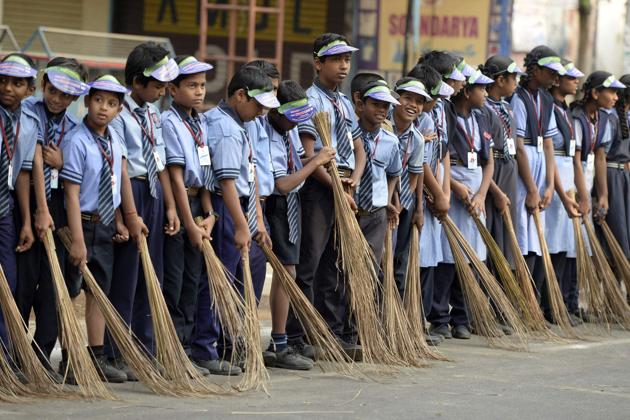
The government is planning how to implement its sankalps or commitments to create a new India free of communalism, caste, corruption, poverty, dirt and terrorism by 2022. The plans will have to be radical. So far the changes brought about have only had limited success. Just look out of the window when travelling by train through the outskirts of any town and you will see how far India has got towards being dirt-free during four years of the swachh or clean India campaign.
The deep-seated nature of the problems the government faces and suggestions for solving them are described in a recently published weighty volume, weighty in size and in content, titled Alternative Futures. Edited by Ashish Kothari, founder member of the environmental group Kalpavriksh and KJ Joy, a senior fellow with the Society For Promoting Participative Ecosystem Management. The volume contains 34 papers written by a wide variety of people engaged in trying to bring about change in today’s India. Take one of the sankalps, removal of poverty. The problems which have to be overcome are described in the introduction as “gross inequality, marginalisation of hundreds of millions, and ecological instability”. The alternatives envisioned are radical, way beyond what any party or politician today is talking about, but that should not consign them to the realm of dreamland. As one paper puts it, “the process of envisioning is crucial as it may influence the course of events and can help to lose the cynicism of the present to retain the hope for the future.”
The subtitle of the volume is India Unshackled and one of the themes running through the papers is the need to free Indians from the shackles of top-down government which gives them no say in policies or the implementation of those policies. Development is planned in Delhi or state capitals and economic policies are based on the economics taught in Western universities. But although the papers are critical of the functioning of Indian democracy there is no suggestion that India should be anything other than a democracy. In one paper, Aruna Roy and her colleagues in the Mazdoor Kissan Shakti Sangthan, or MKSS, say “Contemporary democratic practice faces huge challenges and yet it is one of our only areas of hope...for the poor and marginalised democracy is a lifeline for expression and dissent.” What this volume calls for is a more democratic democracy freed from the present power structures. I very much like the slogan quoted in the MKSS paper, - “yeh sarkar hamari aapki hai, nahin kisi ke baapki”,(this state is ours it doesn’t belong to anyone’s father).
{{/usCountry}}The subtitle of the volume is India Unshackled and one of the themes running through the papers is the need to free Indians from the shackles of top-down government which gives them no say in policies or the implementation of those policies. Development is planned in Delhi or state capitals and economic policies are based on the economics taught in Western universities. But although the papers are critical of the functioning of Indian democracy there is no suggestion that India should be anything other than a democracy. In one paper, Aruna Roy and her colleagues in the Mazdoor Kissan Shakti Sangthan, or MKSS, say “Contemporary democratic practice faces huge challenges and yet it is one of our only areas of hope...for the poor and marginalised democracy is a lifeline for expression and dissent.” What this volume calls for is a more democratic democracy freed from the present power structures. I very much like the slogan quoted in the MKSS paper, - “yeh sarkar hamari aapki hai, nahin kisi ke baapki”,(this state is ours it doesn’t belong to anyone’s father).
{{/usCountry}}When it comes to the economy not surprisingly the all-pervasive obsession with GDP growth, equating it with development, comes under fire in the papers. There is a consistent call for decentralising the economy, reviving local and regional economies, and for questioning the manner in which today’s development model “displaces natural capital by financial capital.”
The authors argue that their economics can sustain well-being for all. For instance, in a paper called ‘Crafts Show The Way For Indian Industrialisation,’ the author points out that for all the handicaps they face, being clobbered by intermediaries who control credit, market and raw materials, India’s artisans still produce millions of metres of cloth every year. The case for the efficacy of democratic democracy is made in the MKSS paper where it’s argued that the Right to Information Act, which their movement campaigned for so successfully “enabled citizens to realise their sovereignty changing the unequal relationship between citizens and government.”
The government is unlikely to take this volume seriously. But the problems they seek to overcome can’t be ignored. They are all too real. The government will have to come up with some radical alternatives of its own to the present economics, politics, and governance of India to achieve the sankalps.
The views expressed are personal