There is a principle of European law known as subsidiarity. Under that principle, the European Union can only act if it can be shown that the action taken at that rarefied level would be more effective than action taken at the national or local level. In other words, decisions should be taken as near the grassroots as possible. Subsidiarity should surely underpin the relations between Indian states and the central government because the country is a federation with power divided between the central government, state governments and panchayats.
But there has always been a question mark over the extent to which India is a federation. Many years ago, I heard the distinguished civil servant, former governor of the Reserve Bank of India and confidant of Jawaharlal Nehru, LK Jha, say India had “a centrist Constitution with federal trimmings”. Over the last week or so, its federalism which has been questioned in the rowdy controversy in Parliament over the government taking decisions on agriculture and other subjects which many state governments insist it is their right to take. The government has insisted that it needs to legislate so that all farmers, everywhere in India, have the freedom to sell their produce anywhere.
The prime minister did promise co-operative federalism when he first came to power but as Member of Parliament (MP) Dinesh Raj of the Bahujan Samaj Party (BSP) said: “The cooperative federalism the Prime Minister claimed to have championed is going exactly the other way.” Congress MP Manish Tewari told Parliament a bill about the governance of cooperative banks was a frontal assault on the federal structure of the Constitution. The manner in which the bills were passed, the lack of discussion, the questionable parliamentary procedures could not be described as cooperative. At one stage, seven bills were passed in under four hours in the Rajya Sabha. Nor, of course, could the abuse of the Deputy Speaker of the Rajya Sabha by Opposition members be described as cooperative.
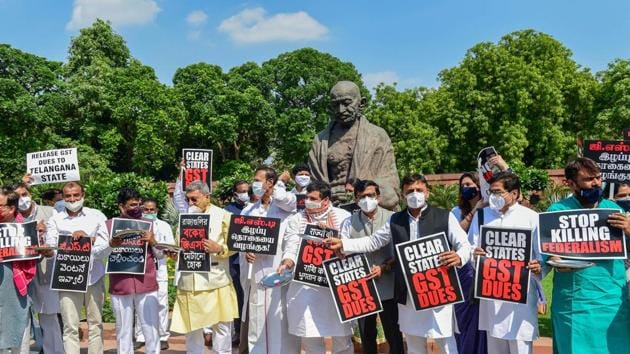
When the states agreed to surrender their rights to levy a number of different taxes and the central government replaced them with the one Goods and Services Tax (GST), chief ministers (CMs) were guaranteed that any loss of income they suffered would be made up by the central government for five years. Now, with the decline in economic activity caused by the pandemic, the central government does not have the revenue from GST to compensate the states. The CMs say the Centre should borrow money to pay the compensation guaranteed to them, but the Centre insists that the states should borrow money to fund any deficit they suffer.
{{/usCountry}}When the states agreed to surrender their rights to levy a number of different taxes and the central government replaced them with the one Goods and Services Tax (GST), chief ministers (CMs) were guaranteed that any loss of income they suffered would be made up by the central government for five years. Now, with the decline in economic activity caused by the pandemic, the central government does not have the revenue from GST to compensate the states. The CMs say the Centre should borrow money to pay the compensation guaranteed to them, but the Centre insists that the states should borrow money to fund any deficit they suffer.
{{/usCountry}}Why does federalism matter so much? India is rightly proud of its diversity and it is federalism which protects that diversity. Take, for instance, language. Without the creation of linguistic states with their own official languages, what would the fate of Tamil in the South, or Oriya in the East, Gujarati in the West and Punjabi in the North have been? Federalism should also play an important role in the system of checks and balances intended to prevent the accretion of too much power at the Centre. It should increase the efficiency of a democracy because its principle of subsidiarity reduces the inefficiencies of top-down government.
Unfortunately, recent events have shown how far India is from being a cooperative federation or union of states. Without cooperation, Indian federalism will be just a trimming.
The views expressed are personal