If you watched the captions that scream out at you from your TV screens every night, their flaming orange hues designed to add to the heat, you would think that complex truths of the turmoil in Kashmir can be squeezed into 140 characters - just perfect for the Twitter age. But, like Akira Kuroswa’s Rashomon (Four people give different accounts of a rape and a murder) taught us, there can be multiple truths. Here are eight truths about Kashmir, seemingly paradoxical; simultaneously truthful.
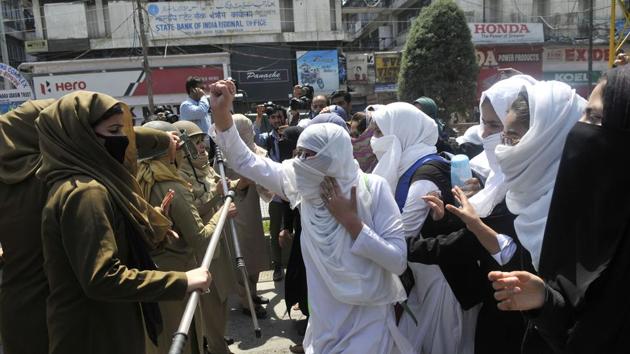
Things in the Valley have not been this bad in two decades. I don’t measure this by violence, terrorism and fatalities - we have seen much worse years on that count. I say this because battling Pakistan’s armed proxies is much more straightforward than taking on your own people on the street. And cloaking militancy with a protective sheet of civilian agitations, women and teenagers among them, means many of the old conflict zone formulas won’t work.
Pakistan’s presence as instigator is at once more visible and more covert. Travel through villages of south Kashmir and you will see many more Pakistani flags than ever before. Quiz Kashmiris about why and some will laugh and say, “It’s just to irritate you people; it’s the one thing that always works.” But, if earlier Pakistan’s role was easier to track, through infiltration, exfiltration and training camps across the border - now it is insidious, engineered through sophisticated social media videos and hawala transactions. Terrorism has not stopped targeting security personnel but propaganda has become a more critical weapon than earlier.
Unlike the hashtag nationalism of venom-spewing anchors, the Army definitely wants political outreach. Soldiers do not want to be used as a substitute for either politicians or policemen. In fact the Army is not in favour of being deployed in situations that pit it against the locals. In the past several high ranking officers have refused to be drawn into managing violent street protests. Lt General DS Hooda, the erudite and never-frazzled officer who oversaw the surgical strikes across the Line of Control told me that it was a ‘missed opportunity’ to not build on the strikes with a simultaneous domestic effort in the Valley. He points out that in addition to putting pressure on Pakistan it was as important to “address the internal situation in Kashmir which had started calming down by this time.”
{{/usCountry}}Unlike the hashtag nationalism of venom-spewing anchors, the Army definitely wants political outreach. Soldiers do not want to be used as a substitute for either politicians or policemen. In fact the Army is not in favour of being deployed in situations that pit it against the locals. In the past several high ranking officers have refused to be drawn into managing violent street protests. Lt General DS Hooda, the erudite and never-frazzled officer who oversaw the surgical strikes across the Line of Control told me that it was a ‘missed opportunity’ to not build on the strikes with a simultaneous domestic effort in the Valley. He points out that in addition to putting pressure on Pakistan it was as important to “address the internal situation in Kashmir which had started calming down by this time.”
{{/usCountry}}Elections in the state have been absolutely free and fair since 2002 but while poll participation signals an institutional improvement it does not mitigate the separatist sentiment. The fatal flaw in conflating voter-turnout with ‘normalcy’ has returned to haunt us with the dismal showing in the Srinagar bypolls. We are trapped by the obvious corollary; if high voter numbers mean a rejection of secessionism what does the lowest voting statistic in 30 years (down to 2% in some parts of Srinagar, under 7% overall) tell us about how Kashmiris feel?
Yes, the Hurriyat gets money and other support from Pakistan to instigate trouble in the state. But several of its members have also been courted on the back-channel by our intelligence agencies for years, obviously with different intents than Islamabad. Former R&AW chief AS Dulat outed the worst-kept secret when he revealed that not just separatists, but even militants had been engaged by Indian sleuths, both politically and financially. “So what’s wrong; it’s done the world over,” Dulat told me. “Corrupting someone with money is more ethical and smarter than killing him.”
Every separatist or militant who has attempted dialogue with New Delhi has been assassinated by Pakistan. The Vajpayee government succeeded in bringing a faction of the Hizbul Mujahideen, led by Abdul Majid Dar, to the table for talks. He was killed soon after. As was Hurriyat representative, Abdul Gani Lone, whose son Sajad is a minister in the present government. A mechanism that provides security and relevance to men willing to give up the gun has not yet taken root in Kashmir even 28 years after the insurgency began.
The problem remains political but radicalisation and a growing Islamism is real. I met a teenage boy strapped to a hospital bed who marched for slain militant Burhan Wani because he “protects Islam.” The Internet has made many angry young Kashmiris part of a global ‘ummah,’ exposing them to more fundamental strains of Islam. Both Wani and his successor Zakir Bhat released videos calling for a Caliphate. One officer argues, “Earlier Islam was a subset of azaadi; now azaadi is a subset of Islam.”
If New Delhi does not start a dialogue process soon, there will be no one to talk to. Separatists have only pocket boroughs of influence and they are fast losing control of the street.
Barkha Dutt is an award-winning journalist and author
The views expressed are personal