Satyagraha (noun), an act of non-violent civil resistance, a term invented by Mahatma Gandhi.
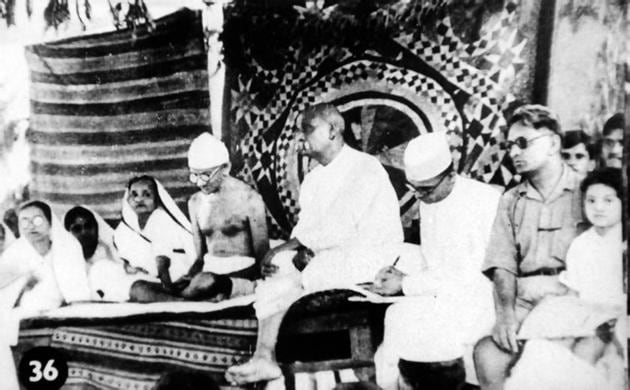
Usage: Mahatma Gandhi first resorted to satyagraha during his early battles in South Africa, though the concept gained in recognition and respect when he applied it to the freedom struggle in India.
The Mahatma came up with the term Satyagraha - literally, “holding on to truth” or, as Gandhiji variously described it, truth-force, love force or soul-force – to describe his method of action in terms that also imbued it with moral content and authority. He disliked the English term “passive resistance”, which journalists had applied to his civil disobedience movement, because satyagraha required activism, not passivity. If you believed in Truth and cared enough to obtain it, Gandhiji felt, you could not afford to be passive: you had to be prepared actively to suffer for Truth.
No dictionary imbues “truth” with the depth of meaning Gandhiji gave it. His truth emerged from his convictions: it meant not only what was accurate, but what was just and therefore right. Truth could not be obtained by “untruthful” or unjust means, which included inflicting violence upon one’s opponent. Hence he would call off a satyagraha if any participant resorted to violence – as he did when the killing of policemen in Chauri Chaura in 1922 led him to call off his nationwide protests just as they were gathering steam.
Gandhiji was profoundly influenced by the principles of ahimsa and satya and gave both a profound meaning when he applied them to the nationalist cause. This made him the extraordinary leader of the world’s first successful non-violent movement for independence from colonial rule. At the same time he was a philosopher who was constantly seeking to live out his own ideas, whether they applied to individual self-improvement or social change: his autobiography was typically subtitled “The Story of My Experiments with Truth”. If truth was his leitmotiv and guiding credo, satyagraha was his principal mode of major action precisely because it was infused with truth, the highest of all moral principles.
{{/usCountry}}Gandhiji was profoundly influenced by the principles of ahimsa and satya and gave both a profound meaning when he applied them to the nationalist cause. This made him the extraordinary leader of the world’s first successful non-violent movement for independence from colonial rule. At the same time he was a philosopher who was constantly seeking to live out his own ideas, whether they applied to individual self-improvement or social change: his autobiography was typically subtitled “The Story of My Experiments with Truth”. If truth was his leitmotiv and guiding credo, satyagraha was his principal mode of major action precisely because it was infused with truth, the highest of all moral principles.
{{/usCountry}}So non-violence, like many later concepts labelled with a negation, from non-cooperation to nonalignment, meant much more than the denial of an opposite; it did not merely imply the absence of violence. Non-violence was the way to vindicate the truth not by the infliction of suffering on the opponent, but on one’s self. In satyagraha, it was essential to willingly accept punishment in order to demonstrate the strength of one’s convictions.
Today, in the “post-truth” era, one can only ask in despair how much of that old spirit of Mahatma Gandhi’s survives in our country’s politics.