


 Live Score
 Cricket Teams
 Cricket Players
Afghans, Dutch and the making of a winning tale
With their cool dismantling of champions England and hot South Africa, Afghanistan and Netherlands sparked joy of a very World Cup kind.

 Prefer HTon Google


A cricket meme this week features a captains’ photo taken before the tournament. The ten men have been asked to strike an ageing pose – Usain Bolt’s thunderbolt – so that the whole thing looks like a dad joke. In the crop on the meme, only four are visible. The seasoned South Africa and England captains have thrown themselves into it, angling their torsos, tossing their heads up. At their backs, Scott Edwards of Netherlands and Afghanistan’s Hashmatullah Shahidi, stiff as cardboard cut-outs, have their fingers pointed straight in front, the slightest of smirks on their faces. “Bavuma and Buttler had no clue what was behind them,” is the caption.
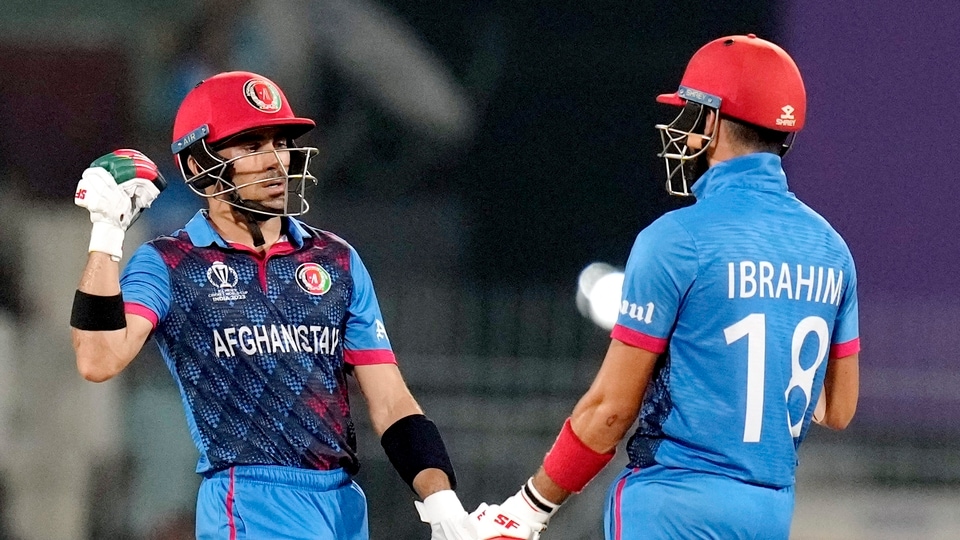
With their cool dismantling of champions England and hot South Africa, Afghanistan and Netherlands sparked joy of a very World Cup kind. Memes, laughs, tears. The little boy who wept and hugged Mujeeb Ur Rahman at the end of the match in Delhi, Mujeeb posted afterwards, was not Afghan, he was Indian, overcome with happiness. And in the chilly night at Dharamsala on Tuesday, as Bavuma, a white towel draped over his jersey, looked on like a forlorn king, the Dutch fans who danced with unchoreographed zest were joined by Indians rooting for the underdog.
Among the Dutch supporters was Richard de Lange, a real-estate professional and amateur cricketer from The Hague. His family was four of twenty-odd travellers from home. When their team stuttered to 82/5, de Lange told me, the fans took bets on the final score: these ranged between 120 and 180. At 150/7, de Lange breathed a sigh of relief: “At least we have something to defend!”
In a nice inversion, as the innings progressed – Edwards’ superb knock, a vintage keeper-batter’s, full of sweeps and reverses; excellent big-hitting by the old hand Roelof van der Merve and young kid Aryan Dutt; the opposition fielders dropping catches, its bowlers running up a tally of 21 wides; all this hoisting the total to 245 – de Lange began to think of South Africa as the amateurs. “They really lost it, the body language, the interactions, they lost their hats, such experienced players.” He sounded almost sympathetic.
The victory was by no means a fluke – after all, they beat South Africa in last year’s T20 World Cup – but it is extraordinary. Netherlands has some 5,000 active cricketers. An average week in Mumbai’s Azad maidan might yield that many. According to Peter Miller in Second XI: Cricket in its Outposts, over 20 sports in Netherlands “have a greater level of popularity than cricket”.
De Lange is not from a cricket family. He happened upon the game at his football club, which had cricket in the summers. Afterwards he joined the Voorburg Cricket Club, home to star all-rounder Bas de Leede, whose younger brother plays with de Lange’s son in the Netherlands Under-19 team. For all Netherlands has gained from foreign-born players, so have, to different degrees, England and New Zealand. Here’s a small example of how, given a fair chance, the game can spread organically. Cricket barely believes that anymore.
For a top side, the “road to the World Cup” means a year or two of fiddling with combinations. Now consider Netherlands’ road. In 2014 they lost their ODI status, missed qualification for the 2015 World Cup, and with that the million-dollars-a-year funding. Step by arduous step from there: winning the World Cricket League second division in 2015, then the World Cricket League championship in 2017, this July at the World Cup qualifiers edging past three Test teams – West Indies, Zimbabwe, Ireland – to get into the World Cup, with the coach Ryan Cook making a public appeal at the press conference: “This is a call-out to anyone who wants to play us. We’d love to have a fixture or two.” Soon the Dutch board was putting out advertisements for net bowlers to help the team in India.
The key stretch on Netherlands’ road was the thirteen-team World Cup Super League that ran from 2020 to 2023, which guaranteed games against top opposition. De Lange wistfully recalls “the summer of cricket, 2022. Pakistan, West Indies, England all came and played three matches each. We had nine international matches against Full Members. It was unimaginable!” Netherlands lost all nine matches but, by every account, gathered invaluable experience that helped them in the qualifiers down the line.
De Lange noticed the other effects, too. The England games – Buttler’s team piled up a record 498 runs in one – drew crowds of “6000 to 7000, which is a massive number for Netherlands”. The press began to take a greater interest. He was pleased to find news of the Dharamsala victory in the top slot of the sport section of NOS, “our BBC”.
That pathway has gone. The World Super League, with its even spread of commitments, did not serve the interests of the larger boards and has been scrapped for now. It means no guaranteed big games for Netherlands. No details certain about the funding, too, except that it will be insufficient.
By contrast, Full Member Afghanistan’s share from the ICC, according to the proposed revenue-distribution model accessed by ESPNcricinfo, is set to be $17 million a year for the next three years. But Afghanistan has always had other struggles. It is a team that rose from outside its borders, learning cricket in the refugee camps outside Peshawar, and plays its home matches in the UAE, Greater Noida, Dehradun, Lucknow, wherever it can.
When I visited the Afghan consulate in Mumbai the other day, beside the governor’s estate on the Walkeshwar shoreline, I was not sure whether there would be locks at the gate. There had been reports that, in the power struggle between the Taliban and the diplomatic corps appointed by its predecessor, the embassies and consulates were to be shut down and perhaps already were.
But at the gate I found Waris, an employee and cricket nut, who had travelled to the north for Afghanistan’s first two matches of the tournament, missing out on the England victory, which his friends attended (and then celebrated all night). I returned the next day for a chat, as told, but Waris was out shopping. He was buying supplies, he told me on the phone, for a prayer service for casualties in the recent earthquakes in Herat. Over 2,000 have died in those. In a world of humans gone mad, acts of god get barely a moment on the news cycle, and if the cricket team can move neutrals let alone countrymen to tears of joy, that counts for something.


