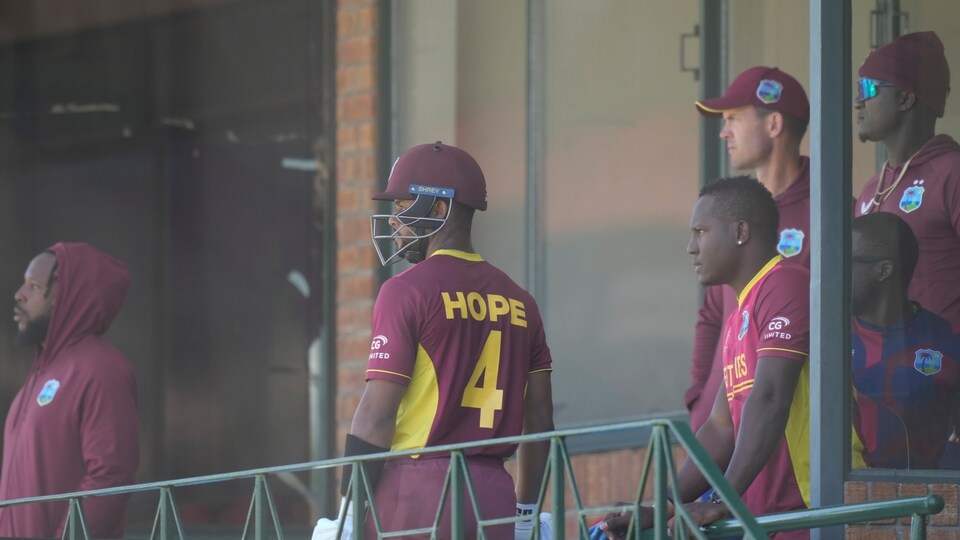
If the World Cup is the barometer of cricket’s health, there are compelling reasons to believe the game has seen better days. The current cycle that has witnessed two World Cup winning teams stumble, and how, only strengthens that concern. If it was a fall from grace for Sri Lanka – they have had to take the qualifying route for the 2022 (T20) and 2023 (ODI) World Cups – West Indies’ shock elimination from the qualifiers means the winners of the first two editions won’t play in the ODI World Cup in India (October-November) for the first time ever
West Indies failed to qualify for the ODI World Cup. (AP)
It is sure to leave a void, especially with cricket yet to throw up worthy replacement teams.
For example, Bangladesh — the first nation to get Test status this century — have just one quarter-final (2015) and a super eight (2007) finish. Afghanistan, elevated to Test status in 2018, haven't gone past the group stage in their two appearances. More disconcerting is the slide of the African and European nations. Zimbabwe, once a middleweight, have not qualified for a 50-over World Cup since 2015, missing out this time although the qualifiers were played at home. Kenya have fallen off the grid. Netherlands have been around since 1996, Scotland 1999 and Ireland 2007. But apart from Kenya’s spirited run to the semi-finals in 2003 – they gave India a mild scare – and Ireland reaching the super-eight in 2007, their results haven’t been encouraging.
All these nations were considered moving wheels of cricket as it looked to establish itself as a global sport. Sri Lanka and Zimbabwe were the first to emerge, before the 1990s gave us Bangladesh, Kenya, Scotland and UAE. The next decade witnessed a surge in participation with Canada, Netherlands, Ireland and Afghanistan frequently making the cut. Except for Sri Lanka, who won their only ODI World Cup (1996) within 15 years of getting Test status, no other cricket nation could build on the initial gains. Zimbabwe were undone by internal strife while it is a puzzle how Bangladesh, despite talent, infrastructure and passionate fan support, have failed to carve a niche for themselves.
At the root of this is global cricket’s revenue model which leans heavily towards bigger nations. It has made the ecosystem top heavy, leaving some of the erstwhile powers struggling to keep their place. Media reports in May spoke of how Associate members felt the proposed new international revenue distribution model could potentially stall the growth of the game. “The new model is now even more heavily weighted towards the bigger cricketing nations, and there is a risk that the proposed changes will exacerbate this imbalance, putting the future of the game at further risk,” Tim Cutler, CEO of Vanuatu Cricket Association told Reuters. “The sad reality is cricket will not grow beyond its current corners of the world... if the allocation of the game's global funds are not more equally done with a view to actually growing the game.”
The allocation of games too is fuelling this imbalance.
The disparity couldn’t have been more glaring than in the last Future Tour Programme (FTP) cycle. Zimbabwe, Ireland and Afghanistan combined have played just 23 Tests since 2017. All of them have been allocated more Tests in the new FTP for 2023-27, but very few against India, England and Australia. Zimbabwe have been given 109 matches across formats but not a single T20 against the Big 3. Afghanistan are trying to repair their image after Australia pulled out of an ODI series because of Taliban’s ban on university education for girls. But the moot point still is that some countries don’t want to play others.
When International Cricket Council (ICC) gave Test status to Ireland and Afghanistan in 2018, it suddenly had 12 full members at a time when it was launching a nine-team Test championship cycle and the now-defunct World Cup Super League (ICC will have a 14-team World Cup for 2027) where only the top eight could qualify. It made it a classic case of supply outweighing demand. It straightaway affected the international calendar that was already being arm-twisted by some of the bigger stakeholders.
It’s clear the Big 3 — India, Australia and England—are monopolising cricket by playing more against each other. Franchise cricket too is a significant disruptor with IPL, PSL, Big Bash and the Hundred carving out windows in FTP. England and Australia use their respective summers to host an Ashes every four years. India exercise a stranglehold on their November-February window, normally beginning it with a big tour and allocating the rest of the days to several small tours to maximise revenues. That leaves very little window for the newer members to get quality practice against better teams. That is bound to affect the health of the game in the long run.
Somshuvra Laha is a sports journalist with over 11 years' experience writing on cricket, football and other sports. He has covered the 2019 ICC Cricket World Cup, the 2016 ICC World Twenty20, cricket tours of South Africa, West Indies and Bangladesh and the 2010 Commonwealth Games for Hindustan Times.Read More


 Live Score
 Cricket Teams
 Cricket Players