


 Live Score
 Cricket Teams
 Cricket Players
Sanjay Manjrekar wants Devdutt Padikkal at No.3 even if Sai Sudharsan returns: ‘Godsent for India’
Sanjay Manjrekar hailed Devdutt Padikkal as “godsent” against spin and backed him to retain India's No.3 spot even after Sai Sudharsan returns.

 Prefer HTon Google


Devdutt Padikkal turned an injury-enforced opportunity into a compelling selection argument on the opening day of the first Test against Sri Lanka in Galle, producing his maiden Test century and earning rich praise from former India batter Sanjay Manjrekar.
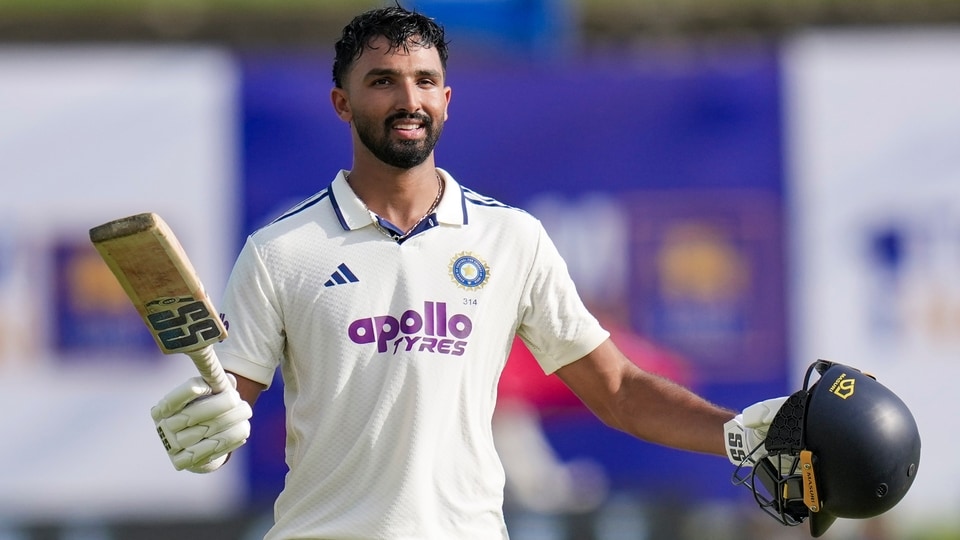
Brought into the XI after Sai Sudharsan was ruled out with a foot injury, Padikkal walked in at No. 3 after Yashasvi Jaiswal was run out for 32. The left-hander announced himself immediately, driving his first delivery for four before settling into an innings that combined assurance in defence with calculated aggression against Sri Lanka's spinners.
Padikkal shared a substantial partnership with KL Rahul, who made 77 before retiring hurt with cramps after tea. The Karnataka batter carried on undisturbed, eventually reaching his maiden Test hundred and finishing the rain-curtailed day unbeaten on 131 off 178 balls as India closed on 288 for two.
Deep Dive

Shubman Gill came in after Rahul had retired hurt and was later dismissed for 16, before Rishabh Pant joined Padikkal towards the end of the day's play. The innings also ended India's 20-Test wait for a century from the No. 3 position and has immediately opened a debate over whether Padikkal should retain the spot even after Sudharsan recovers.
Manjrekar certainly believes he should.
During Padikkal's innings, the former India batter posted on X: “Devdutt Padikkal god sent for India v spinners. Excellent technique, both in defence & attack.”
Manjrekar wants Padikkal retained at No. 3
Manjrekar later elaborated on Padikkal's technique during a discussion on Sony Sports, highlighting the range of options he possesses against spin.
“Devdutt Padikkal was the big change that India had,” Manjrekar said. “I really think selection is so good that when you see Padikkal walk in and play spin so comfortably—because he's good in defense against spin, he's good at picking 1s and 2s when the field is slightly deep, and then he's also good at playing attacking shots, and that too off the back foot on slow, turning pitches.”
Padikkal repeatedly used the depth of the crease to negotiate Sri Lanka's spinners, while also stepping out when the opportunity presented itself. One of the standout moments of the innings came when he charged Prabath Jayasuriya and lofted the left-arm spinner over long-on for six.
For Manjrekar, however, it was Padikkal's ability to score off the back foot on a slow-turning surface that made him particularly valuable.
“That's something remarkable. On slow, turning pitches, to hit shots off the back foot with a straight bat and the pull shot tells you that it's somebody who wants to get onto the back foot,” he said. “And the best way to play spin on a slow, turning pitch is to play the majority of the bowling off the back foot.”
Manjrekar then went a step further, arguing that Padikkal's proficiency against spin should keep him at No. 3 irrespective of Sudharsan's availability.
“Along with that, he's also got this knack of going down the pitch and hitting the ball over the sight screen. So on pitches where there is going to be an emphasis on spin, India should bat him at number 3 even if Sai Sudharsan comes back, because he looks such a formidable player against spin,” Manjrekar said. “I think it was godsent for India—Devdutt Padikkal at No. 3 with the kind of spin talent he has.”
Padikkal's hundred, therefore, did more than put India in control in Galle. It may also have complicated one of their most important selection calls for the remainder of the series.


