


 Live Score
 Cricket Teams
 Cricket Players
How to win an IPL trophy: The five-point recipe that could make or break GT and RCB in Ahmedabad
IPL success hinges on strong performances in early and middle overs, with winning teams showing better run rates and fewer wickets lost.

 Prefer HTon Google


Every winning captain says roughly the same thing at the presentation. Backing the process. Trusting the boys. Taking it one game at a time. It sounds like nothing. It is, in fact, everything, because the process they are describing has a very specific shape, and that shape shows up in the data with uncomfortable consistency.
The powerplay is no longer the warm-up. It is the match.
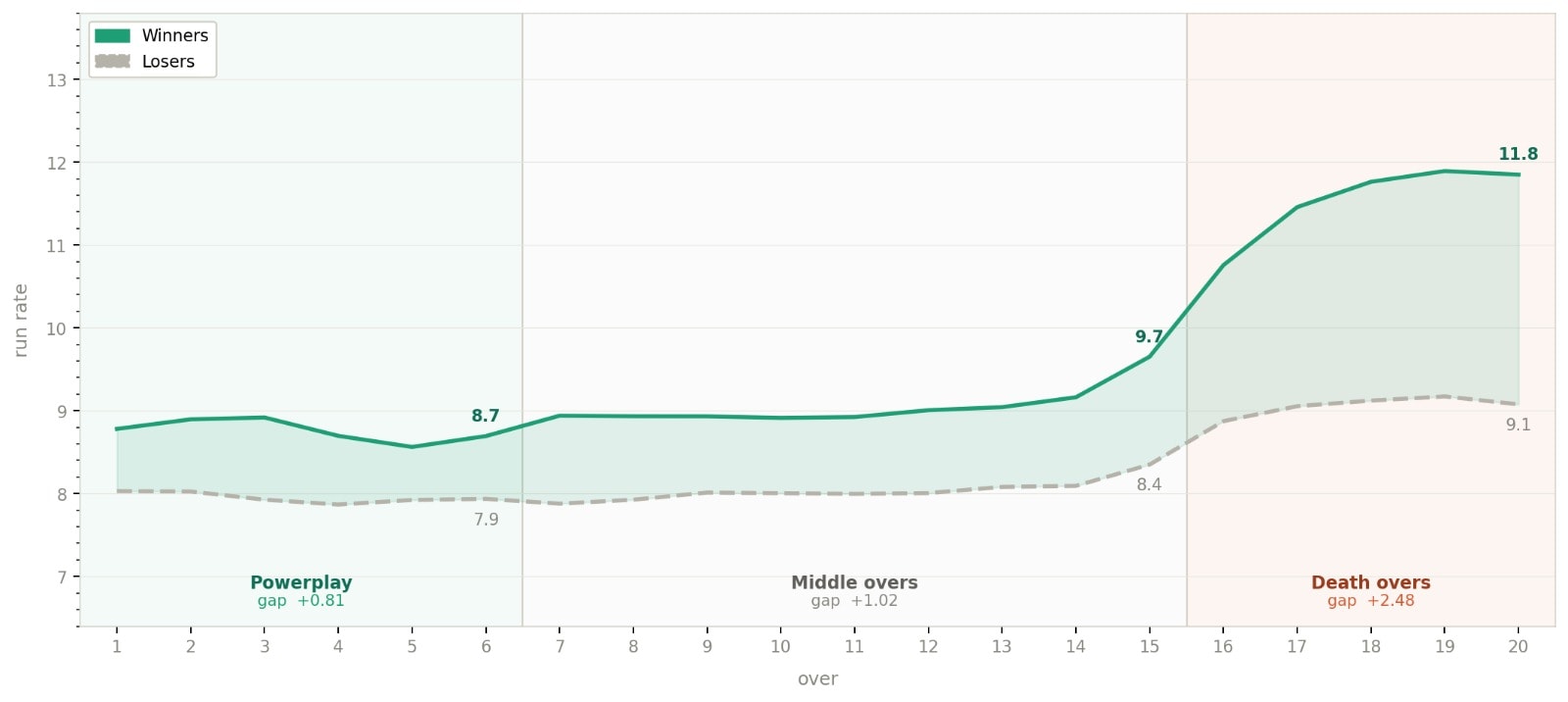
For a long time, received wisdom held that T20 cricket was decided at the death. Win overs 16 to 20, and you win the game. The data from recent seasons has quietly buried that idea. Winning teams in the powerplay run at 9.41. Losing teams run at 8.40. A difference of one run per over, compounding across six overs into a lead the rest of the innings, almost never overturns. Look at every final in this era (read the impact sub era), and the pattern holds without exception. Chennai Super Kings went at a run rate of 12.0 in overs one to six in the 2023 final. Kolkata Knight Riders matched that exact number in 2024. In both cases, the match was over before the powerplay fielding restrictions lifted. Winning teams also average 1 powerplay wickets lost (nearly). Losing teams average 2. It is the difference between momentum and damage control.
Protect the middle phase
If the powerplay is where teams build the lead, overs seven through fifteen are where they either consolidate it into something insurmountable or slowly bleed it away. Champions average 2 wickets in this phase. Teams that lose average nearly 3. Nearly a full wicket difference, and it decides which batting unit gets to the last five overs with options and which one gets there with prayers. The gap in run rate is equally stubborn. Winners score at 8.99, losers at 7.99. One extra run per over, eight extra runs across the phase. The 2025 final illustrated this cleanly. Punjab Kings matched RCB's powerplay almost ball for ball, then managed 67 in the middle against RCB's 77. Six runs across nine overs. Final margin: six runs. The middle overs were the entire match, hiding in plain sight.
Death bowling is not the finish line. It is the lock on the door.
Here is the number that surprises. The biggest run-rate gap between winners and losers across three seasons is not in the powerplay or the middle overs. It is in overs sixteen to twenty. Winning teams operate at 11.69 in the death. Losing teams sit at 9.12. A gap of 2.57 runs per over. This is what specialist bowling at the back end actually buys you. Bhuvneshwar Kumar this season: 26 wickets at an economy of 8.00. Kagiso Rabada: 26 wickets at 9.48. Same tally, entirely different match impact. The difference between 8.00 and 9.48 across four overs is roughly six runs. In a final, six runs is the trophy.The
Score more in boundaries than you concede
Sixes per hundred balls have climbed from 6.48 to 7.80 across last three seasons. The six-to-four ratio has moved from 0.51 to 0.57. Champions score 59.6% of their runs from boundaries against 56.7% for runners-up. That three-point gap sounds thin. Across a 175-run innings, it is five or six extra runs that cost zero in terms of wickets and put no pressure on the non-striker. Boundary efficiency is a quiet multiplier on every other advantage a team builds. Par has moved accordingly. The average innings score now sits at 184. A team posting 185 and defending it is, statistically, the house. Everyone else is gambling.
Win the match before the toss
Ten of the 18 finals were won batting first. Eight were won chasing. There is no pattern. No toss bias. No formula that resolves the bat-or-bowl question before a ball is bowled. What this means is that teams built for execution in both directions have a structural advantage over teams optimised for one mode. The 2023 final was decided chasing. 2024 was decided chasing. 2025 was decided defending by six runs after the other side nearly pulled off the impossible. In each case, the winning team was not executing a plan designed around the toss. They were executing their plan regardless of it. Any franchise can buy a Rabada or build a Kohli-anchored lineup. Very few can make those assets equally dangerous with bat or ball, first innings or second, 185 to defend or 185 to chase.
Tonight in Ahmedabad, Gujarat Titans and Royal Challengers Bengaluru will spend forty overs finding out which of these rules breaks first. Gill and Sudharsan need a powerplay that does not repeat Dharamsala. Patidar and co. need a middle that holds even if the top order flickers. Bhuvneshwar needs a death spell that locks the door so tight no key exists. The recipe is not a secret. Everyone can read it. The hard part, the only part that separates champions from the rest, is executing it under 1,32,000 people on the biggest night of the year, with every ball broadcast to a hundred million more. That is why they play the match.


