It's the last ball of a semi-final match. The star batsman needs at least 4 runs for his team to qualify for the final. He adjusts his leg pad once, twice, a third time; the left-handed fast bowler mutters under his breath. The batsman smiles, but not for long. The following ball bowls him out. Teeno dandi gul (All three stumps gone).After a split-second of deafening silence, the fielding team breaks into a jig. The batsmen march towards the umpire, yelling. Large sections of the crowd weigh in too, insisting it was a No Ball. After 10 minutes of this, the umpire turns to face the audience, holds both his ears and apologises for a faulty decision. It was a No Ball, he says sheepishly. The bowling team curses at the umpire, but eventually returns to their fielding positions. This game is being played in Ralegan Therpal village, Ahmednagar district, Maharashtra, as part of the Ralegan Premier League. The league is a 6-over, inter-village game launched in March, with 29 games played between 16 teams over five days, for a grand prize of Rs 16,000.
This game of the Ralegan Premier League, launched in Maharashtra in March, started an hour late because the organisers could not convince a local goatherd to move his goats away from the pitch. (Photos: Arijit Sen)Across the country, similar 'premier leagues' have sprung up at the village level over the past five years, inspired by the eight-year-old Indian Premier League. In Bilimora, Gujarat, there is the Sai Cup Cricket League, now in its second year; Gopal Khera in Uttar Pradesh has the Durgesh Singh Premier League, named in honour of the main sponsor, at the suggestion of the sponsor himself. The bigger leagues include the Junnar Premier League, launched in 2012 in Khed district, Maharashtra, and the Indian Gramin Cricket League (IGCL) in UP's Lucknow district, where 100 villages play each other for prestige, the thrill of winning, and a bicycle for each member of the winning team.
The Facebook page of the Indian Gramin Cricket League.While informal and semi-formal cricket tournaments have always been played at the village and district level, the leagues format is new and has become the rage because of its more entertaining short format and the glamour of a sponsored team with competing logos, posters, uniforms and even mottos such as 'We born to win'. All matches are played with tennis balls, and are 6 to 12 overs long. At the 'venues', the audience sits in groups under and in trees. Most of these matches are held in summer, timed to coincide with the Indian Premier League and the school vacation, but the commentators are the only ones with shelter - usually a cloth 'tent' propped up by poles. Despite the sweltering heat, crowds of about 500 show up for the smaller leagues' matches, and thousands travel from nearby towns and villages to root for their teams in the larger leagues such as Junnar and IGCL. There is an online audience too. "The Junnar Premier League is Maharashtra's most popular, with each game getting up to 100,000 hits," says Santosh Nanekar, a Mumbai resident and founder of two-year-old website tenniscricket.in, which covers local cricket tournaments and offers online coverage of six village leagues in the state. "Hits for the other leagues range from 200 to 20,000 per series. Most of our users are internet mobile users." The prestige that attaches itself to the players and even the umpires and commentators is considerable. Audience members frequently announce spot prizes of up to Rs 1,000 for best commentary, best hat-trick or best six, etc. 'Icon players' - the ones exchanged between teams, with verbal contracts that are hotly negotiated - get hundreds of likes for photographs they post on Facebook, and have crowds of youngsters asking for photographs and even autographs, starry-eyed at the thought that they might be looking at a future IPL player (a couple of village-level players have made that transition). This glamour rubs off on the happy sponsors too. "People from 16 villages know who I am now," says Singh of Gopal Khera, a businessman who runs hotels and pathology labs in villages near Lucknow. "I want to one day see players from here playing in the Indian Premier League."On the map
{{/usCountry}}The Facebook page of the Indian Gramin Cricket League.While informal and semi-formal cricket tournaments have always been played at the village and district level, the leagues format is new and has become the rage because of its more entertaining short format and the glamour of a sponsored team with competing logos, posters, uniforms and even mottos such as 'We born to win'. All matches are played with tennis balls, and are 6 to 12 overs long. At the 'venues', the audience sits in groups under and in trees. Most of these matches are held in summer, timed to coincide with the Indian Premier League and the school vacation, but the commentators are the only ones with shelter - usually a cloth 'tent' propped up by poles. Despite the sweltering heat, crowds of about 500 show up for the smaller leagues' matches, and thousands travel from nearby towns and villages to root for their teams in the larger leagues such as Junnar and IGCL. There is an online audience too. "The Junnar Premier League is Maharashtra's most popular, with each game getting up to 100,000 hits," says Santosh Nanekar, a Mumbai resident and founder of two-year-old website tenniscricket.in, which covers local cricket tournaments and offers online coverage of six village leagues in the state. "Hits for the other leagues range from 200 to 20,000 per series. Most of our users are internet mobile users." The prestige that attaches itself to the players and even the umpires and commentators is considerable. Audience members frequently announce spot prizes of up to Rs 1,000 for best commentary, best hat-trick or best six, etc. 'Icon players' - the ones exchanged between teams, with verbal contracts that are hotly negotiated - get hundreds of likes for photographs they post on Facebook, and have crowds of youngsters asking for photographs and even autographs, starry-eyed at the thought that they might be looking at a future IPL player (a couple of village-level players have made that transition). This glamour rubs off on the happy sponsors too. "People from 16 villages know who I am now," says Singh of Gopal Khera, a businessman who runs hotels and pathology labs in villages near Lucknow. "I want to one day see players from here playing in the Indian Premier League."On the map
{{/usCountry}}Back in Ralegan…A strip of land has been cleared on local villager Ananda Supekar's 1-acre farm, by the tractor of another farmer, Mahesh Karkhile. Cement has then been poured on the strip to create a yard-long space exactly half the size of an actual pitch; local transporter Santoshsheth Babanrao has footed the bill for this work.All these names, including that of village sarpanch Satishsheth Gadilkar, who contributed Rs 8,000 to the Rs 16,000 grand prize, and Arun Eknath, a local activist who pledged Rs 501 as the prize for best catch, are printed on a foot-long and extremely text-heavy poster. The posters can be seen everywhere in the village, from the walls of houses to the stores and also on the farm ground. "This is our crucial publicity tool and the reason why most sponsors sign on - to read their names on the posters," says match organiser Satish Jinjerke, 25, who spends the rest of the year as a pharmaceutical salesman on the outskirts of Pune city. "The league-format matches have become quite popular in the villages around Pune. I thought that it would be nice to have one in my home village. I started gathering sponsors in January and coaxing people in the village to contribute. Most people were willing, but not all the funds promised have been turned in…" Today's game has begun an hour late. Jinjerke has had trouble coaxing a local shepherd to lead his grazing goats out of the boundaries. Working five days a week while seeking sponsorships and making logistical arrangements for a league is tough, Jinjerke says, "but I wanted to do it anyway. I love cricket." Fame and FortuneMost teams are owned and most prizes sponsored by local politicians, groups of village elders, and affluent local sheths, usually landlords, small businessmen or traders. Others sponsor the 'infrastructure' such as tractors, lights and the canvas shelters under which commentators are seated. "The aim is to provide entertainment for the villagers and offer a platform where village youngsters can showcase their talent," says Deepak Mandale, a cricket coach in Pune and a well-known commentator. Across UP and Gujarat, most matches are conducted at night so that even those with jobs or fields to tend can take time out to watch the games; also, the afternoon heat in summer is prohibitive. When prize money is not available, winners take home motorcycles or even bicycles. Sometimes, prize money is accompanied by wristwatches or water purifiers. "Inspired by the T20 format, these games are even shorter and faster-paced, with multiple games played in a single sitting," says Amol Sonavne, founder of CricketGraph.com, which tracks local matches and IPL-style leagues across the country.
Meet the ownersEngineer Vishal Gaikwad from Kokhodi village and mobile repair shop owner Aadesh Korde from Babhulvad village, both in Ahmednagar district, Maharashtra, own teams in the Ralegan Premier League. Their names appear on the RPL posters as well. And their players wear T-shirts with their names and photos on them. In exchange, they provide the players with food, transport (usually one jeep in which all 13 players are crammed together) and the league registration fees of Rs 1,001. "If my team wins I will be the happiest person, as not just people in my village but even in villages far away will know me as the owner of the winning team," says Gaikwad.
The commentators’ pavilion during a game in Maharashtra.The owners play the crucial role of selecting players from the village and securing 'icon players' for their teams. Icon player Satish Gawde, 35, a school teacher from Shirur village, played for the Kokhodi village team after the latter's owner Vishal Gaikwad agreed to pay him and his brother, a doctor, a total of Rs 3,500 a day for a three-day series. "For two years, I have been playing about five games a month from March to June and December to February," says Gawde, a self-taught player who has been nicknamed Romance of Cricket for his graceful batting.
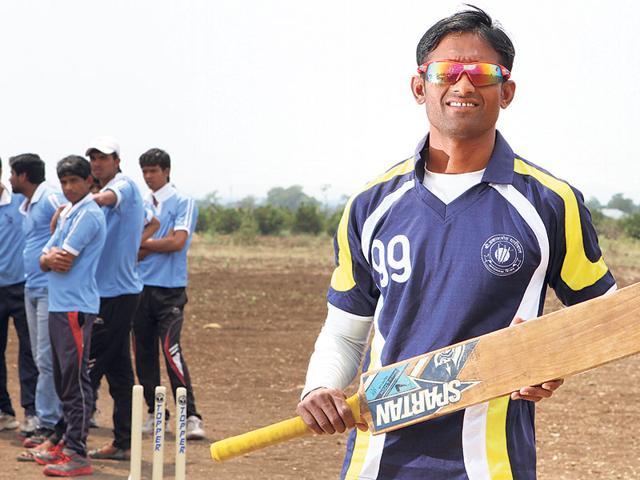
Aside from the 'contract fees' and special prizes for spectacular fours, sixes, hat-tricks and catches, Gawde has earned large sums in prizes declared on the spot by thrilled members of the audience. "I have been making about Rs 4 lakh a year playing these village matches," he says. He has spent part of this money on a second TV set and refrigerator for his home. "I have been able to save my entire salary in these months," adds Gawde, whose cricket photographs get about 200 likes each on Facebook. Organisers also use WhatsApp to 'broadcast' games to distant villages and beyond, sending out live scores to fan groups. "People are continuously WhatsApping even while a game is on, because so many people want to know what is happening in the match," says batsman Ganesh Jadhav, 34. He has been nicknamed God of Cricket, a nod to his resemblance to Sachin Tendulkar "in face and voice".
Ganesh Jadhav, 34, is popularly known as God of Cricket because of his resemblance to Sachin Tendulkar ‘in face and voice’.Many of these leagues also have dedicated Facebook pages where fans and organisers upload short video clips of the games. Videos are also uploaded on YouTube. Technology is coming to the rescue in other ways too. To prevent a badgering of umpires as in the Ralegan Therpal game, some leagues have introduced a 'third umpire' in the form of a laptop that records the match live and can offer footage for review. "We just wanted to put an end to the constant fighting between umpires and players," says Avinash Mate, chairman of Shri Pandurang Sports Club in Nimgaon Sawa that organises the Junnar Premier League.