India's 3-1 ODI series victory over New Zealand offered plenty of encouragement for the bowling attack, but the batting numbers revealed a vulnerability that the team management cannot afford to overlook ahead of the ODI World Cup 2027. The returns from the top four were inconsistent, with Rohit Sharma and Virat Kohli's struggles particularly conspicuous.
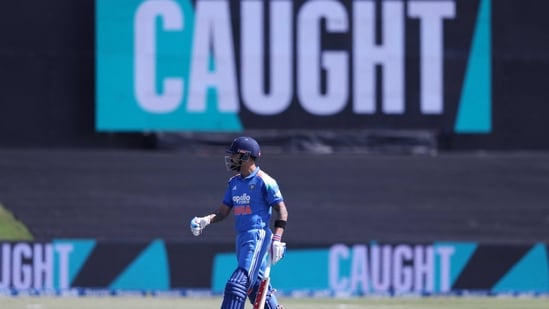
Rohit finished with 30 runs from 4 innings at an average of 7.50, with scores of 0,23,0 and 7 respectively. Kohli managed 86 at an average of 21.50, but that figure has come mainly because of his 74-run knock in the first ODI. His next three innings, the former India captain scored just 12 runs, with returns of 7, 0 and 5.
Together, India's two most experienced ODI batters accumulated 116 runs in 8 innings at a combined average of 14.50. More tellingly, Kohli's 74 accounted for nearly 64% of their combined tally. Take that one innings out, and the pair managed just 42 runs across seven innings.
The concern is not merely the absence of big scores. It is the lack of consistency from two batters expected to provide the foundation to India's innings, particularly when conditions favour the new-ball bowlers.
The problems, however, have gone beyond Rohit and Virat, as the top order consistently failed to score runs.
{{/usCountry}}The problems, however, have gone beyond Rohit and Virat, as the top order consistently failed to score runs.
{{/usCountry}}Shubman Gill, who featured in the first two matches, scored 37 runs at an average of 18.50. Shreyas Iyer managed 67 in four innings at 16.75, while Ruturaj Gaikwad, who replaced Gill for the final two matches, scored 23 at 11.50.
Across the four completed ODIs, these five players, who rotated through India's four top-order positions, contributed 243 runs. That amounts to approximately 15.2 runs per top-four batting slot.
Last two matches expose problems
The first two ODIs were shortened by rain and decided through the DLS method, while the third was abandoned without a ball being bowled. The final two matches, thus, offered a more substantial examination of India's batting.
The results were very concerning. In the fourth game, India were bowled out for 89, while chasing 334. Rohit, Kohli and Iyer fell for ducks, while Gaikwad made five. India's top four managed just five runs between them, with Matt Henry claiming six wickets for 27.
The final ODI brought little improvement. Rohit and Virat scored 7 and 5, while Gaikwad and Iyer scored 18 and 22. The top four managed 52 runs, leaving Axar Patel and Ishan Kishan to provide the resistance, scoring 46 runs each.
India's top four contributed 57 runs across the two games. The contrast with the lower order was stark: Axar and Kishan alone scored 92 between them in the fifth ODI.
It also highlights an important distinction. India did not simply lack a century or a substantial partnership. They repeatedly lost wickets early, forcing a full collapse, or leaving the middle order to rebuild rather than capitalise on a settled platform.
ALSO READ: The bowlers were up to the task in challenging ODI series: Shreyas Iyer
The World Cup warning
Beyond the numbers, the Indian top order's struggle against New Zealand exposed a technical challenge that could resurface at the ODI World Cup 2027. The likes of Rohit, Virat, and Iyer found it difficult to negotiate the pace, bounce and early movement, with New Zealand's seamers repeatedly exploiting uncertain footwork.
Gautam Gambhir acknowledged the difference in batting conditions from home after the fourth ODI. "In India, the easiest time for batting is the first 10-15 overs. Here it's probably the hardest time," the India head coach said.
The head coach described New Zealand's conditions as the "closest India could expect to encounter at the World Cup". With South African pitches also capable of offering pace and bounce, the ability to judge lengths early, make decisive footwork, and play shots according to the movement and bounce in the opening overs will be crucial.
India have nearly a year to work on those aspects, but the New Zealand series has raised a question worth pondering: if their top order consisting of the likes of Rohit Sharma and Virat Kohli can be unsettled so consistently by quality pace in seam-friendly conditions that could resemble those in South Africa, how well prepared will they be when the stakes are considerably higher?