


 Live Score
 Teams
Teams Players
Rod Marsh, Australia's keeper of faith departs after memorable innings
Caught Marsh bowled Lillee appeared 95 times, still a world record.

 Prefer HTon Google


Rod Marsh is flying. Gary Gilmore is in his follow-through, Tony Greig is looking back, presumably perplexed at the unfolding acrobatics. Ian Chappell is ready, his hands still in the catching position, eyes fixed on the ball, a bent right knee indicating the anticipation for what should be a regulation catch at the first slip. But, Rod Marsh is flying.
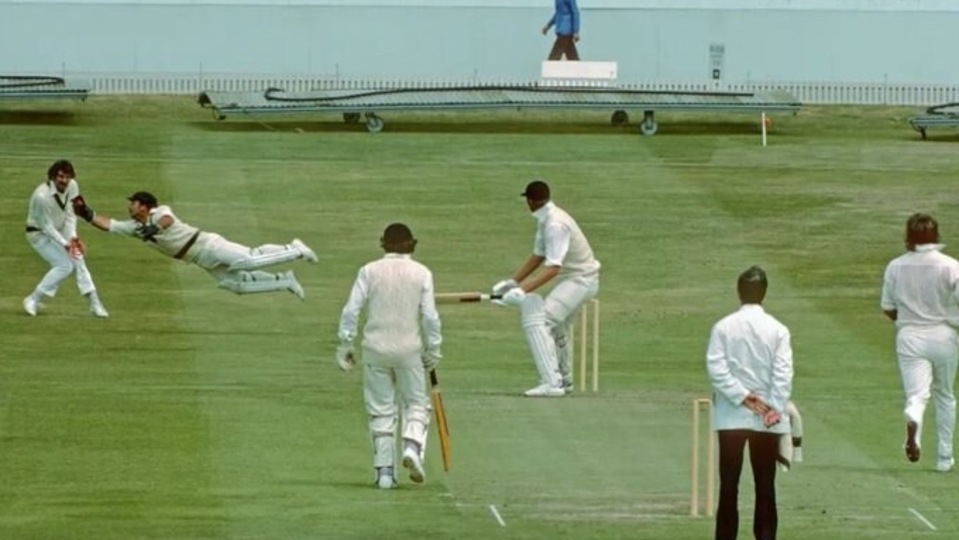
His left hand is bent at 90 degrees, his legs ramrod straight. The flight path is unhindered, the take-off smooth. The outstretched left hand has grabbed the ball— in the webbing of the glove, between the index finger and thumb, literally under Chappell's nose. Poetry in motion and whatnot. This was 17 years before Jonty Rhodes’ ‘is it a bird, is it a plane’ run out of Inzamam-ul-Haq. If there ever was a picture worth a thousand words, this, shot by Patrick Eager, starring Rodney William Marsh in full pomp, should be it.
Greig would go on to build a distinguished career as a commentator, and one can only imagine the magic his mesmerising lilt would have created if he were calling that grab. Nothing, however, can possibly match Chappell's take. “Listen you fat b....d, catches on my right are mine,” I told him during the celebration. That’s one reason our friendship endured: We both made our points clearly,” Chappell, who led Australia in that match at the 1975 World Cup, wrote in ESPN on February 27.
Marsh, 74, passed away this morning after suffering a massive heart attack in Queensland last week. He was in induced coma at Royal Adelaide Hospital until death.
Born in the Western Australian suburb of Armadale in Perth, Marsh made his first-class debut in 1968-69 and two years later, was picked by the Don Bradman-led selection panel for the home Ashes.
He played 96 Tests in a 14-year career, effecting a then-world record 355 dismissals. He kept to the likes of Dennis Lillee and Jeff Thomson with aplomb, and formed a particularly potent combination with Lillee, often anticipating swing and bounce to make barely believable catches look di rigueur. Not surprisingly, ‘c Marsh b Lillee’ appeared on scoreboards 95 times, a record that still stands. The next best pairing — ‘c Gilchrist b McGrath’ — is five short. In what can only be termed a poignant quirk, Lillee too ended his career with a then-world record 355 dismissals, making sure the number remains inextricably linked to him and Marsh.
Marsh was no slouch with the bat either, scoring 3633 Test runs with three centuries. He also featured in 92 ODIs, where his 124 dismissals were accompanied by 1489 runs, scored at an ahead-of-its-time strike rate of 82.26.
However, like all men and women of substance, Marsh's life cannot, and should not, be defined by sheer numbers alone. He was an Aussie icon, a harbinger of an era of brawn, where hirsute heroes went about their business in unbuttoned shirts and rolled-up sleeves.
Sporting a mean walrus moustache, a slightly ungainly girth, and an unruly mop of hair that jutted out of his baggy green in the most devil-may-care fashion — as if to purr, ‘hair gels are for sissies’ — Marsh was the alpha male before the term became a thing. With Lillee, Thomson, Chappell brothers, and Doug Walters, he was part of a generation that heralded a cultural shift in Australian cricket, making them the only real rivals of the generation-defining West Indies team.
For all his perceived machoism and a tough-as-nails exterior, Marsh remained committed to his integrity and principles. In the 1977 Centenary Test at the MCG, where his unbeaten ton in the second innings helped Australia set England a target of 463 runs, he memorably called back Derek Randall after the England batter was adjudged out to a catch that Marsh knew was not clean. Randall was batting at 161 then.
Four years later, Marsh made his displeasure clear when Greg Chappell asked younger brother Trevor to bowl underarm against New Zealand. “Don’t do it, no mate!” Marsh is reported to have said, shaking his head in disagreement.
Marsh hung his boots after the 1984 Test against Pakistan in Sydney, along with his partner-in-crime Lillee and Greg Chappell.
Post-retirement, he took over as the director of the Australian Institute of Sports cricket academy in Adelaide, where his keen eye unearthed a generation of future Aussie legends, including Ricky Ponting who he marked for impending greatness.
In 2001, Marsh joined England and Wales Cricket Board’s cricket academy, and a year later, became their national men’s team selector, thus playing a key role in England’s famous 2005 Ashes win. He also served as Australia’s national selector for the men’s team (2014-16).
Marsh is a member of the Australian Cricket Hall of Fame, Sport Australia's Hall of Fame, and the ICC Hall of Fame, and is also a recipient of the Order of the British Empire. He is survived by wife Roslyn and sons Daniel, Paul, and Jamie.


