Indian cricket loves the all-rounder. It has spent years discussing what Ravindra Jadeja allows a Test XI to do, how Hardik Pandya changes the construction of a white-ball side, and how precious a cricketer becomes when one selection can solve two, sometimes three, problems at once. Balance is among the most frequently used words in the game.
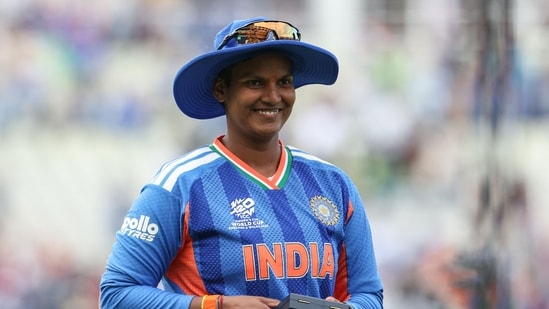
For more than a decade, Indian women's cricket has had a player who has provided precisely that luxury. Deepti Sharma has opened the batting, occupied the middle order, repaired collapses, finished innings, taken the new ball, strangled teams through the middle overs, bowled when batters are swinging at the death and remained one of India's sharpest fielders. The assignment has changed repeatedly. Deepti has rarely disappeared.
On Sunday night in Dubai, another number arrived to put a measure on that remarkable longevity. Playing her 150th T20I, Deepti returned scarcely believable figures of 3/0 from 1.1 overs as India dismissed Thailand for 65 and won their Women's Asia Cup opener by 94 runs. The third wicket took her to 171 in T20 internationals, making her the highest wicket-taker in the history of the format.
Yet even 171 tells only part of the story. Deepti had already moved beyond former teammate Jhulan Goswami's 355 wickets in June to become the highest wicket-taker across women's international cricket. Her latest three wickets have taken that overall collection to 362: 25 in Tests, 166 in ODIs and 171 in T20Is.
{{/usCountry}}Yet even 171 tells only part of the story. Deepti had already moved beyond former teammate Jhulan Goswami's 355 wickets in June to become the highest wicket-taker across women's international cricket. Her latest three wickets have taken that overall collection to 362: 25 in Tests, 166 in ODIs and 171 in T20Is.
{{/usCountry}}The record has changed hands. What it should really change, however, is the way Deepti Sharma is discussed.
Before the wickets, there were runs
Perhaps nothing explains Deepti's career better than a statistic that now feels almost misplaced beside her name. Long before she became the most prolific wicket-taker women's international cricket has seen, she was a teenage opener capable of producing one of the most extraordinary batting performances in the game's history.
In May 2017, at only 19, Deepti hammered 188 against Ireland in Potchefstroom. Alongside Punam Raut, she put on 320 for the first wicket, at the time the highest partnership for any wicket in women's ODIs and the first 300-run stand in women's international cricket.
The significance today is not simply that Deepti could once bat higher up the order. It is that India possessed a player capable of making 188 as an opener and subsequently asked her to remodel herself around the requirements of the team. As the years passed, batting positions moved. Responsibilities changed. Her bowling became increasingly important. Eventually, the off-spinner who had begun as one useful component of an unusually broad skill-set became one of India's primary weapons.
There was no dramatic reinvention announcement. Deepti simply kept adding. Her wicket-taking accelerated rather than merely accumulated. When she overtook Jhulan earlier this year, the numbers showed that 110 of her first 167 T20I wickets had arrived since the beginning of 2022. In ODIs too, 97 of her 166 wickets had come from 2022 onwards. This was not simply a longevity record being approached by someone surviving on past excellence. Deepti had become more productive as her career matured.
The cricketer India can move anywhere
The easiest way to underestimate Deepti is to call her an off-spinner who can bat. India have rarely had the luxury of defining her so narrowly. She has been a frontline bowler and a genuine batting option simultaneously, while her fielding has remained another independent source of value. When India coach Amol Muzumdar jokingly called her the team's “Ben Stokes” after the 2023 Test against England, the comparison came after a performance that almost sounded manufactured to demonstrate the meaning of an all-rounder.
Deepti scored 67 in India's first innings and then destroyed England with 5/7. She added four more wickets in the second innings to finish with 9/39 as India completed a 347-run victory, then the biggest by runs in women's Test cricket. A few months later came another reminder in an entirely different competition. In the 2024 Women's Premier League, Deepti scored 295 runs at an average of 98.33 and a strike rate of 136.57 while also taking 10 wickets. Against Delhi Capitals, she made 59 and claimed 4/19, becoming the first woman to combine a fifty and a hat-trick in the same T20 match.
This is the unusual thing about her career. Remove one part of Deepti Sharma's game and there is still enough left to construct a serious international cricketer. For much of her career, that versatility has perhaps worked against the size of her reputation. Specialists are easier to define. A devastating opener owns the highlights when she scores a hundred. A strike fast bowler owns the moment when she blows away a top order. Deepti's value has often existed in less glamorous territory: the partnership that needs rebuilding, the four overs that have to be found, the dangerous middle phase that needs controlling, the breakthrough after a stand develops, the extra batting depth that permits another tactical choice elsewhere.
Those contributions do not always create posters. They win a remarkable number of cricket matches. Then came the World Cup that made ignoring her impossible
If Deepti's career needed one tournament to compress all of its qualities into an irresistible argument, the 2025 ODI World Cup provided it. India won the Women's World Cup for the first time. Deepti finished as its leading wicket-taker with 22 wickets and also scored 215 runs. No cricketer, male or female, had previously combined more than 200 runs and 20 wickets in a single ODI World Cup. She was named Player of the Tournament.
And when India reached the biggest game their women's team had played, their serial problem-solver solved two more problems. Against South Africa in the final, Deepti made 58 with the bat and then took 5/39 with the ball. India's maiden World Cup triumph had many architects, but the tournament's defining all-rounder had reserved her most complete performance for its final night.
Harmanpreet Kaur later revealed something revealing about Deepti's journey. India had been telling her for years that she possessed “something special”, reminding her that she could influence matches with bat, ball and in the field. Harmanpreet felt that Deepti sometimes held herself back and did not always believe sufficiently in the extent of her own ability. Perhaps that explains part of the strange relationship between Deepti and acclaim. For years, there was very little theatre about her greatness. She simply turned up, accepted the next task and accumulated evidence. Eventually, the evidence became overwhelming.
There are the 362 international wickets now. There are 171 in T20Is, more than any woman to have played the format. There is the 188 as an ODI opener, the nine-wicket Test, the WPL season in which her batting exploded, the World Cup in which she became its leading wicket-taker and Player of the Tournament, and the final in which India needed an all-round performance and received 58 runs and five wickets.
Sunday's record, therefore, should not be viewed as the moment Deepti Sharma became one of the greats of Indian cricket. It is merely another marker telling everyone how far down that road she had already travelled. For years, whenever India found a hole in their XI, Deepti was among the players asked to fill it. The batting position could change. The phase in which she bowled could change. The format could change. Even the version of Deepti Sharma that India required could change. The one thing that rarely did was her presence. At 362 wickets and counting, perhaps the quiet constant has finally produced a number loud enough for everyone to hear.