For Nazma, watching Jemimah Rodrigues pull off a historic run chase against Australia in the Women's World Cup semi-final was more than just witnessing a match-winning innings. It was a moment that prompted her to put into words a longing she had been carrying for years.
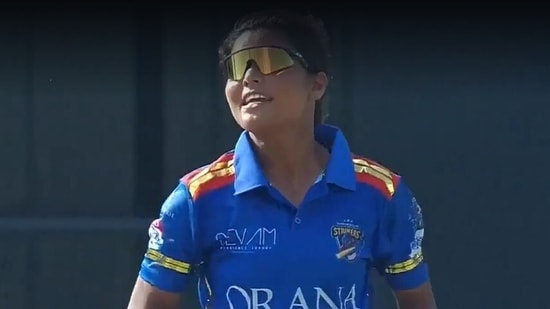
She took to social media to message the India batter, telling her that she too wanted to play on that stage, alongside those players and win matches for her team. Little did she know that the message would eventually become part of a story that came full circle when Delhi Capitals picked her at the Women's Premier League (WPL) auction.
"That match was so inspiring for me. I watched the whole match. Jemimah took care of the team and played a responsible innings in such a pressure situation. She was short of runs and confidence, but when I watched that match, I felt that I have to do the same for my team," Nazma told reporters in a virtual media interaction.
Her largely inactive instagram account suddenly saw some activity as she posted a story about Rodrigues and sent her a message expressing her ambition.
{{/usCountry}}Her largely inactive instagram account suddenly saw some activity as she posted a story about Rodrigues and sent her a message expressing her ambition.
{{/usCountry}}"I messaged her saying that I also want to play on that stage. I also want to play among these players and win matches for my team. I know that I am made for the stage. One day, I will play with these players and win matches for my team," she said.
Rodrigues responded warmly, even reposting the message when she was acquired for ₹30 lakh. The two subsequently spoke on Instagram. The journey to the WPL signing, however, has been anything but straightforward. It has taken her nearly 12 years, multiple state changes, long spells on the sidelines.
For the first five or six years after taking up cricket, Nazma spent more time on the bench than on the field. Initially a medium-pacer, she was struggling to find opportunities when a suggestion to move to Nagaland changed the course of her career.
Her father, who had played cricket and kabaddi during his college days, was initially hesitant. But Nazma convinced him that there was little point practising throughout the year without getting a chance to play.
"My dad had one condition that I shouldn't bowl there, I should bat. When I went to Nagaland, I gave a trial as a batter. It went well," she recalled.
Nazma made her U-23 and senior debuts for Nagaland, scored her first century and made an unbeaten 121, which she remembers as the state's highest score at the time. A registration issue during the COVID period, however, meant she could not continue representing Nagaland.
She subsequently spent a season with Uttarakhand before returning to Delhi. Even then, opportunities were hard to come by. An accident ruled her out of the T20 set-up, and although she made the one-day squad, she was not getting regular chances. Instead of allowing frustration to take over, she began using her time on the bench to study the game.
"I could understand how to bat and what the batter in the middle was doing. I feel I gained more maturity by sitting outside and learning the game," she said.
The Delhi Premier League eventually became her turning point. Her performances caught the attention of the coaching staff, and she gradually established herself in both the T20 and one-day teams.
In her first DPL season, she picked up 4 wickets in three matches at an economy rate of 5.12. She topped it up with 12 wickets in seven matches – the most by any bowler – at an economy rate of 6.17.
Through the uncertain phases, her family remained her strongest support system.
“They told me that if I wanted to do something in my life, it would be my achievement. They could only give me the freedom to do it and show me their trust,” she said. "Our house is not very big, but whenever I bring home a trophy, my mother makes a place for it near the Quran," she said.
“They (parents) started their journey of life from zero, but they never let my brother and me feel their struggles. There is a sense of responsibility that we have to do something for our parents.”
"Initially, I used to live for my parents. But now I also want to make a name for myself. I want people to consider me an idol.”
Now, with the WPL opportunity, Nazma is looking to make the most of the stage she once imagined herself playing on.