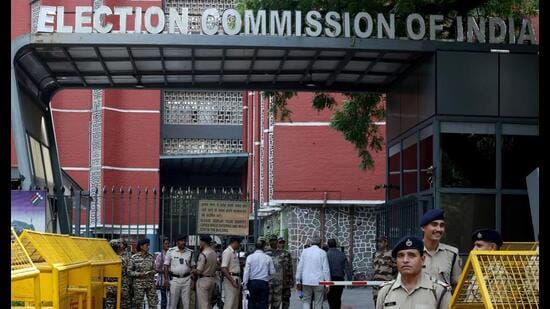
The Election Commission of India (ECI)’s affidavit in the Supreme Court highlights the consensus and unanimity behind the poll body’s decisions, and argues that its intentions behind ordering both the special intensive revision (SIR) and several changes in the contentious exercise were honourable and in line with its constitutional remit. The reply, which goes some way towards clarifying the motives of the body, leaves key procedural changes unexplained.
On SIR, the affidavit says all decisions were taken unanimously by three election
The Election Commission of India (ECI)’s affidavit in the Supreme Court highlights the consensus and unanimity behind the poll body’s decisions, and argues that its intentions behind ordering both the special intensive revision (SIR) and several changes in the contentious exercise were honourable and in line with its constitutional remit. The reply, which goes some way towards clarifying the motives of the body, leaves key procedural changes unexplained.
On SIR, the affidavit says all decisions were taken unanimously by three election commissioners (ECs) and that suggestions, queries, or objections during deliberations didn’t count as decisions. It clarifies that letters by two ECs to the cabinet secretary concerned an internal work order that was never implemented after another July 30 decision. On the question of motive, ECI presents a credible case. But it never answers procedural queries around who ordered the changes, whether objections raised by ECs were addressed, or how the constant tweaks in SIR procedure evolved.
On Form 6, the statutory application used for enrolling new voters, ECI said the additional declaration was a separate document, and not a modification of the requirements laid down under the Registration of Electors Rules, 1960. But its admission that the way it appeared online “could be construed as though an amendment of Form 6 had been made” and that “certain steps taken by the officers” needed “to be corrected” raises more questions, especially against the backdrop of earlier ECI communication that said the “declaration attached to Form 6 for SIR has been upheld by the Hon’ble Supreme Court”. This newspaper has reported that the declaration before the apex court was a different one. On West Bengal, ECI admitted that the state chief electoral officer (CEO) filed 1.6 million appeals before judicial tribunals to delete voters. But it doesn’t answer who authorised these appeals or whether each case — already cleared by a judicial officer — was individually evaluated.
Motives are important (apart from being the focus of protests and legal challenges by the opposition parties). But equally important are procedures and deliberations that formulate them. For a gargantuan exercise such as SIR, procedural hardships can make the difference between holding the right to vote and losing it. Procedural violations can have real-world consequences, seen most tragically in Bengal where 2.71 million people were disenfranchised for simply running out of time. In recent weeks, ECI has done well in simplifying processes and relaxing onerous conditions for verification, but it cannot elide the questions raised by the harassment of millions of ordinary Indians, who deserve a fuller and more transparent explanation. As the custodian of the world’s largest democracy, ECI must aspire to a higher standard and set the record straight.
One Subscription.
Get 360° coverage—from daily headlines
to 100 year archives.
Archives
HT App & Website