Delhi’s air quality has worsened to alarming levels with the onset of winter. Besides obvious methods to control air pollution, one solution that has long-term benefits could be a change in modes of transportation. Of these, a workable though (initially) expensive initiative would be electric vehicles (EV).
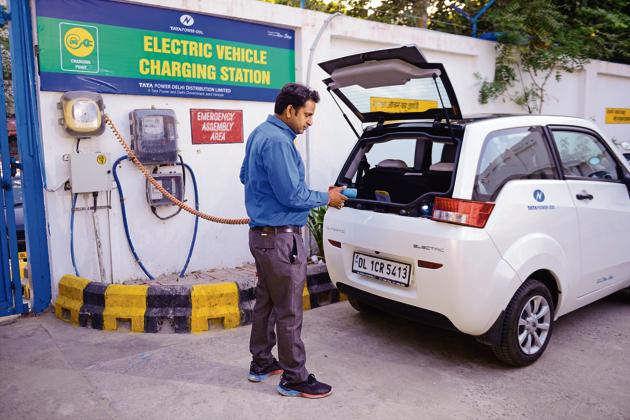
The cost of buying vehicles and setting up support infrastructure is prohibitive– the global estimate by Goldman Sachs is six trillion dollar for infrastructure. This remains the biggest barrier to EVs becoming more accessible for a country such as India. But the economic and social costs of pollution are now so severe that drastic remedial measures and long-term plans are called for. Much like any new product, its production and operation cost will automatically go down as the demand goes up.
China, with almost half the world’s sales of EVs, is way ahead of others with its policy of making it mandatory for automakers to include EVs in their output. Tesla, with its cheaper models, is expected to make a further push in the US market; among the European markets, Norway is leading the way, where almost one-third of new car registrations are EVs. The country has been a few years ahead of others when it comes to adopting EVs, primarily because the Norwegian government allowed exemptions on import tax and VAT, waived road tolls and allowed EVs to bypass normal traffic and use bus lanes. By 2025, Norway will also not register vehicles that use fossil fuel. Other countries are jumping onto this bandwagon too.
India, unfortunately, is far behind. The Nation Electric Mobility Mission Plan, 2013, envisaged five to six million electric and hybrid vehicles by 2020 but, as of now, Mahindra and Suzuki are the only Indian manufactures that have announced their EV plans. (India has only 10 electric/hybrid car variants to choose from, compared to 54 in the US and over 100 in China.)
{{/usCountry}}India, unfortunately, is far behind. The Nation Electric Mobility Mission Plan, 2013, envisaged five to six million electric and hybrid vehicles by 2020 but, as of now, Mahindra and Suzuki are the only Indian manufactures that have announced their EV plans. (India has only 10 electric/hybrid car variants to choose from, compared to 54 in the US and over 100 in China.)
{{/usCountry}}Electric vehicles have obvious benefits; the reduced emissions during their lifetime outweigh the environmental effects of the production and end-of-life phases. Also, with less than a third of the parts of regular cars, electric models are comparatively easier to manufacture. Their tank-to-wheel efficiency is three times higher than internal combustion engine vehicles, and they do not emit carbon dioxide and pollutants like NOx, non-methane hydrocarbons and particulate matter. Additionally, they provide smoother operation, with less noise and vibration. A push for EVs could help reduce the toxins we breathe. The annual smog blanket over our cities is motivation enough.