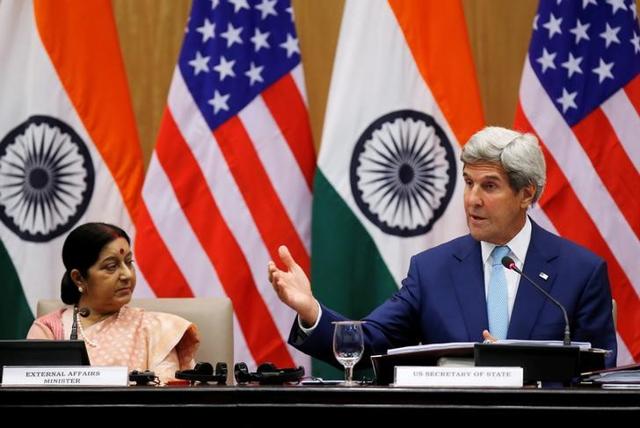
Declaring there is no distinction between good and bad terrorism is a favourite expression of statesmen around the world. United States Secretary of State John Kerry said it in New Delhi on Tuesday, his Iranian counterpart echoed this in Tehran at about the same time, Russian leader Vladimir Putin made the same case earlier this month – and the list goes on and on. Unfortunately, in almost every case the government or even individual has a different definition of who is defined as a “terrorist.” New Delhi is no different. For example, Mr Kerry’s government puts Hezbollah in Lebanon, a political movement who uses terrorist tactics, on its blacklist. No Indian official or leader would ever say the same. In any case, mouthing this expression does not necessarily matter. What matters is what policy a government practises on the ground, whether in terms of direct military action or diplomatic sanction.
Read: A message to Pak: Kerry joins Swaraj in saying there’s no good or bad terrorist
There is no good or bad terrorism became much more commonplace in diplo-speak after the 9/11 attack on the US by al-Qaeda. It can be argued that for a short span most world governments coalesced around the idea that any organisation that carried out terrorist acts, irrespective of motive, was outside the international pale. But it did not last. New Delhi, in particular, felt let down when Washington, needing to use Pakistan as a logistics base for its military operations in Afghanistan, began watering down its criticism of Pakistan’s sponsorship of terror groups.
The two governments continue to agree to disagree about the acceptability of the tangled web of groups that today pass for the Taliban. The US’s continuing unwillingness to support the United Nations Comprehensive Convention on International Terrorism is still treated as a litmus test by India – and one that Mr Kerry notably failed in his statements. However, a new draft text for the convention --- now being moved by India in the United Nations --- will hopefully meet the concerns of the US, the Organisation of Islamic Countries and other objectors.
{{/usCountry}}The two governments continue to agree to disagree about the acceptability of the tangled web of groups that today pass for the Taliban. The US’s continuing unwillingness to support the United Nations Comprehensive Convention on International Terrorism is still treated as a litmus test by India – and one that Mr Kerry notably failed in his statements. However, a new draft text for the convention --- now being moved by India in the United Nations --- will hopefully meet the concerns of the US, the Organisation of Islamic Countries and other objectors.
{{/usCountry}}Read: Worth remembering Modi’s words on freedom, liberty on I-Day: John Kerry
India can take heart that each wave of terrorism that strikes the world has helped reduce the earlier excuses that governments would give for defining a specific individual or group as a “freedom fighter” or “insurgent” rather than a terrorist.
Only the most optimistic should believe that Pakistan, a country wedded to the use of terrorism as an instrument of statecraft and whose society is increasingly embracing a culture of Kalashnikovs and suicide bombers, will change its ways because of international statements.
Read: Logistics agreement with US: Why signing LEMOA is significant for India
But these do place constraints on Islamabad’s ability to blatantly support terrorists. In the meantime, India should not expect the threat of terrorism to go away soon and keep its powder dry. The continuing holes in India’s counterterrorism preparations deserve greater scrutiny than statements about the moral acceptability of terrorism.