To judge a country’s relationship with India, apply a simple metric. Is it playing a positive role in India’s economic transformation and developmental goals? On that metric, Japan would rank as among India’s closest partners with its investments in signature infrastructure projects. Add another metric. Is the country in sync with India’s strategic outlook? And on that yardstick too, Tokyo would rank as arguably New Delhi’s closest friend in Asia given their shared anxieties about Beijing’s belligerence and the need
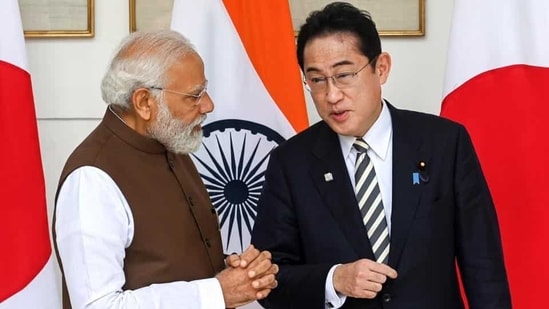
To judge a country’s relationship with India, apply a simple metric. Is it playing a positive role in India’s economic transformation and developmental goals? On that metric, Japan would rank as among India’s closest partners with its investments in signature infrastructure projects. Add another metric. Is the country in sync with India’s strategic outlook? And on that yardstick too, Tokyo would rank as arguably New Delhi’s closest friend in Asia given their shared anxieties about Beijing’s belligerence and the need to maintain stability across the Indo-Pacific. With this level of convergence — and few areas of friction — it is not a surprise that over the past 15 years, Prime Minister (PM) Manmohan Singh and Narendra Modi have invested in the relationship with Japan. From Tokyo, if the late Shinzo Abe engineered a paradigm shift by placing India at the centre of its engagement in the region, Fumio Kishida has taken it forward, as seen in the Japanese PM’s visit to India this week.
The two countries had substantive bilateral engagements and discussed how they can work together given the uniqueness of the moment — Japan heads G7 as India leads G20 — in a fractured world. But it was Mr Kishida’s speech at Sapru House on Japan’s new plan for a free and open Indo-Pacific (FOIP), with India as an “indispensable partner”, that stood out as the defining moment of the visit. If Shinzo Abe had first spoken of the confluence of the two seas — Pacific and Indian Ocean — in the Parliament of India and introduced the concept, Mr Kishida sought to give it a more concrete shape and lend the idea of FOIP with substance. The moment to do this was ripe, for as an idea, FOIP has become institutionalised in the foreign policy approaches of dozens of countries, even if their definition of what it means differs.
Mr Kishida first spoke of the rationale of FOIP and placed it in the context of international changes, including the rise of the Global South. He distilled the idea to its fundamental tenets — freedom and rule of law — while speaking of its inclusive and open nature. And then he offered four specific pillars for cooperation — principles for peace and rules for prosperity, addressing challenges in an Indo-Pacific way, multi-layered connectivity, extending efforts for security and safe use of the “sea” to the “air”. While each pillar merits more policy attention, Mr Kishida has performed an important service by building on the idea of FOIP in the country, where, as he put it, it all began.
One Subscription.
Get 360° coverage—from daily headlines
to 100 year archives.
Archives
HT App & Website