Within two days of opening, the Barapullah Phase III flyover had turned the 8-km drive from Safdarjung Hospital to Sarai Kale Khan in Delhi into a crawl of more than an hour. A Delhi Traffic Police drone survey traced the jam to the points where multiple roads and flyovers merge that break basic rules of road design. At several points, two three-lane roads feed one three-lane corridor, and over Sundial Park, a lane ends abruptly. Every forced merging sends a
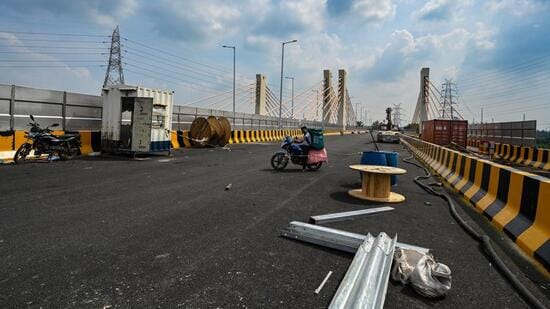
Within two days of opening, the Barapullah Phase III flyover had turned the 8-km drive from Safdarjung Hospital to Sarai Kale Khan in Delhi into a crawl of more than an hour. A Delhi Traffic Police drone survey traced the jam to the points where multiple roads and flyovers merge that break basic rules of road design. At several points, two three-lane roads feed one three-lane corridor, and over Sundial Park, a lane ends abruptly. Every forced merging sends a wave of braking back up the road, and the queues spread across Ring Road, Mathura Road and the DND flyway.
As anger grew, public works department (PWD) minister and BJP leader Parvesh Verma blamed the previous AAP government, saying key design calls were taken in 2014-15. A PWD official told HT that the planning studies behind the design are more than 20 years old, which places them well before the decisions Verma attributes to the AAP, though that absolves no party, and no part of the bureaucracy. None of this is new. When Delhi’s ₹777-crore Pragati Maidan tunnel flooded and cracked, PWD demanded ₹500 crore from Larsen & Toubro, which countered with a ₹500-crore claim of its own. In Mumbai, the rebuilt Gokhale bridge opened six feet out of line with the adjoining flyover, and the municipal corporation blamed the Railways. In Bhopal, seven state PWD engineers were suspended, and later reinstated, over the Aishbagh overbridge’s near right-angle turn, and PWD and the Railways took 10 months to pass a corrected design.
Some of this is unavoidable. Dense cities force agencies to build into one another’s structures, and scarce land leaves designers little room. The more hands a design passes through, the more it needs a single owner answerable for whether a project works, end to end. Without that owner, India gets disputes over money, suspensions that lapse, and, as Verma now proposes, a consultant to fix a problem created by bureaucratic ping-pong. Every public work should carry a named authority answerable for its design as a whole, with an independent traffic audit published before the ribbon is cut. The same ping-pong governs far more than flyovers. Delhi is entering its pollution season, when blame for the city’s air will bounce between several states and the Centre, each holding a piece of the problem and none answerable for the whole. Barapullah is a small, visible example of a habit that costs the country far more than is evident.
One Subscription.
Get 360° coverage—from daily headlines
to 100 year archives.
Archives
HT App & Website