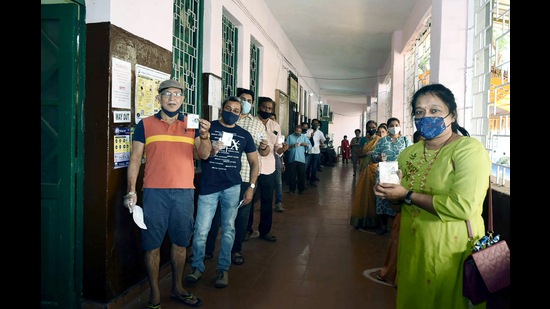
Roughly 29 million voters spread across three states and 165 constituencies sealed the fate of 1,500 candidates in the biggest day of voting in the five-state election cycle on Monday. Much of the attention in this poll season is focused on India’s most politically crucial state, Uttar Pradesh, but in some ways, the single-phase electi-ons in Uttarakhand and Goa underline some trends about India’s electoral politics.
The states are witnessing a direct electoral battle between the Bharatiya Janata Party (BJP),
Roughly 29 million voters spread across three states and 165 constituencies sealed the fate of 1,500 candidates in the biggest day of voting in the five-state election cycle on Monday. Much of the attention in this poll season is focused on India’s most politically crucial state, Uttar Pradesh, but in some ways, the single-phase electi-ons in Uttarakhand and Goa underline some trends about India’s electoral politics.
The states are witnessing a direct electoral battle between the Bharatiya Janata Party (BJP), which is the incumbent party in both of the provinces, and the Congress. They are a reminder — along with Gujarat, which goes to the polls later this year, and four states (Karnataka, Madhya Pradesh, Rajasthan and Chhattisgarh) that vote next year — that despite powerful regional forces, the principal national adversary to the BJP remains the Congress. From now on, the two parties are locked in a direct contest in every state poll till 2024, and the victor of these fights will have an edge in the national election. Two, the results of elections in these two states will offer clues on how voters view parties and perceive anti-incumbency. In Uttarakhand, the BJP attempted to beat anti-incumbency by replacing its chief minister twice in the span of a year. In Goa, where 27 of the 40 legislators elected in 2017 have switched parties, it is yet unclear whether anti-incumbency sentiment is attached to the party or the candidate. The Congress, from which a majority of the defections occurred, has sought to counter this phenomena by nominating many fresh faces. These contrasting approaches underline different underst-andings of voter behaviour and the varying levels of control the two parties have on their leaders.
Three, despite their drastically different geographies, the mountainous Uttarakhand and the coastal Goa are united by the rising threat to their fragile ecological balance and increased vulnerability to the climate crisis. Yet, environmental protection is a major election issue neither in Uttarakhand — where cloudbursts, landslides and flash floods claim hundreds of lives and hundreds of crores of rupees in property damages — nor in Goa, where illegal mining, unsustainable tourism and untrammelled infrastructure development wreak havoc on its beaches, forests and land. Elections function as effective tools of accountability for most aspects of public life and policy, except — as appears in Goa and Uttarakhand — the environment.
One Subscription.
Get 360° coverage—from daily headlines
to 100 year archives.
Archives
HT App & Website