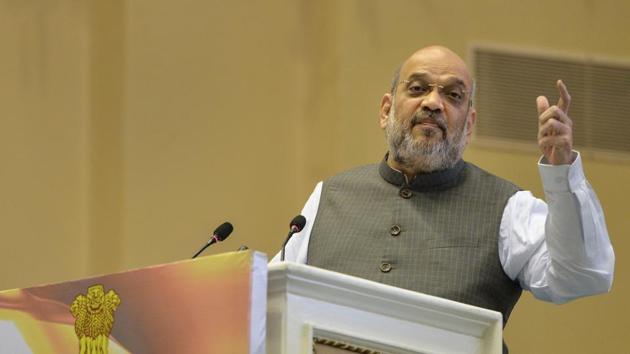
Home Minister and Bharatiya Janata Party (BJP) president Amit Shah’s comments on Saturday, on Hindi and Indian languages, have sparked a controversy. On the occasion of Hindi Diwas, Shah recognised that India was a land of many languages. But he underlined that it was crucial to have one language which became India’s identity globally. Shah said that this language can be Hindi. He encouraged the use of mother-tongues, but also appealed to citizens to use Hindi. Shah’s comments have drawn fierce criticism, particularly from the south.
One of Independent India’s foremost challenges was managing the question of language. The Constituent Assembly decided not to have any single national language. When discussions began over the federal structure, Jawaharlal Nehru was not comfortable with the idea of identity-based states. But the power of language-based movements compelled him to change his mind. The State Reorganisation Committee recognised language as a principle for state-formation. The language question resurfaced in the 1960s, over making Hindi the sole official language. Tamil Nadu erupted in fury. And the Centre had to backtrack. India eventually arrived at the three-language formula - of the use of English, Hindi, and a regional language.
The existing linguistic arrangements are best left intact. One, India’s success as a united, vibrant democracy has come from recognising linguistic diversity. In contrast, Pakistan’s efforts to impose Urdu over its Bengali-speaking citizens in the east led to the creation of Bangladesh. There is an increasing political divide between north and south India today. It is important not to add a linguistic divide to the mix. Two, concerns that India needs one language to become united may be misplaced. With migration, media, technology, increased economic and social interactions beyond one’s own region, Indians are forging bonds with each other in unprecedented ways. And finally, the BJP should act in its own self-interest. It was earlier seen as a north-Indian, Hindi-speaking party. Its expansion in recent years has come from recognising cultural and linguistic distinctiveness. Any effort to impose a degree of linguistic homogeneity may draw political backlash and harm its own prospects.