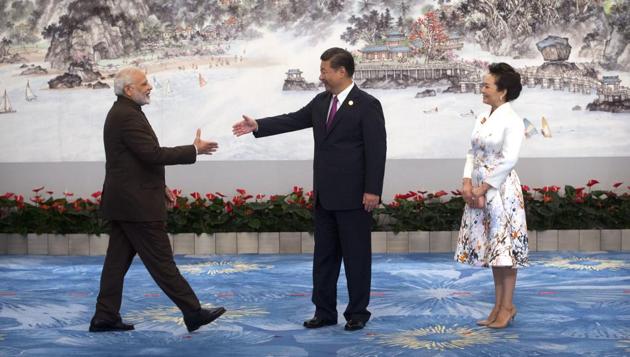
When you think about Doklam, keep calm and carry on. Prime Minister Narendra Modi and the Chinese leader, Xi Jinping, seemed to have sensibly adopted the view that there is more to the larger Sino-Indian relationship than a border stand-off during their hour-long meeting on the sidelines of the BRICS summit in Xiamen. They both agreed to treat Doklam and similar border incidents as problems that should be managed rather than treated as a fatal flaw in bilateral relations between the two largest Asian countries.
Doklam, as seems to have been recognised by both sides, represents a new phase in the territorial disputes between New Delhi and Beijing. One, India was defending the claims of a third country, Bhutan, with which it has a defence understanding. Two, as a consequence, there was just enough misunderstanding for the crisis to escalate quickly to the point it had the potential to become something larger than either side wanted. There seems to be a case for India and China to begin negotiating yet another border management agreement, but one that incorporates protocols regarding military confrontations in third countries and even the maritime domain.
The BRICS summit was a symbol of how much larger the Sino-Indian relationship is than disputes over uninhabited bits of rock. The Xiamen summit continued the emerging economies tradition of laying out an international order which would give them a greater say in rules-making and institutional representation. It also incorporated a number of other emerging economies for the first time, signalling how the BRICS concept is attractive to other players as well.
The surprise was the Chinese acquiescence to a mention of Pakistan-based terrorist organisations like the Lashkar e Tayyeba and Jaish e Mohammad in the joint statement. The statement does not denounce these groups or call for action against them, it merely expresses concern at these and other terrorist groups. Nonetheless, it reflects an evolutionary step upward in Beijing’s attitude to terrorism. Namely, that while Pakistan remains its “all-weather friend,” the former’s use of terrorism to further its political agenda is a flawed policy that undermines a growing Chinese interest in regional stability. The joint statement was noticeable for speaking about almost every major international conflict that has a bearing on world stability. It is hard to see India and China ever becoming close friends but they need not become violent rivals. By getting through the Doklam crisis without a shot being fired and even high-level summitry being sustained, they have shown that as they both rise, the potential for cooperating more and confronting less remains considerable.
{{/usCountry}}The surprise was the Chinese acquiescence to a mention of Pakistan-based terrorist organisations like the Lashkar e Tayyeba and Jaish e Mohammad in the joint statement. The statement does not denounce these groups or call for action against them, it merely expresses concern at these and other terrorist groups. Nonetheless, it reflects an evolutionary step upward in Beijing’s attitude to terrorism. Namely, that while Pakistan remains its “all-weather friend,” the former’s use of terrorism to further its political agenda is a flawed policy that undermines a growing Chinese interest in regional stability. The joint statement was noticeable for speaking about almost every major international conflict that has a bearing on world stability. It is hard to see India and China ever becoming close friends but they need not become violent rivals. By getting through the Doklam crisis without a shot being fired and even high-level summitry being sustained, they have shown that as they both rise, the potential for cooperating more and confronting less remains considerable.
{{/usCountry}}