E-Paper



Number Theory: Just over 50% Indians have three meals a day
This is the first of a two-part series in share of Indians who eat three meals a day. The second part will look at share of children eating three meals a day.

 Prefer HTon Google


Are Indians eating healthy? This is one of the most polarising questions on the state of India’s economy and the fruits it has delivered for 1.4 billion Indians. On the one hand are statistics which claim a massive reduction in poverty and very high rates of growth. On the other hand, there are instances, such as during the pandemic, when the government announced 5 kg of extra food entitlements for as many as 800 million people, suggesting that even basic food security continues to be precarious. There is also the more nuanced question of whether we have reconciled our analysis of food security to just the calorie question and are ignoring the deficiency of protein and other critical nutrients and the concept of balanced diets. Somewhere between these important and data dependent questions is a basic fact check about the number of meals people have in a day.
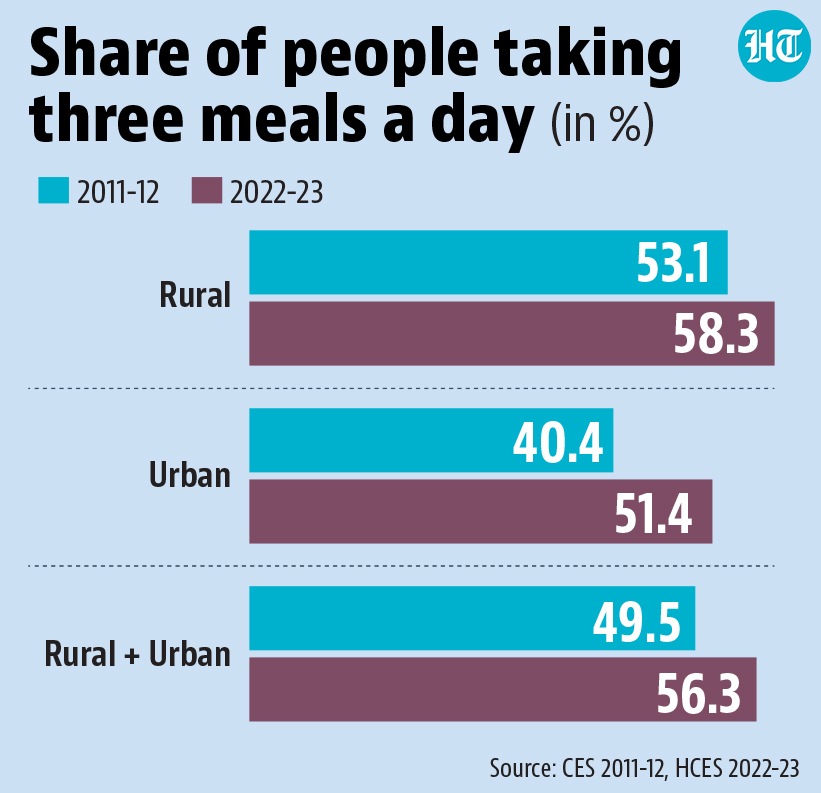
An HT analysis from the recently released Household Consumption Expenditure Survey (HCES) shows that only 56% of Indians reported eating three meals a day. While While the proportion is higher than what it was in the previous survey a decade ago, there are other interesting and also troubling insights in the data.
This two-part series, which is based on an HT analysis of unit level data from the 2022-23 and 2011-12 consumer expenditure surveys will look at this issue in detail. The first part will look at trends in the number of meals eaten by the overall population and the second part will look at the number of meals eaten by children.
 More than 40% Indians skipped either breakfast, lunch or dinnerThe HCES data asks a simple question to its respondents on the “number of meals usually taken in a day”. The data shows that 56% of the population had three meals a day while 43% just had two . A break-up by location and gender shows that while rural areas do better , there is not much of a difference between men and women when it comes to the number of meals. A comparison of the HCES 2022-23 data with the 2011-12 CES shows that this number has increased by about seven percentage points between two surveys. 43% Indians not having at least one meal, prima facie, looks like a bad state of affairs. To be sure, the HCES report does give some context on how to read these numbers and there are elements which could lead to these numbers being either under or overestimates. “A ‘meal’, as opposed to ‘snacks’, ‘nashta/tiffin’ or ‘high tea’, contains larger quantum and variety of food…The difference in quantity will therefore be the guiding factor for deciding whether the plate is to be labelled as a ‘meal’ or a ‘nashta’”, the report says, which brings in an element of undercounting of number of meals. Similarly, the report suggests that smaller parcels of food received by workers in multiple households ( such as domestic workers) could be counted as a one full meal taken outside, which could potentially overestimate the number of meals.
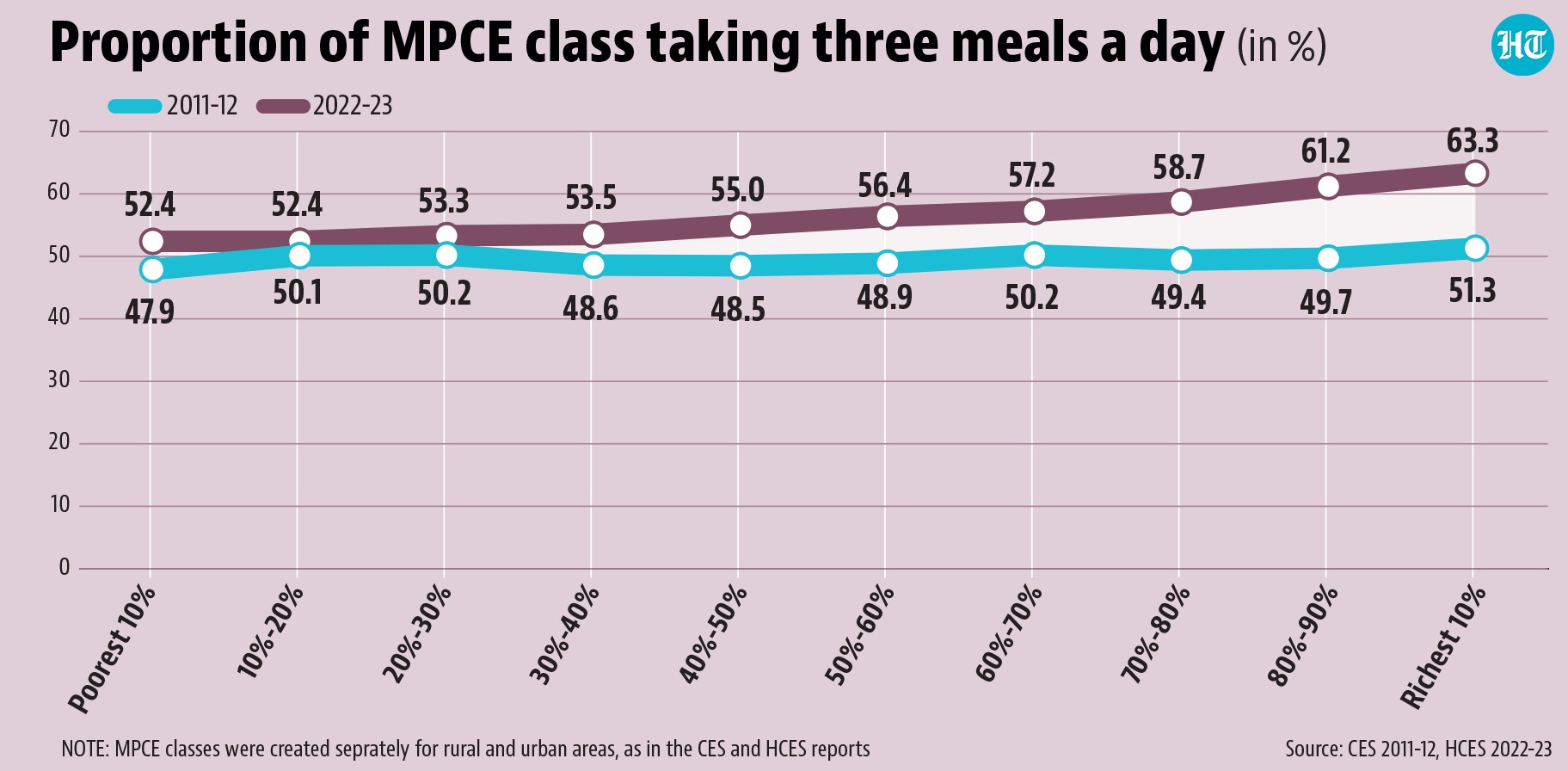
- And the share of persons who have three meals increases among the richThis is borne out by a simple disaggregation of the data by monthly per capita expenditure (MPCE). The share of persons who reported having three meals was 52% in the bottom decile of MPCE but increased to 63% in the top decile. A decile-wise comparison of the 2022-23 and 2011-12 consumer surveys shows that the share of persons having three meals a day has increased across economic classes with the increase being bigger for the richer segments of the population.
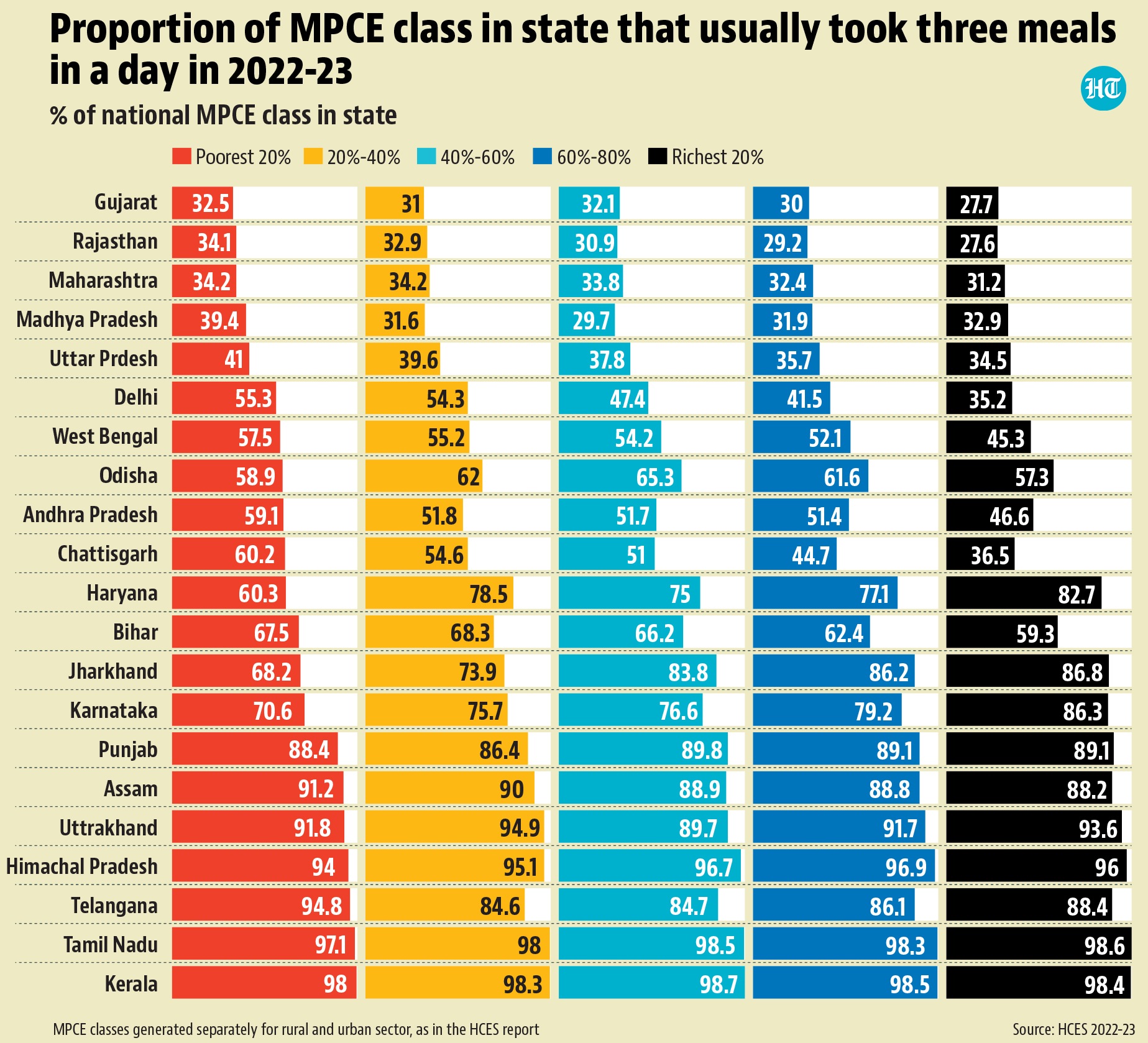
- There is a large difference in share of population eating three meals across statesThis difference is even bigger than the difference among different MPCE classes. Among 21 major states, the share of the population eating three meals varies from around 98% in Kerala and Tamil Nadu to just 31% in Rajasthan and Gujarat. Belonging to a rich or poor class does not change this number drastically for most states. For example, the share of population in the top MPCE decile consuming three meals a day in Gujarat and Rajasthan is lower than what this number is in Kerala and Tamil Nadu even in the lowest MPCE decile. State and class-wise data read together shows another counter-intuitive trend. In states such as Chhattisgarh, Delhi, Gujarat, Rajasthan, Uttar Pradesh, and West Bengal, share of richer population consuming three meals is lower than the poorer population, a trend opposite to that seen at the national level.