E-Paper



Number Theory: The new demographic truths facing the world
.
Published on: Dec 3, 2024, 07:39:45 IST

 Prefer HTon Google
Share via


Copy link

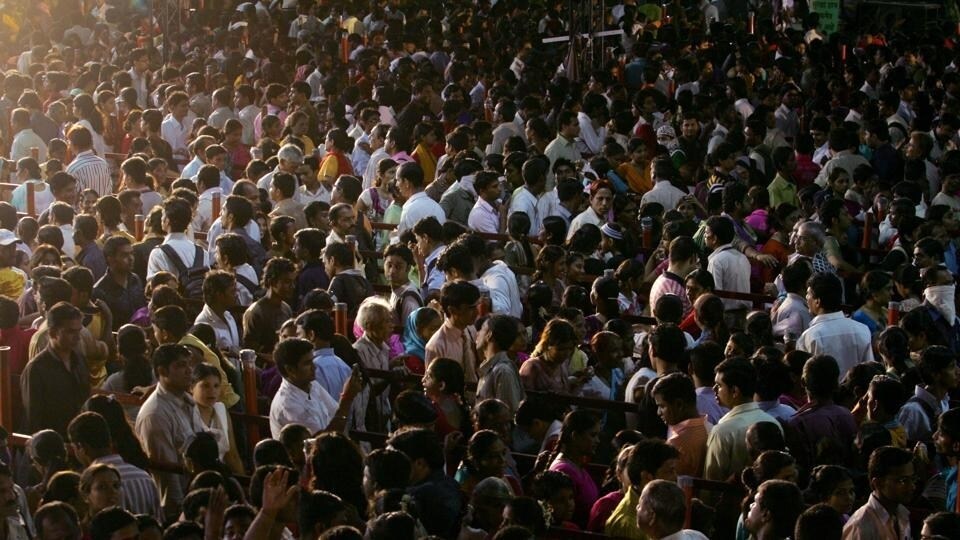
From Trump promising a crackdown on illegal immigration in the US to politicians in India asking people to have more children, demographics are finding more and more echo in politics and world affairs. While the world is indeed headed into a different demographic trajectory compared to the past, the reality is very different from the rhetoric which is employed. Here are four charts that explain this in detail.
The new demographic truths facing the world
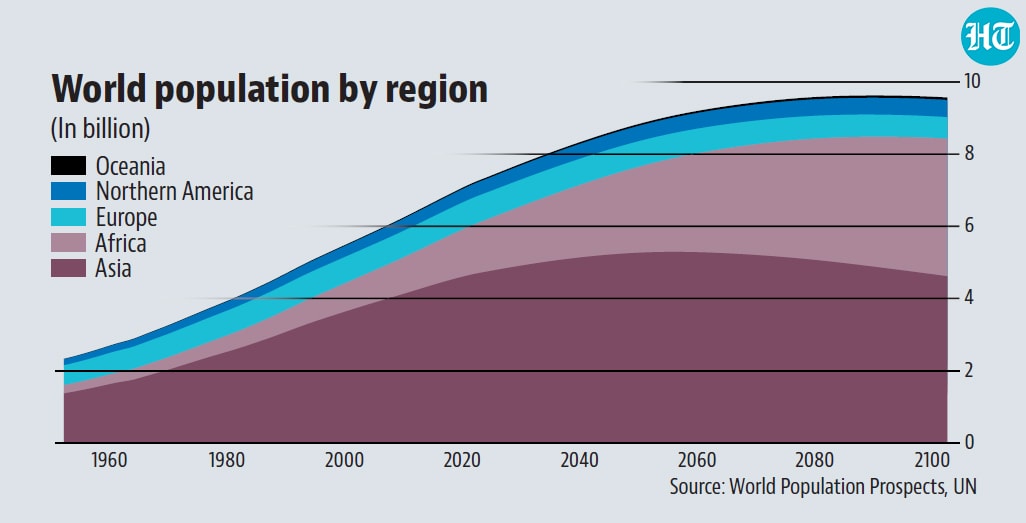
 One in four people in the world live in a country whose population growth has peaked…As of 2024, 63 countries, home to 28% of the global population, had already peaked in size. Another 48 nations, representing 10%, are projected to peak between 2025 and 2054. Meanwhile, 126 countries will likely continue growing beyond 2054, potentially peaking after 2100. The global fertility rate has declined from 3.3 in 1990 to 2.3 births per woman in 2024, with over half of all countries below the replacement level of 2.1. This demographic change will see the share of Africa in global population go up from 20% currently to nearly 40% by 2100. Meanwhile, the share of Asian countries, which is currently 64% will decline to 48%, and that of Europe will go down from 10% to around 6%.
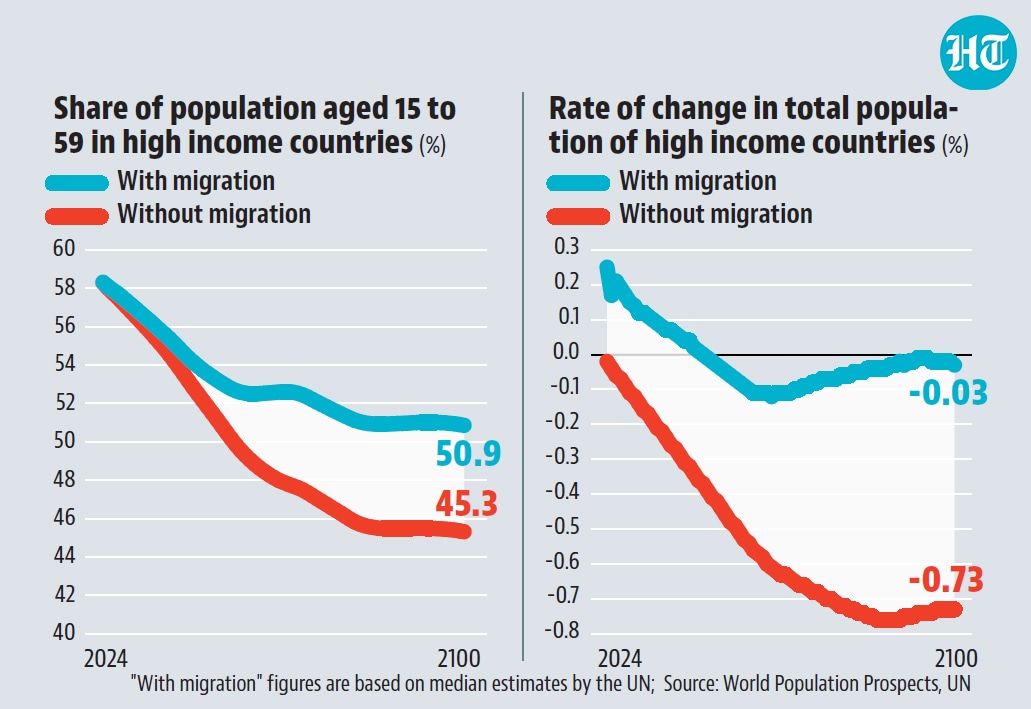
- …And without migration, developed countries would have seen a fall in their population from 2024For all the political traction to anti-immigrant politics in advanced countries, it has been a boon rather than a problem for them. UN estimates show that had it not been for migration, the developed countries would have started seeing a fall in their population from 2024 onwards. Incoming migrants are expected to delay this pivot to 2046 as of now. What is even more important is that migration will also help developed countries flatten the fall in the share of working age population. The share of those aged 15 to 59 in high-income countries currently stand at 58.31% and is expected to reach 50.86% by 2100. However, without any migration, this figure will be around 5.5 points lower at 45.32% by 2100.
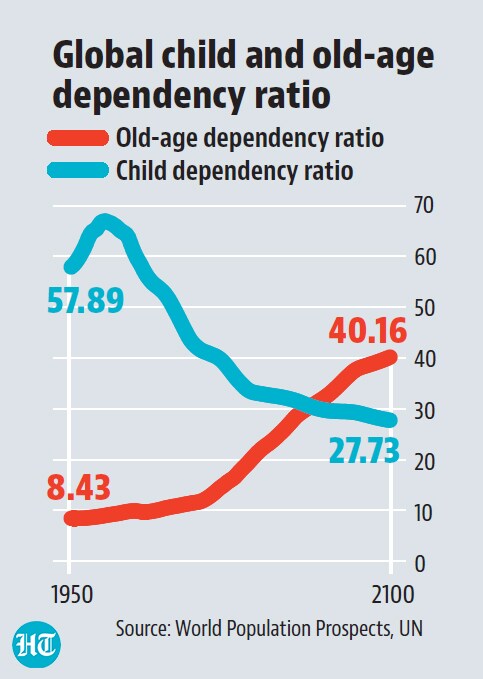
- Changing composition of population is an even bigger challenge than absolute population levelsThe dependency ratio measures the number of dependents (children and older adults) relative to the working-age population (15-64). A dependency ratio below 50% — more than two working-age individuals per dependent — is ideal. But for regions with historically high TDRs due to high birth rates, a goal below 67% is considered more realistic. Globally, the total dependency ratio currently stands at 53.7%, and it will reach 67.9 by 2100 -- it stands at 54.8% in high income countries and is projected to go up to 77.4%. A breakdown of dependency ratio into child dependency ratio (ages 0-14 upon 15-64) and old-age dependency ratio (ages 65+ upon 15-64) shows a contrasting picture. While CDR has continued to fall over the years, ODR is expected to go up. In fact, the CDR to ODR ratio will fall below 2 in 2030, indicating the oversized share of the elderly among the dependent population. As the worldwide population skews older, a shrinking younger generation will have to shoulder the growing burden of supporting an expanding elderly population.
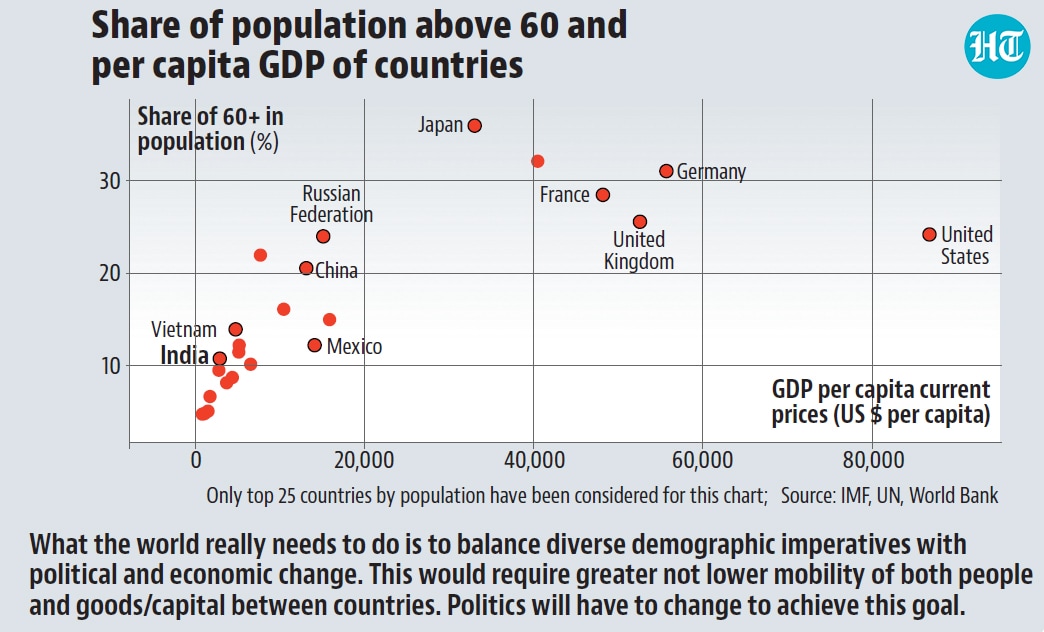
- But not all countries are ageing at the same paceAs of 2024, 14.5% of the global population is aged over 60. But it varies significantly for individual countries. In China, this ratio crossed one-in-five for the first time in 2024. India crossed the one-in-ten mark in 2021, and it will cross the one-in-five ratio in 2049. For developed and developing countries, the numbers are 27% and 12% in 2024. While the share of 60-plus population broadly correlates with per capita GDP, there are some outliers such as China, whose natural trajectory of demographic transformation was disrupted by its one-child policy.
- InferenceWhat the world really needs to do is to balance diverse demographic imperatives with political and economic change. This would require greater not lower mobility of both people and goods/capital between countries. Politics will have to change to achieve this goal.