
 E-Paper



‘No Other Choice’ Review: A Bloody Job Search in South Korea
Park Chan-wook directs this macabre comedy about a man who, having lost his job in a corporate restructuring, takes homicidal action to resurrect his career.


 Prefer HTon Google


In “No Other Choice,” Man-soo, a manager at a large paper company in South Korea, is not only happy with his work but also with his wonderful family, peppy sex life and pair of adorable golden retrievers. So when he duly exclaims “I’ve got it all,” you can practically hear the anvil of ironic doom shifting into position above his head.
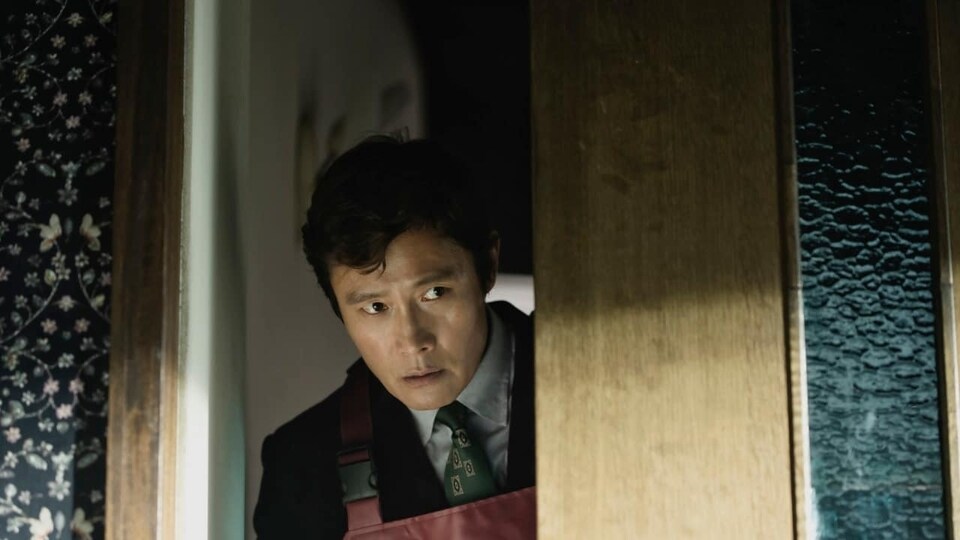
Engagingly portrayed by Lee Byung-hun (who played Storm Shadow in the G.I. Joe movies and more recently appeared on “Squid Game”), Man-soo comes apart when he loses his job in one of those dreaded corporate restructurings that play so much havoc with so many lives. Reduced to lugging boxes in a retail store, he longs to get back into the paper game he thought he played so successfully for 25 years. Matters have become urgent: His wife, Mi-ri (Son Ye-jin of “The Truth Beneath”), nonchalantly informs him that, after a few months of unemployment, the family is going to have to sell the house, the car and even her tennis racket. There’s no longer even enough money for dog food, so away go the pets.
In desperation, and perhaps losing his mind, the seemingly mild-mannered Man-soo becomes obsessed with nailing the application process for a comparable job. But, after scheming to obtain the résumés of rival applicants, he worries one of them is better positioned to be hired. What if he took his father’s old Vietnam War pistol off the wall and killed the other job-seekers? Maybe, as the Americans who just took over his former employer like to say, there is no other choice. If reducing headcount is a worthy capitalist goal, Man-soo might simply be proving his worth as a manager in a more direct way. “In the execution phase,” he notes, “you have to be persistent and bold.”
An adaptation of Donald Westlake’s 1997 novel “The Ax,” writer-director Park Chan-wook’s black comedy has the feel of a sardonic Coen Brothers misadventure, with so much bad behavior on all sides that it’s easy for the audience to root for the nervous, uncertain Man-soo even as his thoughts turn to murder. The real villain, we’re meant to believe, is capitalism, with its relentless creative destruction portrayed as coldly as the scenes of mighty trees being ripped down, stripped down and turned into paper. Satiric attacks along these lines have become a Korean specialty, with the film joining “Squid Game” and Bong Joon-ho’s 2019 Oscar winner “Parasite” in suggesting there’s something deeply inhuman and wrong about the way capitalism picks winners and losers.
Mr. Park’s movie maintains a goofy, anything-can-happen quality reminiscent of “Fargo,” however, and isn’t particularly heavy-handed in its disdain for corporations. Those who dread being knocked over the head with a political message can rest easy; it’s an amusing caper, not a stern lecture.
On the other hand, features designed to thrill Occupy Wall Street types tend to be overly praised for their thematic correctness, even when their flaws are fairly evident. Mr. Park, who is best known for hard-edged noirs such as “Oldboy” and “Sympathy for Mr. Vengeance,” is surprisingly adept at comedy, but he also has a tendency to let a joke drag on (as in an extended sequence in which a murder is delayed while people attempt to shout loudly enough to be heard over an aggressively loud stereo).
Pacing is a recurring problem: Running about two hours and 20 minutes, the film is easily half an hour too long as it indulges in irrelevant asides and digressions. For instance, way too much time is spent exploring the life of one of Man-soo’s rivals for the job, Gu (Lee Sung-min), an alcoholic with an abrasive wife who is starting to put his life in order as Man-soo incompetently stalks him. The film’s repeated invocation of its own title in different contexts is another instance of adding too many eggs to the custard. Better are the quick gags: When the police come to arrest Man-soo’s son for stealing phones, they don’t notice the prominent improvised burial site on the property.
Quibbles aside, though, “No Other Choice” is a sly slay-fest, with an appropriately mordant ending that, in a wordless image, has much to say about how a maximally efficient company operates while implicitly posing pointed questions about the future of workers who think of our jobs as central to our lives. You’d be unwise to look to the movies for economic insight—this one amounts to an extended fatuous argument that an individual who behaved like a corporate restructuring would be a psychopath. But among contemporary socio-economic parables, Mr. Park’s latest is an amusingly cutting one.


