Scientists are now certain that a layer of aerosols that appears over Asia every monsoon season is pollution-fuelled, and can mess with the global climate.
The layer that appears between 13-18 kms above the earth’s surface is called the Asian Tropopause Aerosol Layer or ATAL. It forms in June and fades away by October.
“Modeling work carried out in our group suggests that the ATAL is indeed manmade with a strong contribution from Sulfur emission in Asia,” Jean-Paul Vernier, a scientist at NASA Langley Research Center, said.
The research, a collaboration by Indian, American and European scientists, into the recently discovered phenomena, shows that this layer is getting thicker. There has been an increase in particle concentration within the ATAL since the late 90’s following drastic increase in ground emissions in Asia over the same period of time.
The bad news is that some scientists believe this layer is capable of creating the kind of hole in the Earth’s ozone layer that currently exists over Antarctica.
“We believe that the ATAL could also deplete the lower part of the ozone layer in the tropics through chemistry similar to what happens in the polar region and lead to the ozone hole,” Vernier said. Researchers are looking for evidence that this has already occurred.
“Intensity of aerosol layer are usually measured as aerosol optical depth,” Harish Gadhavi, a scientist at the Physical Research Laboratory in Ahmedabad, explained. “In last 18 years layer’s aerosol optical thickness has increased from 0.002 to 0.006 which is a 3- fold increase.”
{{/usCountry}}“Intensity of aerosol layer are usually measured as aerosol optical depth,” Harish Gadhavi, a scientist at the Physical Research Laboratory in Ahmedabad, explained. “In last 18 years layer’s aerosol optical thickness has increased from 0.002 to 0.006 which is a 3- fold increase.”
{{/usCountry}}A thicker ATAL would block solar radiation and have an overall cooling effect on the temperature near the ground similar to what happens after a volcanic eruption, called the umbrella effect. It is unusual that the layer has appeared in the absence of any recent volcanic eruptions.
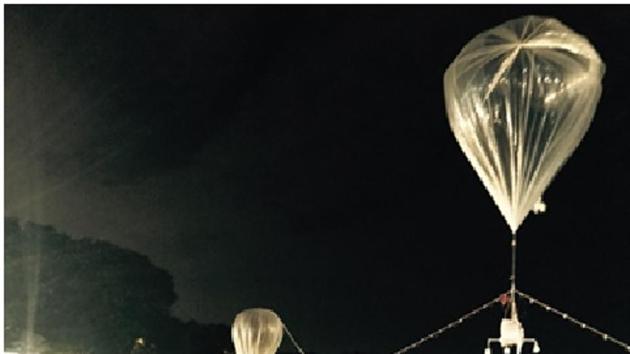
The ATAL could also interfere with the formation of cirrus clouds . Its impact on the monsoons is still being studied. In August, NASA and ISRO carried out a round of balloon measurements, that help validate data collected using satellites, and will shed more light on the composition and effects of this looming phenomenon.
“The presence of the ATAL is not only a regional issue but can have global implications since the tropics is the entrance door for air which spread through the stratosphere via the global atmospheric circulation,” Vernier said.