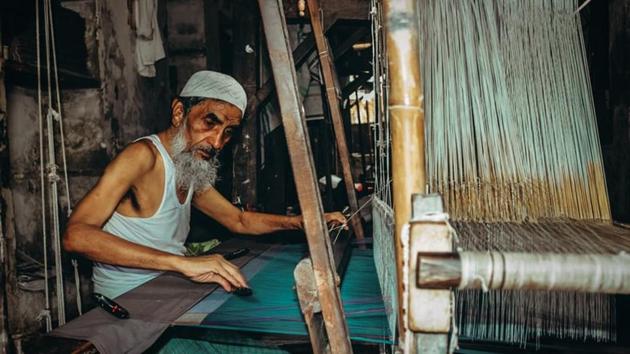
Weaving the gossamer fine fabric which made his hometown Chanderi famous the world over, Mohammed Dilshad says his life is in tatters with no money, no food and no work.
Till a little before the lockdown started on March 25, he would be out for days at a stretch, participating in craft fairs like the Dastkar bazaar in big cities and coming back to his Madhya Pradesh home only to produce the rolls of ‘chanderi’ fashioned into saris, dupattas and dresses. Life had settled into a routine – not an affluent existence but a comfortable one -- but that all seems in the distant past. Help has been negligible in these difficult times and even managing two meals a day is becoming a challenge, said the fourth generation Chanderi craftsperson based out of the small town, famous for its light and comfortable weaves in silk and cotton. “We didn’t understand the lockdown would mean no movement, no work and no money. The MP government gave rations but only rice. How can one just have rice?” Dilshad told PTI over the phone. Dilshad, a National Award winning weaver, is one of the 68 lakh artisans employed by the textile handicrafts sector, bringing in Rs.36,798.20 crore through exports, according to the Ministry of Textiles’ annual report for 2018-19. His crisis finds resonance in distant corners of India.
Buying a curio, a sari or a folk painting has slipped right down in the list of priorities, leaving artisans like him counting each rupee and scrambling to feed their families. Part of an over Rs 24,000 crore industry, the weavers, potters, block printers, painters and a host of others represent the best of traditional craft from the length and breadth of India. Many of them, working from their villages, would sell their craft at the various bazaars and fairs in cities and to big time retailers. But the coronavirus forced lockdown, which entered its fourth phase on Monday, has ended it all The raw material in stock at their homes finished first, then the orders dried up and now, with no idea of when markets will open fully or who will buy their wares, India’s artisans are counting each rupee and scrambling to feed their families. “The first week was not very difficult. We had some raw material in stock and continued to work. The seriousness of the situation only hit us when we ran out of work to do, and there was no money coming in,” Dilshad said. The 34-year-old -- a father of two, lives with his brother, also a Chanderi weaver, and his family -- said he received some money towards the beginning of the lockdown from a not-for-profit NGO but the money is drying up fast. The artisan community in the region, he said, had also appealed to the Weavers Service Centre in Indore for some relief. “We were told our request has been forwarded to higher authorities, but we haven’t heard back. Our major problem is that we don’t have any rations. “The nature of our work is such that we would not stay in Chanderi for more than 10 days at a stretch — we make the product, and then go out to make the sales, and this circle would continue,” he said. Jaya Jaitly of the Dastkaari Haat Samiti, a not for profit organisation that works with craftspersons, is worried about the future of the sector.
{{/usCountry}}Buying a curio, a sari or a folk painting has slipped right down in the list of priorities, leaving artisans like him counting each rupee and scrambling to feed their families. Part of an over Rs 24,000 crore industry, the weavers, potters, block printers, painters and a host of others represent the best of traditional craft from the length and breadth of India. Many of them, working from their villages, would sell their craft at the various bazaars and fairs in cities and to big time retailers. But the coronavirus forced lockdown, which entered its fourth phase on Monday, has ended it all The raw material in stock at their homes finished first, then the orders dried up and now, with no idea of when markets will open fully or who will buy their wares, India’s artisans are counting each rupee and scrambling to feed their families. “The first week was not very difficult. We had some raw material in stock and continued to work. The seriousness of the situation only hit us when we ran out of work to do, and there was no money coming in,” Dilshad said. The 34-year-old -- a father of two, lives with his brother, also a Chanderi weaver, and his family -- said he received some money towards the beginning of the lockdown from a not-for-profit NGO but the money is drying up fast. The artisan community in the region, he said, had also appealed to the Weavers Service Centre in Indore for some relief. “We were told our request has been forwarded to higher authorities, but we haven’t heard back. Our major problem is that we don’t have any rations. “The nature of our work is such that we would not stay in Chanderi for more than 10 days at a stretch — we make the product, and then go out to make the sales, and this circle would continue,” he said. Jaya Jaitly of the Dastkaari Haat Samiti, a not for profit organisation that works with craftspersons, is worried about the future of the sector.
{{/usCountry}}Besides being able to return to work at the earliest, the artisans also need to make up for lost time in terms of sales, and that will be a challenge in a world with social distancing, she said.
“One of the most worrying things for them is what kind of marketing they will be able to do when the lockdown is lifted. What will the nature of the market be… we won’t have crowded bazaars, e-commerce hasn’t picked up as of now,” Jaitly told PTI. The handicrafts sector in the country also comprises craftspeople who practice other art forms — pottery, bamboo and dokra art, and painting that might not fall under a government ministry but contribute to the country’s earnings through both domestic and international sales.
In the Rajasthan village of Kot Jewar, renowned for its blue pottery, an art form recognisable for its use of cobalt blue dye, Ram Narayan Prajapati, his son Vimal Kumar and their 250 odd employees face a dire tomorrow. All their orders have been cancelled and there are no takers for the products in their inventory. Prajapati and his son have collaborated with the India Craft project to make some sales and raise funds in order to help out their artisans.
“We have at least 50 families (over 250 individuals) of potters. All our orders have been cancelled, and we have plenty of stock, but we won’t be able to sell all of it even in two years. “Our artisans are finding it difficult to continue with their daily lives,” Kumar said in a Facebook video directed at potential buyers. According to the India Craft project, a sum of Rs 3,000 can help an artisan household of four members with rations for up to a month. “Through this campaign we hope to support 50-60 families in the Kot Jewar region,” the group said in an online post.
Purnima Rai, a former president of the Delhi Crafts Council, said the situation is getting worse as the lockdown progresses.
“When the lockdown started, there was no immediate distress… they (artisans) were okay, they were at their homes, some of them had farmlands. They did not face the hardships that were being faced by, say, the migrant labourers, but now there is a lot of anxiety over whether they will be able to work again,” she said. “This sector not only has a huge contribution to the economy, but also provides good, sustainable livelihoods in the rural sector. It is a huge employer of people,” Rai said. “I have not seen them do anything at all from the ministry of textiles or others, nobody has mentioned the word craftsperson,” agreed Jaitly.
(This story has been published from a wire agency feed without modifications to the text. Only the headline has been changed. )
Follow more stories on Facebook and Twitter
Catch your daily dose of Fashion, Taylor Swift, Health, Festivals, Travel, Relationship, Recipe and all the other Latest Lifestyle News on Hindustan Times Website and APPs.
Catch your daily dose of Fashion, Taylor Swift, Health, Festivals, Travel, Relationship, Recipe and all the other Latest Lifestyle News on Hindustan Times Website and APPs.