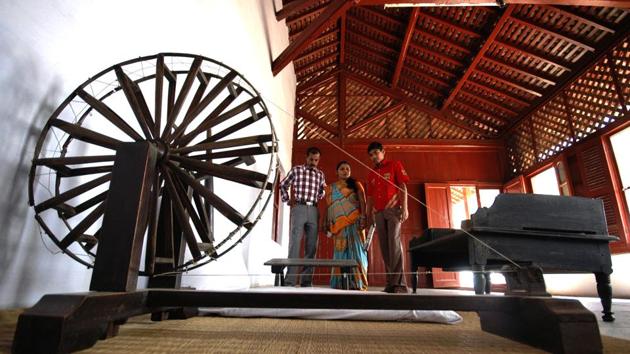
For Mahatma Gandhi, khadi was symbolic of self-reliance, sustenance and hardwork. And, almost a century after his swadeshi movement propelled the nation to stand on its feet, the handspun and handwoven fabric continues to capture the zeitgeist of the generation.
With the rise of everything handcrafted in fashion, khadi, too, has seen a new lease of life. “A sense of peace, calm, and discipline — the spinning of the weaver’s wheel (charkha) aimed at spreading these emotions. But, after independence, khadi was neglected for many years, becoming a poor man’s fabric. But, now, with many contemporary designers and projects working with the fabric, khadi has evolved to become a luxury product. World over, people appreciate its imperfect perfection (the uneven, khaddar texture),” says designer Anju Modi, who works with khadi extensively.
“Khadi has evolved to become a cooler fabric because of its India quotient. The youth today relates it to a sense of patriotism, and to its ‘India proud’ factor. Also, Indian fashion industry has played a pivotal role in making khadi fashionable again,” says Sunil Sethi, president, Fashion Design Council of India, which has also promoted India’s rich heritage of khadi.
Designer Anavila Misra, agrees. “New explorations by various designers at yarn, textile and ensemble level has lent khadi a very chic look, combined with the already rustic and earthy textured feel of the fabric,” she says. For designer Anita Dongre, khadi is relevant because of its practicality, too. “In a tropical country like ours, it offers cool comfort. And, it can mould into any style — from everydaywear to formal eveningwear,” she says.
{{/usCountry}}Designer Anavila Misra, agrees. “New explorations by various designers at yarn, textile and ensemble level has lent khadi a very chic look, combined with the already rustic and earthy textured feel of the fabric,” she says. For designer Anita Dongre, khadi is relevant because of its practicality, too. “In a tropical country like ours, it offers cool comfort. And, it can mould into any style — from everydaywear to formal eveningwear,” she says.
{{/usCountry}}Khadi is a key fabric not only because of the fashion factor, but because its production promotes sustainability. “Gandhiji believed that a cloth that creates employment and satiates hunger is beautiful. The same idea is relevant today because it’s the spinners and hand weavers, mostly from really weak sections of the society, who produce khadi. Nowadays, the question that is asked is: Who made your clothes? When the answer is ‘the most needful,’ you know that you have empowered someone,” says designer Rahul Mishra.
And, what does khadi mean to the youth? “I love to wear khadi —it is comfortable, and very fashionable according to me,” says 20-year-old student Kajal Kaushik . “When we’re proudly embracing fashion statements from the ’80s and ’90s then why not include something of our own? Khadi is highly popular again and is affordable too. I wear it with pride!,” says Nayanika Sircar, an 18-year-old Delhi University student.
Catch your daily dose of Fashion, Taylor Swift, Health, Festivals, Travel, Relationship, Recipe and all the other Latest Lifestyle News on Hindustan Times Website and APPs.
Catch your daily dose of Fashion, Taylor Swift, Health, Festivals, Travel, Relationship, Recipe and all the other Latest Lifestyle News on Hindustan Times Website and APPs.