Over the past two years, artificial intelligence has evolved from an experimental technology to a boardroom priority. Companies across industries have rolled out chatbots, automated workflows and experimented with generative AI across their operations. But as the initial excitement gives way to implementation, businesses are discovering that building AI is only the beginning. The harder challenge is making it work inside the complexity of a real enterprise.
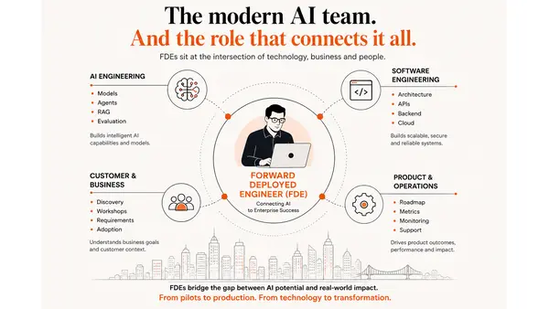
Enterprise AI has to navigate fragmented data, legacy systems, security requirements and organisation-specific workflows. A model may perform exceptionally well in a demonstration, but unless it integrates into the way a business operates, the impact remains limited. It's a challenge many organisations are now confronting as they move from AI experimentation to enterprise-wide adoption. Research suggests that despite significant investment, many enterprise AI initiatives fail to translate into measurable business value not because the technology falls short, but because deployment is far more complex than expected.
That shift is changing what companies look for in AI talent.
Companies are no longer looking only for engineers who can build AI applications. They also need people who can deploy those applications inside complex businesses, integrate them with existing systems and ensure they deliver measurable outcomes. This is where Forward Deployed Engineers come in: a new class of engineers built to bridge the gap between what AI can do and what businesses actually need it to do.
"It's the difference between building an AI application and making AI useful inside a business," says Amar Srivastava, CEO Online & Group CPO at Scaler. "For the last few years, the conversation around AI has largely been about building better models. The next phase will be about something very different making those models work inside real businesses. That requires engineers who can move between technology, customers and business problems, and own the path from AI capability to measurable outcome. That's the role FDEs are beginning to define."
{{/usCountry}}"It's the difference between building an AI application and making AI useful inside a business," says Amar Srivastava, CEO Online & Group CPO at Scaler. "For the last few years, the conversation around AI has largely been about building better models. The next phase will be about something very different making those models work inside real businesses. That requires engineers who can move between technology, customers and business problems, and own the path from AI capability to measurable outcome. That's the role FDEs are beginning to define."
{{/usCountry}}Betting that this shift will fundamentally reshape software engineering careers, Scaler has developed a dedicated Forward Deployed Engineering specialisation, set to commence this August. According to the company, interest from both enterprise recruiters and software engineers has grown rapidly, mirroring the industry's growing focus on deployment-oriented AI roles.
A shift in how software engineering is evolving
Calling Forward Deployed Engineering just another AI role misses the bigger shift. As AI models become more accessible, competitive advantage is shifting away from simply building technology towards implementing it effectively. Increasingly, enterprises aren't looking for engineers who can only write code, they need engineers who can understand business context, make decisions amid ambiguity and work directly with customers to translate AI capabilities into operational outcomes.
Companies such as OpenAI, Anthropic and Palantir have built teams dedicated to helping customers operationalise AI. Amazon Web Services has committed $1 billion towards building a dedicated Forward Deployed Engineering organisation, while Microsoft has announced a $2.5 billion investment in enterprise AI deployment capabilities. In India, Tata Consultancy Services and Infosys have announced plans to build a workforce of nearly 13,000 Forward Deployed Engineers cumulatively, signalling that deployment expertise is becoming a strategic priority well beyond AI-native companies.
Taken together, these developments point to a broader industry transition. As AI models become increasingly commoditised, the differentiator is no longer access to the technology itself it's the ability to deploy that technology inside complex organisations and generate measurable business outcomes.
Why companies are paying a premium
One reason companies are paying a premium is that the role combines skills that rarely exist in one person. Knowing AI models isn't enough for FDEs, models will keep changing. What companies value is the ability to understand systems, customers and business problems.
Traditional software engineers are trained to solve technical problems. Forward Deployed Engineers solve business problems using technology. That means working through ambiguity, integrating AI into legacy systems and collaborating with customers instead of simply writing code.
Perhaps the biggest distinction is how success is measured. A traditional software engineer might be evaluated on the quality of the software they build. A Forward Deployed Engineer is ultimately judged by whether that technology creates value for the business—that shift, from shipping software to owning outcomes, is what makes FDEs fundamentally different.
Why India has an opportunity
The timing is important. As foundation models become increasingly accessible through APIs and enterprise platforms, the technical barrier to experimenting with AI is falling. The harder problem is adapting those capabilities to a company's data, systems, processes and customers. That is creating demand for engineers who can operate at the intersection of AI and implementation, making FDEs increasingly central to enterprise AI adoption.
The country's IT services industry and Global Capability Centres have spent decades helping enterprises build, modernise and integrate complex technology systems. Those capabilities make India well placed for the next phase of AI, helping enterprises deploy it at scale.
However, industry leaders believe the talent pipeline must evolve alongside demand. While familiarity with AI has grown rapidly, relatively few engineers have experience deploying AI in production environments. Scaler's Confidence-Capability Gap Report found that while 89% of engineers believe they are AI-ready, only 19% are actively building AI systems, highlighting the gap between awareness and real-world implementation. To help bridge that gap, the company has committed ₹25 crore towards training 10,000 Forward Deployed Engineers over the next two years.
As AI moves from experimentation to enterprise-wide adoption, success will increasingly depend not on who builds the smartest models, but on who can make those models work inside real businesses. For the next generation of AI engineers, the defining question may no longer be "What can you build?" but "What business outcomes can you deliver?"
Note to readers: This article is part of HT's paid consumer connect initiative and is independently created by the brand. HT assumes no editorial responsibility for the content, including its accuracy, completeness, or any errors or omissions. Readers are advised to verify all information independently.
Want to get your story featured as above? click here!